Bird book parrots message of empathy, hope
Advertisement
Read this article for free:
or
Already have an account? Log in here »
To continue reading, please subscribe:

Digital Subscription
One year of digital access for only $205*
- Enjoy unlimited reading on winnipegfreepress.com
- Read the E-Edition, our digital replica newspaper
- Access News Break, our award-winning app
- Play interactive puzzles
*First annual payment billed as $205.00 + GST for one year. This annual subscription will automatically renew at $233.00 + GST every 52 weeks (10% off the regular annual price of $259.35). Offer available to new and qualified returning subscribers only. Cancel any time.
To continue reading, please subscribe:
Add Free Press access to your Brandon Sun subscription for only an additional
$1 for the first 4 weeks*
- Enjoy unlimited reading on winnipegfreepress.com
- Read the E-Edition, our digital replica newspaper
- Access News Break, our award-winning app
- Play interactive puzzles
*Your next Brandon Sun subscription payment will increase by $1.00 and you will be charged $17.95 plus GST for four weeks. After four weeks, your payment will increase to $24.95 plus GST every four weeks.
Read unlimited articles for free today:
or
Already have an account? Log in here »
Hey there, time traveller!
This article was published 19/09/2015 (4017 days ago), so information in it may no longer be current.
Tuco: The Parrot, the Others and A Scattershot World is the third memoir by Vancouver Island writer Brian Brett. The first two were highly praised, award-winning books. This one has been rightfully chosen by the Globe and Mail as one of the 20 new Canadian books you should read this year.
Brett’s first memoir, Uproar’s Your Only Music, details the harrowing trials and torments of growing up an androgyne — neither boy nor girl, a victim of Kallman’s syndrome preyed upon by bullies and rapists.
Treated with testosterone since the age of 20, Brett is now a hulking six-foot-tall man who lives on a farm with his partner, Sharon, and their family. Trauma Farm: A Rebel History of Rural Life recounts an 18-year “day-in-the-life” of Brett the farmer. But it’s much more than an autobiography — it’s a history of farming, a paean to a life lived in tune with nature, and a polemic against government bureaucracy and agricultural mega-businesses. It’s also a meditation on the social behaviour and intelligence of horses, dogs, pigs and even chickens.
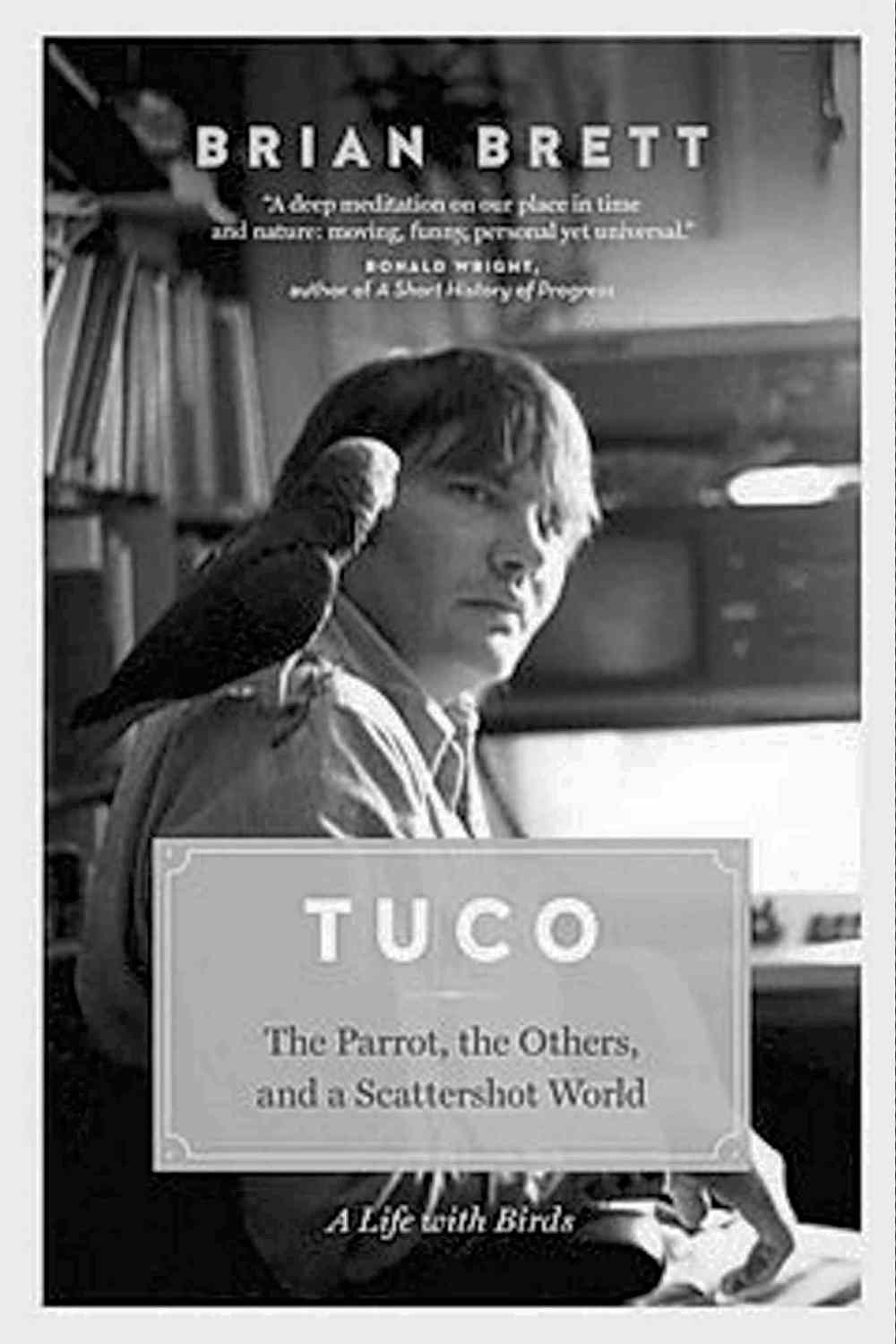
Following up on his observations of familiar farm animals, Tuco is a meditation on the social behaviour, language use and intelligence of parrots and other birds.
Because he was different and misunderstood, shunned and bullied as a child and adolescent, Brett feels he has a special, first-hand knowledge of “othering.” He has been “othered.” He believes “Othering is an ugly evolutionary inheritance… possessed by almost every creature in the animal kingdom” — not just all humans but even Tuco, the parrot that has been his close companion for 25 years.
Parrots, like all creatures, live in “a scattershot world,” a term he developed from an early childhood experience when an angry farmer used a shotgun — a scattergun filled with salt and pepper — to sting his fleeing behind. From this he’s extrapolated a view of the world. Ours is a “scattershot world where pain and laughter and beauty walk hand in hand into the ocean of life.”
Woven into this “natural history of otherness” are stories about dinosaurs and other birds, about Darwin and evolution, about smuggling and the brutal treatment of pet birds, and about the fascinating lives of parrots and their place in literature.
But mostly Tuco is a treatise on the communication skills and various intelligences of animals.
Like all mimic parrots, Tuco is not only an amazing vocal companion, he “can engage the full panoply of human behaviours, including jealousy, shame, deceit, and drunkenness.” The book returns again and again to amusing anecdotes to prove there’s more to this bird, and by implication all parrots, than we’ve given them credit for.
One of Tuco’s favourite games involves the telephone. Tuco imitates the ring perfectly and then imitates Brett’s voice answering the phone and calling out to his wife: “Sharon, it’s for you.”
When she discovers the ruse, Tuco guffaws in his best fake pirate laugh: “Har.” He’s an ingeniously playful and intelligent bird.

Well-researched and closely observed, Tuco is not organized along a clear narrative line.
Some of the transitions are abrupt and illogical, some of the information inconclusive or unnecessary.
Enjoyable and informative, it’s not as polemical as Trauma Farm or as gut-wrenching as Uproar’s Your Only Music. Nor is it “everything you ever wanted to know about parrots.” In the end it’s a plea for less agnotology — culturally induced ignorance — and more empathy and hope.
Gene Walz helped put together the books The Birds of Manitoba and Finding Birds in Southern Manitoba.