

U.S. military science agency the hub of top-secret research and development
Advertisement
Read this article for free:
or
Already have an account? Log in here »
To continue reading, please subscribe:
Monthly Digital Subscription
$1 per week for 24 weeks*
- Enjoy unlimited reading on winnipegfreepress.com
- Read the E-Edition, our digital replica newspaper
- Access News Break, our award-winning app
- Play interactive puzzles
*Billed as $4.00 plus GST every four weeks. After 24 weeks, price increases to the regular rate of $19.95 plus GST every four weeks. Offer available to new and qualified returning subscribers only. Cancel any time.
Monthly Digital Subscription
$4.99/week*
- Enjoy unlimited reading on winnipegfreepress.com
- Read the E-Edition, our digital replica newspaper
- Access News Break, our award-winning app
- Play interactive puzzles
*Billed as $19.95 plus GST every four weeks. Cancel any time.
To continue reading, please subscribe:
Add Free Press access to your Brandon Sun subscription for only an additional
$1 for the first 4 weeks*
*Your next subscription payment will increase by $1.00 and you will be charged $16.99 plus GST for four weeks. After four weeks, your payment will increase to $23.99 plus GST every four weeks.
Read unlimited articles for free today:
or
Already have an account? Log in here »
Hey there, time traveller!
This article was published 26/09/2015 (3843 days ago), so information in it may no longer be current.
It’s a military colossus that outlasted an equally powerful adversary during the Cold War by simply outspending its rival on an inane nuclear-arms race, and now its weaponries boast the latest in high-tech devices with computing capabilities that lack only self-awareness to qualify as science-fictional artificial brains.
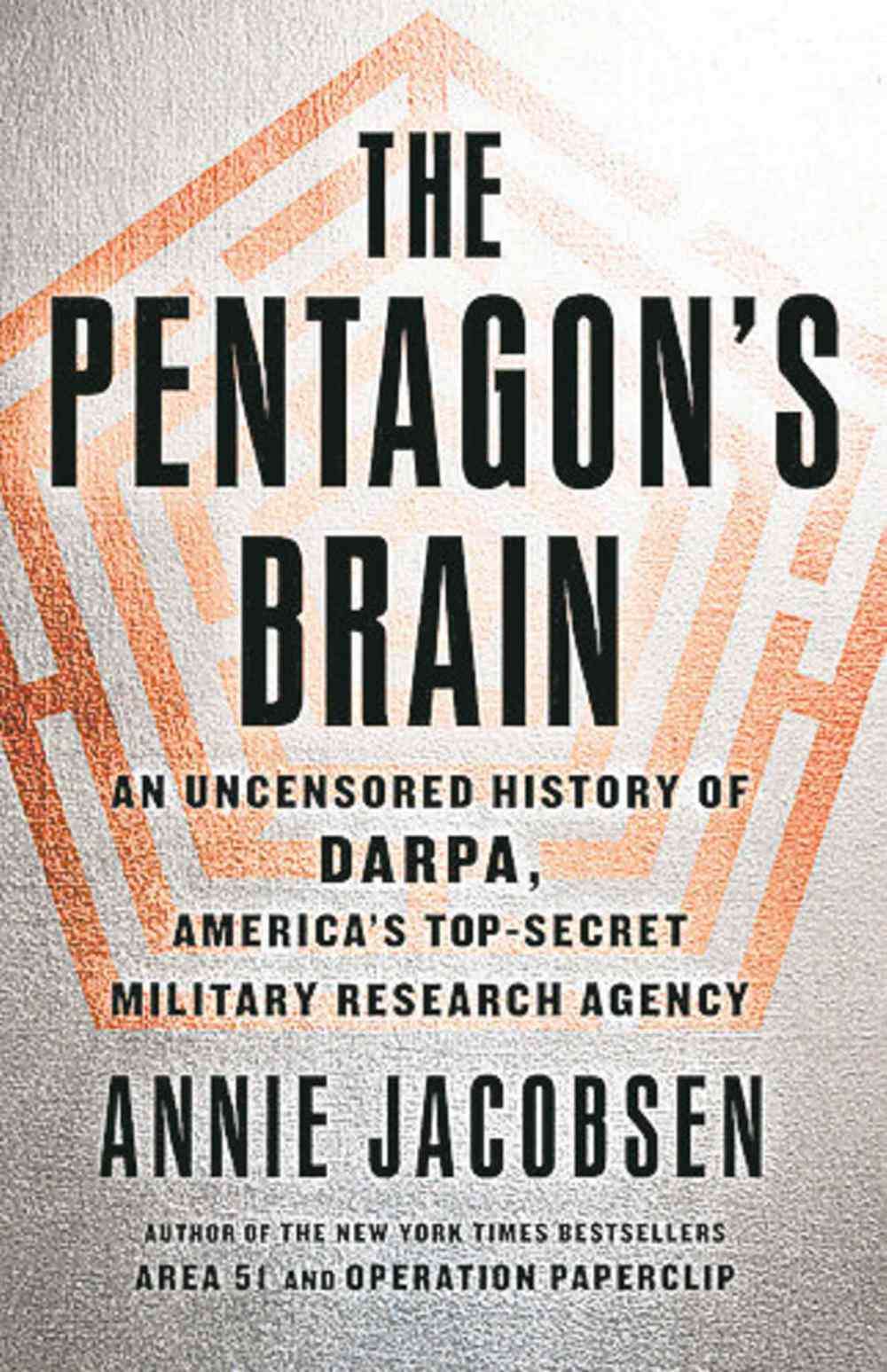
In a superbly crafted and carefully documented history of America’s modern military preparedness, freelance journalist Annie Jacobsen offers readers a glimpse into the highly secretive, strictly classified and monumentally expensive programs emanating from the Pentagon as its satellites monitor potentially dangerous beats for the self-appointed world’s policeman.
Jacobsen is a former contributing editor to Los Angeles Times magazine and a Princeton University grad with an impressive CV. She was able to secure several interviews with high-browed Ivy League alumni involved in top-secret government programs and whose individual recollections help to make the book not only a historical chronicle but a paean within a polemic that blends patriotic pride with moral concerns.
Two earlier books secured Jacobsen’s place as an acclaimed observer of America’s obsession with national security and government secrecy: Area 51 (2011), which shone some light into America’s top-secret military base, and Operation Paperclip (2014), which exposed how former Nazi scientists were ferreted to America after Hitler’s defeat.
Her newest book’s lengthy subtitle serves as its theme: An Uncensored History of DARPA, America’s Top-Secret Military Research Agency, the acronym referring to Defense Advanced Research Projects Agency, or the “brain” within the Pentagon.
Described by Jacobsen as “the most powerful and most productive military science agency in the world,” its mission is to “maintain technical dominance over the rest of the world” by being “10 to 20 years ahead of the technology in the public domain.”
Twenty-six chapters cover the gamut from DARPA’s inception in 1958 to its involvement in America’s wars following the Second World War — in Vietnam, Afghanistan and Iraq — ending with two polemical chapters revealing why science fiction is so admired within the agency created by Congress as a response to the embarrassment and outright fear caused by the Soviet launching of Sputnik in 1957.
Initially called ARPA, the future brain was to serve as the nation’s central research-and-development organization where, according to Jacobsen, leading-edge scientists could access astronomical funding incentives distributed to dozens of affiliated agencies.
Over several decades, the money spent brought “a revolution in warfare” featuring computer and stealth technology, drones, night-vision devices, surveillance cameras and super-reaction sensory devices.
Jacobsen acknowledges some military-driven initiatives have become publicly useful innovations, such as the Internet, global positioning systems (GPS), and the ubiquitous smartphone, but she reminds us the agency was also complicit in fashioning cluster bombs and Agent Orange dropped on Vietnam.

She recounts how that unpopular war prompted the inclusion of “Defense” in the agency’s official name, a public-relations move that camouflaged DARPA’s role in the military’s first-strike capabilities.
Caught off-guard by the Sept. 11, 2001, terrorist attacks, DARPA has since been tasked with expanding a program called Total Information Awareness (TIA) and instructed to create a computer system so intelligent “it would be able to review megadata on 285 million people a day” to ostensibly identify future terrorists.
Jacobsen outlines how the monitoring of society grew following several anthrax scares in 2002, quoting from then-president George W. Bush’s state of the union address in 2003 when he announced he was “deploying the nation’s first early warning network of sensors to detect biological attack.”
The last two chapters force readers to reflect upon why DARPA officials today are close-lipped about its research and development.
Jacobsen states “DARPA has always sought the technological and military edge,” but is perplexed about the secrecy surrounding what are deemed to be purely scientific (albeit controversial) programs such as limb regeneration, cloning and brain-chip implants.

Echoing public concerns about government secrecy prompted by Edward Snowden’s release of classified documents, she questions the Pentagon’s coziness with the Defense Science Board (DSB), which advises DARPA.
Revealing DSB has long advocated for human-machine biohybrids, better known as cyborgs, Jacobsen wonders if the technology it creates could one day outstrip DARPA itself, posing the ultimate question: “How close to the line can we get and still control what we create?”

She concludes: “If DARPA is the Pentagon’s brain, defence contractors are its beating heart,” and reminds readers that back in 1961, president Dwight D. Eisenhower had warned Americans to fear the military-industrial complex, making this book a must-read for skeptics who dismiss the likelihood of a Big Brother world as first envisioned by George Orwell in his dystopian novel Nineteen Eighty-Four.
Joseph Hnatiuk is a retired teacher in Winnipeg.
History
Updated on Saturday, September 26, 2015 8:25 AM CDT: Formatting.