

Brave old world
Brave old world
Advertisement
Read this article for free:
or
Already have an account? Log in here »
To continue reading, please subscribe:
Digital Subscription
One year of digital access for only $1.44 a week*
- Enjoy unlimited reading on winnipegfreepress.com
- Read the E-Edition, our digital replica newspaper
- Access News Break, our award-winning app
- Play interactive puzzles
*Billed as $5.77 plus GST every four weeks. After 52 weeks, price increases to the regular rate of $19.95 plus GST every four weeks. Offer available to new and qualified returning subscribers only. Cancel any time.
To continue reading, please subscribe:
Add Free Press access to your Brandon Sun subscription for only an additional
$1 for the first 4 weeks*
- Enjoy unlimited reading on winnipegfreepress.com
- Read the E-Edition, our digital replica newspaper
- Access News Break, our award-winning app
- Play interactive puzzles
*Your next Brandon Sun subscription payment will increase by $1.00 and you will be charged $17.95 plus GST for four weeks. After four weeks, your payment will increase to $24.95 plus GST every four weeks.
Read unlimited articles for free today:
or
Already have an account? Log in here »
Hey there, time traveller!
This article was published 14/05/2016 (3671 days ago), so information in it may no longer be current.
The history of the 20th century is one of modernization, a story of old ways being left behind. Many traditionalist Mennonites rejected these changes, especially the automobile, which they regarded as a symbol of pride and individualism. They became known as a “horse-and-buggy” people.
Between 2009 and 2012, Royden Loewen and a team of researchers interviewed 250 Mennonites in 35 communities across the Americas about the impact of the modern world on their lives. The resulting book, Horse-and-Buggy Genius: Listening to Mennonites Contest the Modern World (University of Manitoba Press), records their responses and strategies for resisting the very things — ease, technology, upward mobility and consumption — most people today take for granted.
In this passage, Loewen visits an Old Colony Mennonite community in Bolivia.

Drive south of the sprawling city of Santa Cruz, Bolivia, on the two-lane Highway 9. Half an hour later, at the Brechas, where Imperial Oil cut perfectly straight lines and dirt roads through the bushland in the 1950s, turn east. After 10 or so kilometres on a bumpy, dusty, red road, you arrive at Riva Palacios Colony.
It is the most prominent and historical of the 60 Mennonite colonies in Bolivia. But despite its status as the parent colony (1967) of the Old Colony world in Bolivia, there is no sign announcing the colony’s name, no welcome banner, no local hero valorized. And then you discover all three dozen villages of Riva Palacios are also unmarked, even though a locally produced map indicates that each has both a Campo number (a Mexican tradition) and a German-language place name (of West Prussian origin).
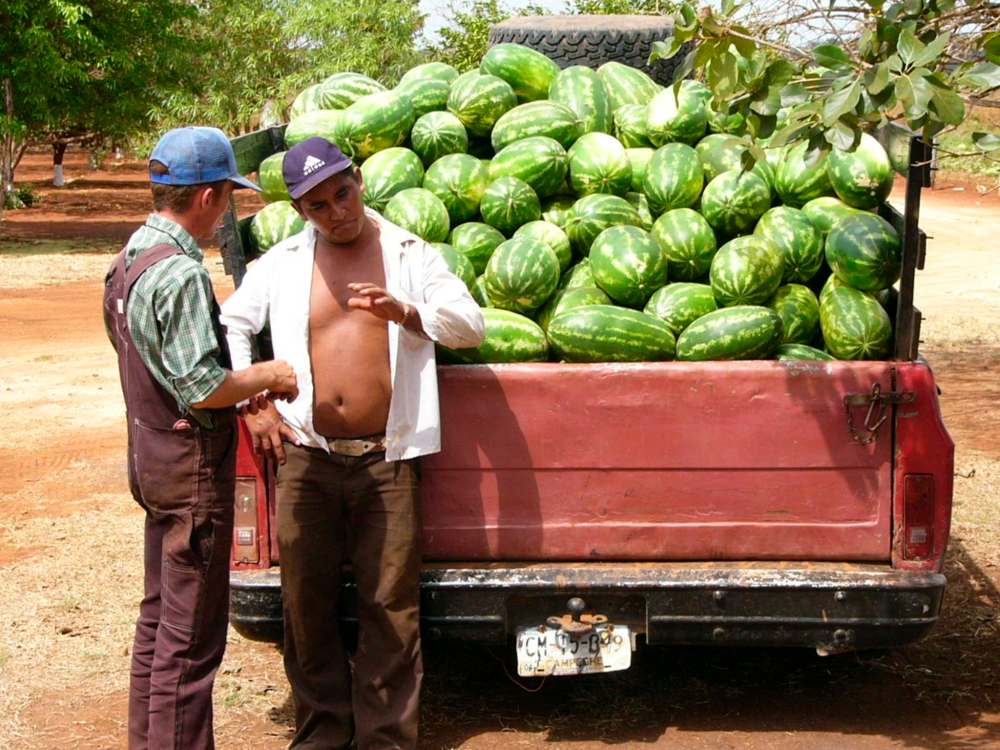
Despite a lack of signage marking colony or village, it is clear that this is an Old Colony Mennonite community. There is the horse-and-buggy traffic, the telltale Old Colonist garb of dark dresses and black overalls, the Low German phrases murmured by passersby. There is also a specifically “Mennonite” geographic ordering, with linear space arranged neatly, intentionally and efficiently. The tractors on steel wheels lumber along on the “lower,” more rutted lane, while the parallel “upper,” better-graded lane is reserved for visiting semis and taxis. The road is perfectly straight, following a square grid survey pattern, a cultural feature transplanted from Canada to Mexico in the 1920s and then brought to Bolivia in the 1960s. Similarly, the farmyards are also arranged in orderly sequence. Most have a picturesque treed lane leading to a farmyard set against a barn at the far end and, at the side of the yard, a neat brick or concrete house set among ornamental trees and colourful flowers.
How does such a place come to be?
It seems to be such a mix of powerful symbols and quiet obscurity. There seems to be an order amid the vagaries of agraria. The roadways and fences seem to be in good repair, internal and external boundaries are maintained, goods and services are produced and exchanged, farm families seem to be faring well, the poor seem to be cared for, a peaceable community seems to exist. What is the genius of this survival?
I am fortunate that on this, my first time in Riva Palacios, I am travelling with my friend Dick Braun of Osler, Sask., in a red, four-wheel-drive SUV. Dick takes me to visit with his friends, Abram and Aganetha Thiessen, at whose place we enjoy a lunch of hearty chicken noodle soup and freshly baked bread.
Abram is an engaging and jocular man. He tells us of his family and farm, he jokes and laments, but along the way he opens up Riva Palacios to us. His narrative outlines an intricate, historically conditioned, self-sufficient and locally regulated institutional arrangement and local economy. The down payment on his farm came from his meagre salary as a village schoolteacher, a position for which he was hired by the Darp Schult (“the village mayor”), who in turn had been elected democratically by the Schultebott (“the village council”), consisting of all land-owning farmers. His salary as a teacher came from the school fund, a village tax, half of which is collected from landowners and half from parents, calculated on the number of children in school.

Later, as a farmer, he interacted with other institutions in the colony. His household sells its milk to one of the colony’s seven locally organized, co-operative cheese factories, which collects a tax that it sends on to the Vorstehers. The Vorstehers, two colony mayors, use the tax money for colony roads and land for the next generation of farm families, but they also resolve conflicts, negotiate between the colony and outside world, and intervene in domestic disputes.
Since the Thiessens were an established family, the Vorstehers approached them one year to see if they would foster a young girl, who now sits at their table. She was brought over by the Vorstehers when her mother died and they decided that her abusive father could not be trusted. They even confiscated his land to hold in trust for the children until they turned 21, thus fulfilling the convention of the Waisenamt (“estates commission”) and its Waisenverordnung (their own 18th-century bylaws governing orderly inheritance).
Abram’s account is of his family’s survival in Bolivia. It is related intricately to a local government that has no legal foundation but tries to ensure social peace and economic success. Abram speaks about institutions that are very old, perhaps 1,000 years old, but also of others recently adopted from non-Mennonite societies. He outlines agricultural adaptation, with some aspects transplanted from the semi-arid mountain valleys of northern Mexico, others benefiting from Bolivia’s warmer and more humid environment. His narrative touches on shifting global markets, new technologies and the lure of chemicalized farm methods that have strangely combined old and new ways. But his stories recount a basic principle: technologies must benefit the whole community, not abet the ascendancy of the individual. Indeed, technologies that pit one farm household against another, or lead to the wider world’s allure of consumer goods, are not accepted.
In talking about their communities, Old Colony Mennonites blend antiquity and invention, old and new, the certain and the risky. The history of their farm community’s survival is always both, a record of what has always been and a conversation on what they have been compelled to do. Old Colonists have survived in strange new worlds by keeping sight of their principles of simplicity, all the while relying on a complex array of old institutions and seasoned farm practices. But their stories also indicate that such a reliance has never been myopic, always also reflecting an openness to some form of adaptation to new circumstances.
Royden Loewen is a professor of history and chair of Mennonite Studies at the University of Winnipeg. His books include Family, Church and Market: A Mennonite Community in the Old and New Worlds, and From the Inside Out: The Rural World of Mennonite Diarists.