Magary’s literary mash-up a riveting read
Advertisement
Read this article for free:
or
Already have an account? Log in here »
To continue reading, please subscribe:

Digital Subscription
One year of digital access for only $205*
- Enjoy unlimited reading on winnipegfreepress.com
- Read the E-Edition, our digital replica newspaper
- Access News Break, our award-winning app
- Play interactive puzzles
*First annual payment billed as $205.00 + GST for one year. This annual subscription will automatically renew at $233.00 + GST every 52 weeks (10% off the regular annual price of $259.35). Offer available to new and qualified returning subscribers only. Cancel any time.
To continue reading, please subscribe:
Add Free Press access to your Brandon Sun subscription for only an additional
$1 for the first 4 weeks*
- Enjoy unlimited reading on winnipegfreepress.com
- Read the E-Edition, our digital replica newspaper
- Access News Break, our award-winning app
- Play interactive puzzles
*Your next Brandon Sun subscription payment will increase by $1.00 and you will be charged $17.95 plus GST for four weeks. After four weeks, your payment will increase to $24.95 plus GST every four weeks.
Read unlimited articles for free today:
or
Already have an account? Log in here »
Hey there, time traveller!
This article was published 10/09/2016 (3644 days ago), so information in it may no longer be current.
This isn’t so much a traditional adventure yarn as it is a mash-up of many disparate journey tales — an ambitious, sustained blend of characters and stories and settings we’ve all read before, or at the very least pretended to.
Magary earned his stripes as an irreverent sports and pop-culture Internet columnist (most famously and still with Deadspin.com). He writes occasionally for GQ, usually on for-crazy-fun assignment. In 2008 he published his first book, Men with Balls: The Professional Athlete’s Handbook, a snide and very funny take-down of professional athletes. Next came a thoughtful, lightly sci-fi novel, 2011’s The Postmortal, before a memoir of his frequent tribulations and less-frequent triumphs as a father, 2013’s Someone Could Get Hurt: A Memoir of Twenty-First Century Parenthood. The Hike is his second novel and it, as the first, is fantasy.
Magary is forever trumpeting (and taking heat for) his self-predicted championship on the crazy cooking reality show Chopped, and he writes this book as if competing in a tightly timed chef show.
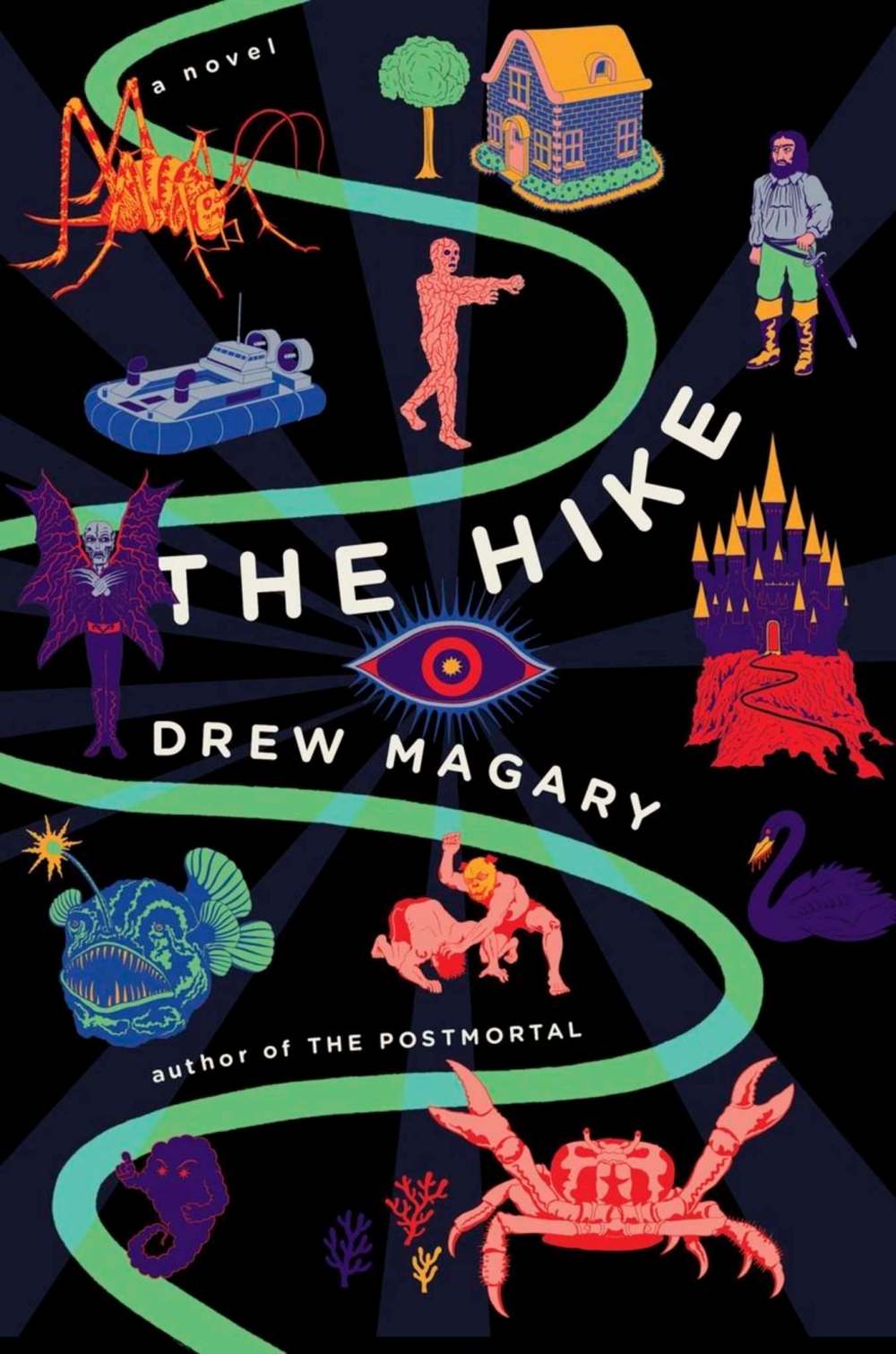
He frenetically lifts off the shelf, framing bits of ancient epics (especially Homer’s The Odyssey) with flavours of modern, playful adventure stories (especially Lewis Carroll and J.K. Rowling), catchy patterns of cult films and shows (especially Groundhog Day and Lost) and even whole features of challenging, narrative-style video games (especially Zork and Myst).
It is terribly dizzying yet awfully familiar all at once.
Ben is our hero. He is very dull and ordinary but in an amusing, endearing way. He is some sort of travelling businessman, away from his family while on the job, early for a mundane meeting with some typical client in a small, quaint spot in the Poconos. After calling his wife and family on his precious and crucial iPhone, he decides he has plenty of time for a wee walk in his charming environs, and sets off for an hour or so.
In minutes, Ben inadvertently ambles through a kind of rabbit-hole and next thing you know, he’s gone for years and years.
Along the immense route and timeless calendar, Ben first meets menacing wild men with Rottweiler faces and then a suspiciously welcoming elderly woman with an olde worlde house, nourishing and scrumptious food, a guarding and daunting garden and, you guessed it, a few magic beans.
Escaping these all early on, Ben stumbles into a kind of dream/drug state and is able to relive a missed romantic encounter with a college crush (he does better this time around).
These haphazard twists all continue and mount at a steady, riveting clip, as Ben meets a talking blue crab who becomes his snarky travelling mate, must engage in manual combat with a very grotesque giant cricket, must win a game of wits with a less-grotesque and rather hilarious human giantess, and must best smoke monsters and mythical beasts by following the instructions in that special book for beating beasts he happened to stumble upon.
He learns en route that his goal is to meet the mysterious “Producer” (presumably either his god or his tormentor or, worse, both) and that his principal means of realizing that goal is to stick rigorously to “the Path” or, quite simply, die horribly, quickly and permanently.
One immediately sees myriad allusions or debts in The Hike (a better title might have been The Beaten Path — although, to be fair, there are rocks, ice and mountains, too).
Here is an Arthurian knight on a cryptic quest, there is a monumental Gilgamesh ironically snatching botanical bits groping for eternal life, here is a chatty Virgil accompanying Dante, there is Harry moving inexorably toward likely doom with Voldemort.
Over and over, Ben finds himself caught between Scylla and Charybdis even as he is Sisyphus all over again.
That Magary cribs so many features for his book — from tiny details, through whole characters and complete episodes, to entire plot structures — is, of course, no crime. Nor is it smug, nor ostentatious.
It is not, though, an achievement that will give readers some kind of epiphany of postmodern intertextuality.
We do not end up seeing and appreciating Homer in Magary and therefore somehow seeing Homer anew through Magary. This is not that sophisticated, even though The Hike does entangle and complicate.
It is far more simple and no less fun.
Laurence Broadhurst teaches English and history at St. Paul’s High School in Winnipeg.