Essays highlight overlooked First World War battle

Advertisement
Read this article for free:
or
Already have an account? Log in here »
To continue reading, please subscribe:
Digital Subscription
One year of digital access for only $1.44 a week*
- Enjoy unlimited reading on winnipegfreepress.com
- Read the E-Edition, our digital replica newspaper
- Access News Break, our award-winning app
- Play interactive puzzles
*Billed as $5.77 plus GST every four weeks. After 52 weeks, price increases to the regular rate of $19.95 plus GST every four weeks. Offer available to new and qualified returning subscribers only. Cancel any time.
To continue reading, please subscribe:
Add Free Press access to your Brandon Sun subscription for only an additional
$1 for the first 4 weeks*
- Enjoy unlimited reading on winnipegfreepress.com
- Read the E-Edition, our digital replica newspaper
- Access News Break, our award-winning app
- Play interactive puzzles
*Your next Brandon Sun subscription payment will increase by $1.00 and you will be charged $17.95 plus GST for four weeks. After four weeks, your payment will increase to $24.95 plus GST every four weeks.
Read unlimited articles for free today:
or
Already have an account? Log in here »
Hey there, time traveller!
This article was published 12/11/2016 (3636 days ago), so information in it may no longer be current.
Etched in stone on the war monument on Winnipeg’s Memorial Boulevard, along with SOMME, VIMY and PASSCHENDAELE, are the words HILL 70. Yet while Vimy and Passchendaele loom large in Canadian awareness of the First World War, Hill 70 has been forgotten.
Douglas E. Delaney and Serge Marc Durflinger hope to change that with their new volume of scholarly essays on the battle, arguing it was at least as important as Canada’s more well-known battles.
Hill 70 overlooked the German-occupied town of Lens, France, significant for its connections to railways and nearby coal production. The four divisions of the Canadian Expeditionary Force (CEF), having fought together for the first time in the battle of Vimy Ridge in April 1917, were now tasked with taking this point along the Western Front in August.
Aside from the site’s strategic value, the Canadians were meant to occupy German forces, preventing them from reinforcing their line in Flanders, Belgium, where the British were making a major thrust.
Canada successfully took the hill, repulsed days of German counterattacks, and suffered 8,677 casualties. At Vimy, Canadians earned four Victoria Crosses; at Hill 70 and Lens, they earned six.
The volume is meticulously researched and will provide much to the student of Canada’s changing role in the First World War. However, despite careful cross-referencing between the chapters, no cohesive narrative of the battle emerges.
The book leads off with Nikolas Gardner’s detailed explication of First World War British command structure, and Canada’s place in it. It provides context but is hardly an engaging start to an argument for including Hill 70 in the same breath as Vimy or Passchendaele.
It might have been better to begin with Dufflinger’s own essay on contemporary coverage of the battle, which garnered exuberant headlines across Canada.
Or, perhaps, the editors would have done well to begin with J. L. Granatstein’s essay on Canadian politics, detailing then-prime minister Robert Borden’s determination to push conscription as well as income tax through Parliament while trying to win a fall election. The pressure to keep the CEF at full strength meant Borden had to choose between inadequate volunteer enlistment or legislating conscription — and torching the Conservatives’ political fortunes in Quebec.

Robert Engen’s chapter on health and front-line medicine paints a vivid picture of the realities of life in the trenches, including such tidbits as the fact that Canada was the only country to vaccinate all its troops against typhoid — which, along with other preventive health measures, had a huge effect on the troops’ combat readiness.
The book is amply illustrated throughout with archival photos, maps and newspaper clippings.
Despite some repetition of information from chapter to chapter, the editors succeed in arguing that Hill 70 was as just as important other more famous battles. As several contributors show, Canadian commander Lt.-Gen. Sir Arthur Currie capitalized on the lessons of Vimy in orchestrating the success and, equally, seemingly ignored those lessons when pressing on immediately to try (and fail) to take the town of Lens.
It may be impossible to create as stirring a portrait of the Battle for Hill 70 as Pierre Berton did for Vimy Ridge in Vimy — mainly because when Berton wrote he could still interview survivors of the battle. And perhaps because Hill 70 was such a success for the Canadians, it doesn’t compel reflection as do other battles such as Passchendaele, whose memory has been bolstered by a relatively recent feature film.
David Jón Fuller previously wrote for the Free Press about Canada and the First World War in The Timber Wolves of War (Nov. 8, 2014).
Our newsroom depends on a growing audience of readers to power our journalism. If you are not a paid reader, please consider becoming a subscriber.
Our newsroom depends on its audience of readers to power our journalism. Thank you for your support.
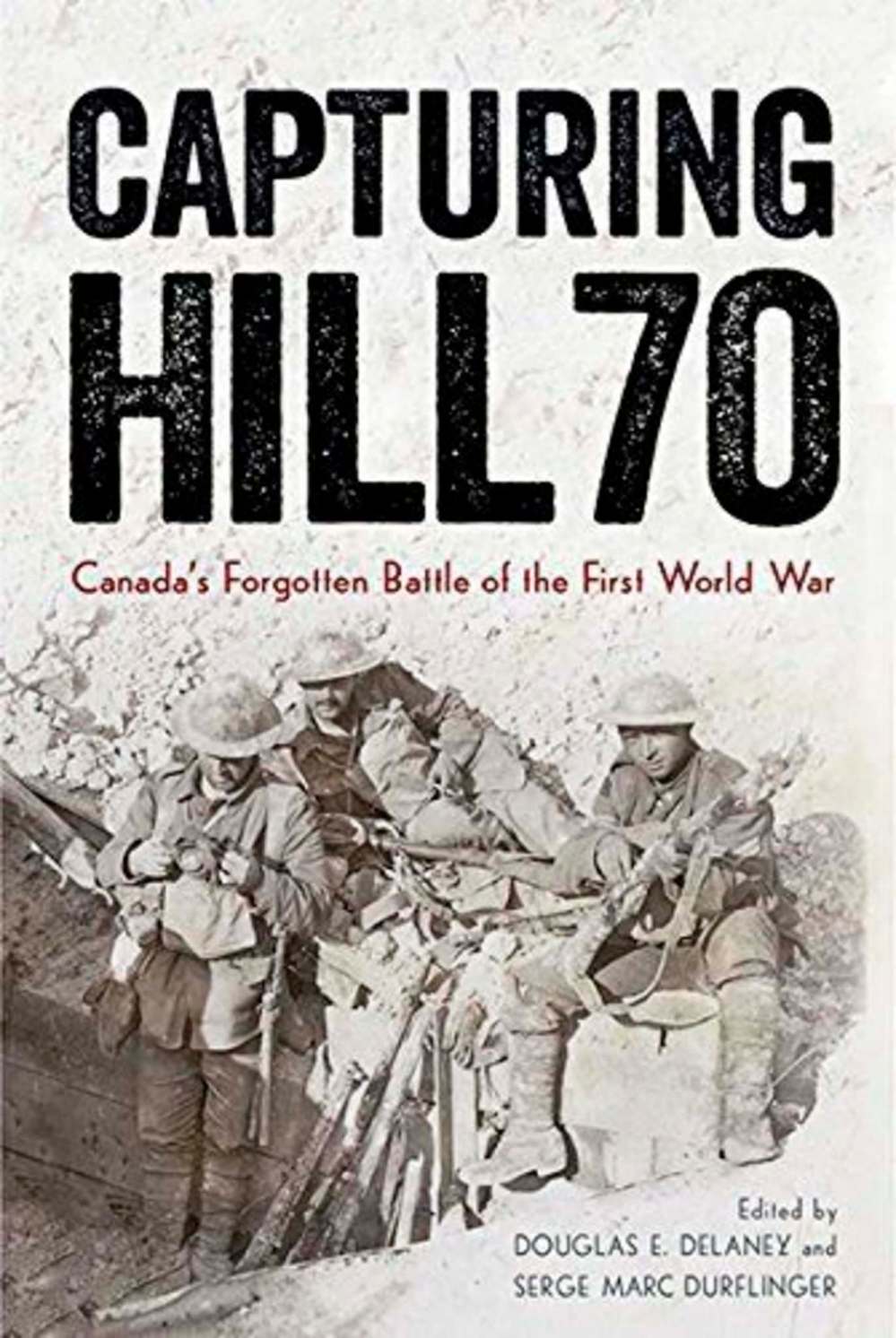
Capturing Hill 70: Canada’s Forgotten Battle of the First World War
Edited by Douglas E. Delaney and Serge Marc Durflinger
UBC Press/Canadian War Museum, 288 pages, $35
Our newsroom depends on a growing audience of readers to power our journalism. If you are not a paid reader, please consider becoming a subscriber.
Our newsroom depends on its audience of readers to power our journalism. Thank you for your support.
Related Articles
Soldier killed in First World War identified as Manitoban
Advertisement Advertise With Us
Advertisement Advertise With Us