A grim tradition
Shirley Jackson's gripping story gets graphic-novel treatment
Advertisement
Read this article for free:
or
Already have an account? Log in here »
To continue reading, please subscribe:

Digital Subscription
One year of digital access for only $205*
- Enjoy unlimited reading on winnipegfreepress.com
- Read the E-Edition, our digital replica newspaper
- Access News Break, our award-winning app
- Play interactive puzzles
*First annual payment billed as $205.00 + GST for one year. This annual subscription will automatically renew at $233.00 + GST every 52 weeks (10% off the regular annual price of $259.35). Offer available to new and qualified returning subscribers only. Cancel any time.
To continue reading, please subscribe:
Add Free Press access to your Brandon Sun subscription for only an additional
$1 for the first 4 weeks*
- Enjoy unlimited reading on winnipegfreepress.com
- Read the E-Edition, our digital replica newspaper
- Access News Break, our award-winning app
- Play interactive puzzles
*Your next Brandon Sun subscription payment will increase by $1.00 and you will be charged $17.95 plus GST for four weeks. After four weeks, your payment will increase to $24.95 plus GST every four weeks.
Read unlimited articles for free today:
or
Already have an account? Log in here »
Hey there, time traveller!
This article was published 24/12/2016 (3549 days ago), so information in it may no longer be current.
‘They made that there box with scraps of the old one,” remarks Old Man Warner, an irate townsperson in Shirley Jackson’s provocative parable The Lottery. The adapted wooden box plays a key role in the town’s eponymous lottery, after which one unlucky, randomly chosen resident must suffer a particularly cruel fate.
Nearly 70 years after the original short story was first published in the New Yorker magazine, Miles Hyman — Jackson’s grandson — has adapted The Lottery into an unsettling, full-colour graphic novel that preserves and re-presents the story’s disorienting astonishment.
Channeling the visceral through the visual, Hyman boldly adds a wordless prologue in which two town elders meet to set the lottery in motion for another year. With shadowy brown hues that quickly establish a creeping dread, the men are depicted in a haze, almost sleepwalking through their actions as they prepare for the event.
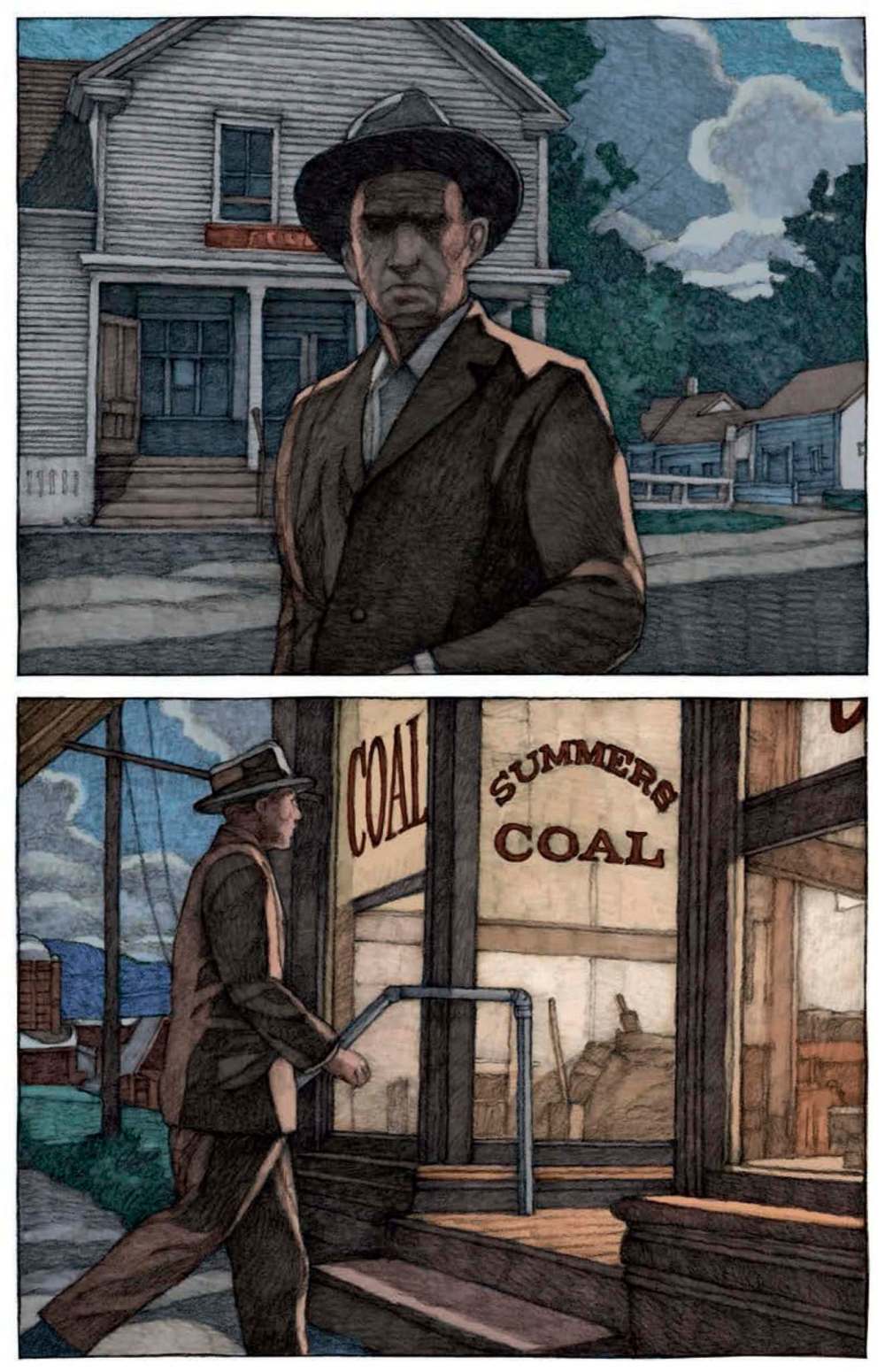
A clinical, disembodied hand inscribes the final, deciding ballot, despite the fact the person attached to the hand theoretically holds the power to end the lottery altogether.
As the story progresses, it becomes evident Hyman’s noirishly rendered silent panels are an apt graphic tribute to Jackson’s sparse prose. It comes as no surprise that Hyman has studied printmaking, often a technique used to create wordless stories in the 1920s and 1930s, ironically falling out of fashion around the same time Jackson’s story was first published.
Another particularly effective silent sequence introduces us to Tessie Hutchinson, the “winner” of the lottery. Purposely framed to invite our voyeurism as Tessie undresses and bathes, Hyman implies it is our own gaze that helps to mark her as doomed, even before we learn of her fate. These quiet, detailed panels also evoke the work of David Lynch — Blue Velvet and Twin Peaks in particular — both of which echo Jackson’s own preoccupation with the shocking within the mundane, and the sinister goings-on in an otherwise sleepy town.
Once the lottery begins, however, Hyman changes our focal point quite drastically, positioning us not as voyeurs privy to events unseen by the townsfolk, but as one of them, immersing and implicating us in the lottery’s proceedings. The story becomes a disorienting blur of faces and voices as the spectacle ensues, as the few young, dissenting voices are shouted down by older townspeople who blindly wield tradition as a weapon against them.
Both Jackson and Hyman make it clear, however, that this tradition is nothing but a convenient excuse to normalize cruelty, noting that “although the villagers had forgotten the ritual and lost the original black box… they still remembered to use the stones.”

A man passing three stones down to his young son for use following the lottery’s outcome resonates especially strongly, given the family connection between Hyman and Jackson. His work finds a new audience and new medium for a tale that highlights a deep-seated propensity for violence in which an excuse, any excuse, will do.
Notably, this panel is also framed in such a way that the recipient of the stones could just as easily be us, all too willing to accept and perpetuate the status quo.
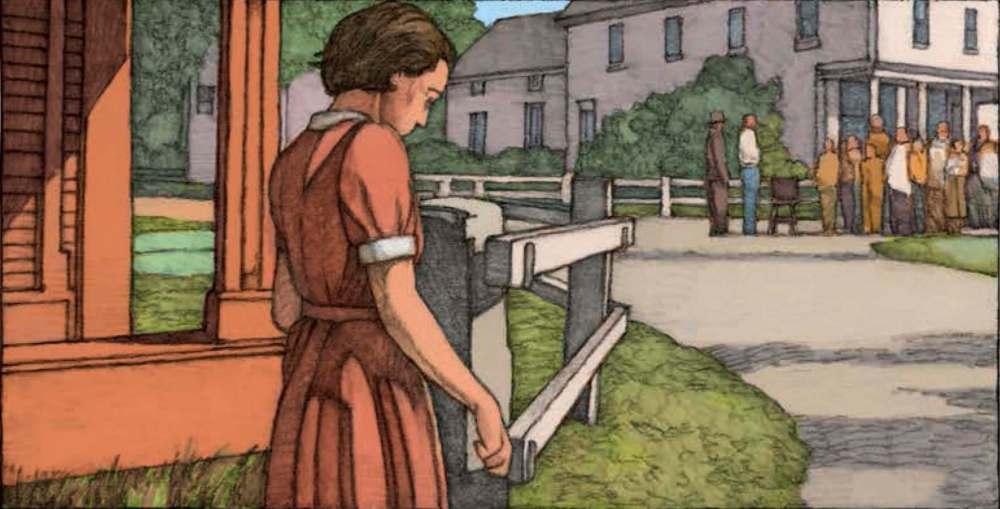
Eerily topical in 2016, Hyman’s inspired interpretation of Jackson’s narrative only enhances The Lottery as a story whose power (and indeed, whose shock effect) lies mainly in its deliberate refusal to explain itself, its damning complacency taking the place of both logic and compassion.
Hyman’s wordless sequences remain the book’s clearest asset, his adaptation re-inscribing Jackson’s short story as an indictment of silence in the face of injustice, especially injustice that masquerades as tradition.
Nyala Ali writes about race and gender in comics and music.

Shirley Jackson’s ‘The Lottery’: The Authorized Graphic Adaptation
By Miles Hyman
Hill and Wang, 160 pages, $23
Advertisement Advertise With Us
Advertisement Advertise With Us