

Tacit agreement
Sikoryak's new graphic novel re-contextualizes iTunes' legalese
Advertisement
Read this article for free:
or
Already have an account? Log in here »
To continue reading, please subscribe:
Monthly Digital Subscription
$1 per week for 24 weeks*
- Enjoy unlimited reading on winnipegfreepress.com
- Read the E-Edition, our digital replica newspaper
- Access News Break, our award-winning app
- Play interactive puzzles
*Billed as $4.00 plus GST every four weeks. After 24 weeks, price increases to the regular rate of $19.95 plus GST every four weeks. Offer available to new and qualified returning subscribers only. Cancel any time.
Monthly Digital Subscription
$4.99/week*
- Enjoy unlimited reading on winnipegfreepress.com
- Read the E-Edition, our digital replica newspaper
- Access News Break, our award-winning app
- Play interactive puzzles
*Billed as $19.95 plus GST every four weeks. Cancel any time.
To continue reading, please subscribe:
Add Free Press access to your Brandon Sun subscription for only an additional
$1 for the first 4 weeks*
- Enjoy unlimited reading on winnipegfreepress.com
- Read the E-Edition, our digital replica newspaper
- Access News Break, our award-winning app
- Play interactive puzzles
*Your next Brandon Sun subscription payment will increase by $1.00 and you will be charged $17.95 plus GST for four weeks. After four weeks, your payment will increase to $24.95 plus GST every four weeks.
Read unlimited articles for free today:
or
Already have an account? Log in here »
Hey there, time traveller!
This article was published 11/03/2017 (3350 days ago), so information in it may no longer be current.
‘I have read and agree to the iTunes Store Terms & Conditions.” There’s a good chance you’ve scrolled past this message at least once and clicked “accept.” So you’ve agreed, but have you actually read the contract? Probably not.
In case you were ever curious, though, cartoonist Robert Sikoryak (he goes by “R. Sikoryak”) has reframed iTunes’ entire unabridged terms and conditions as a series of comic strips. Released by Drawn and Quarterly, Terms and Conditions: The Unauthorized Graphic Novel finds Sikoryak recreating characters from roughly 100 different 20th-century comics, and using each one to illustrate a different section of Apple’s legal agreement.
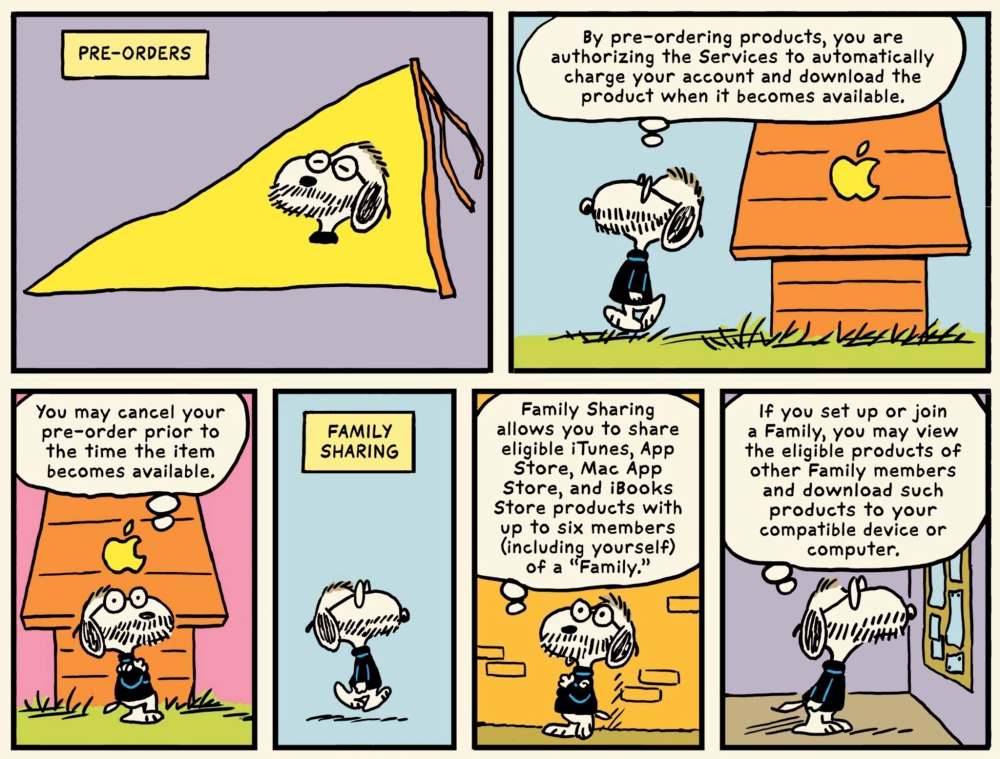
To provide some continuity to the uncanny Silicon Valley he’s established, Sikoryak gives us Apple co-founder Steve Jobs as our narrator. Rather than deploy Jobs as an additional character, Sikoryak depicts Snoopy, Wolverine, Tintin, Dilbert, Dennis the Menace and countless other iconic characters as the equally iconic Jobs, complete with his signature turtleneck and wire-rimmed glasses.
Having Jobs as a narrator is a particularly brilliant move, since comics are the perfect medium to highlight the mythology behind the former CEO, a man often viewed by tech geeks as a superhero (or super-villain: see omnipresent black turtleneck) in his own right. Terms and Conditions’ cartoon Jobs also reminds us how a brand (Apple) can also become a subculture, and how similar this tech subculture actually is to that of comics, especially for those who take a collector’s approach to either. Or, more insidiously, those who use subcultures like these to perpetuate elitism.
Mindful of the fact that Terms and Conditions might be hard for casual comics fans to parse, the book contains an index of what is being parodied on any given page. Sikoryak’s frenetic illustrations provide a reprieve from the dense, repetitive legalese of Apple’s agreement, and this detailed guide underscores the care taken to emulate not only the character design, but the overall style, tone, themes and even colour palettes of the source material. Most importantly though, the index acts as a touchstone to keep readers in on the (extremely absurd) joke.

The book really works best when it fully embraces its own absurdity. As Sikoryak points out, Apple’s intellectual property copyright policy stipulates that no derivative works be created from their products. Terms and Conditions, of course, is not only exactly this type of work, but has been created via a medium that very much relies on its own derivativeness to sustain it (think of the countless spinoffs, reboots and re-imaginings based around pre-existing comics characters and their worlds).
So, is the graphic storytelling used here actually a compatible device to make Apple’s document more readable? Though Sikoryak’s art is quite extraordinary in scope, and does recontextualize the agreement in an interesting way, Terms and Conditions doesn’t really simplify the original contract. The terms and conditions necessary for reading this book, then, rely on viewing it not as a “pictorial legal agreement” (as the book’s back-cover categorization cheekily notes), but as a clever visual history lesson in 20th-century comics.
Nyala Ali writes about race and gender in comics and music.

Terms and Conditions: The Unauthorized Graphic Novel
By R. Sikoryak
Drawn and Quarterly, 107 pages, $17
Advertisement Advertise With Us
Advertisement Advertise With Us