Essays paint politics as a dirty game

Advertisement

Advertise with us

Recently, Donald Trump Jr. tried to justify seeking assistance from a Russian lawyer to undermine Hillary Clinton’s presidential campaign against his father by saying, “I think politics is a dirty game.”

Read this article for free:


or

Already have an account? Log in here »

To continue reading, please subscribe:

Subscribe and receive a limited-edition Free Press branded hat or tote.

Digital Subscription

One year of digital access for only $205*

  • Enjoy unlimited reading on winnipegfreepress.com
  • Read the E-Edition, our digital replica newspaper
  • Access News Break, our award-winning app
  • Play interactive puzzles

*First annual payment billed as $205.00 + GST for one year. This annual subscription will automatically renew at $233.00 + GST every 52 weeks (10% off the regular annual price of $259.35). Offer available to new and qualified returning subscribers only. Cancel any time.

To continue reading, please subscribe:

Add Free Press access to your Brandon Sun subscription for only an additional

$1 for the first 4 weeks*

  • Enjoy unlimited reading on winnipegfreepress.com
  • Read the E-Edition, our digital replica newspaper
  • Access News Break, our award-winning app
  • Play interactive puzzles
Start now

*Your next Brandon Sun subscription payment will increase by $1.00 and you will be charged $17.95 plus GST for four weeks. After four weeks, your payment will increase to $24.95 plus GST every four weeks.

Hey there, time traveller!
This article was published 05/08/2017 (3332 days ago), so information in it may no longer be current.

Recently, Donald Trump Jr. tried to justify seeking assistance from a Russian lawyer to undermine Hillary Clinton’s presidential campaign against his father by saying, “I think politics is a dirty game.”

In a 2014 Ryerson University survey, a majority of Canadians held views similar to Trump Jr., and believed that engaging in politics would tend to corrupt normally honest people.

Ian Greene and David Shugarman, professors at York University and obviously a pair not easily daunted, wrote this book to further democratic education and sustain and strengthen Canadian democracy. Their first sentence bluntly promises a framework for sorting out right from wrong in politics.
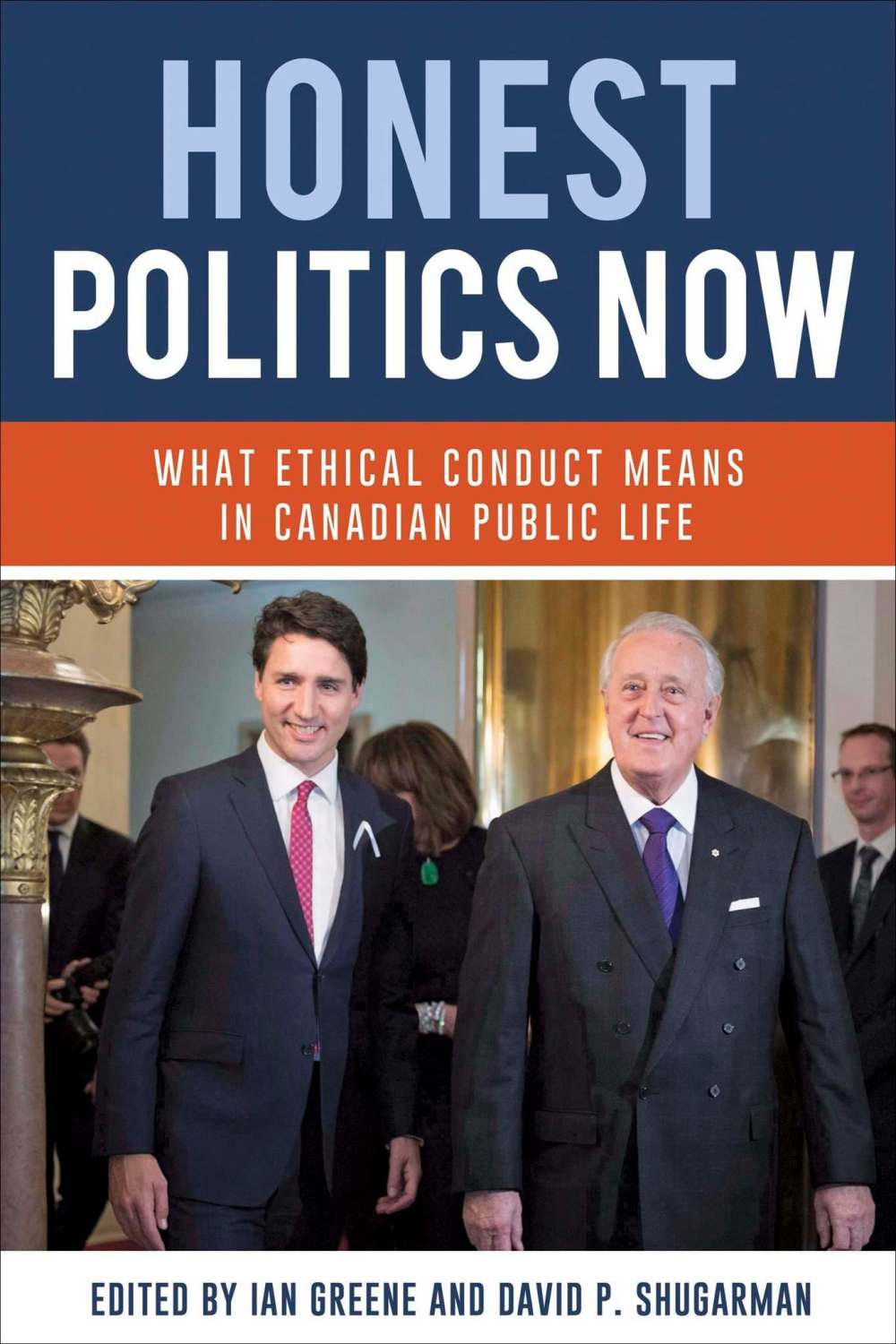
Their format is that of a textbook comprising 11 chapters written by Greene, Shugarman and six others with extensive experience in teaching, politics and ethics. They introduce issues such as conflicts of interest, lobbying, money and whistleblowing, provide case studies at the federal, provincial and municipal levels (the area “where corruption is most likely to occur”) and make conclusions based on them.

While this does not provide the thrills of more popular muck-raking efforts, it will provide the interested reader with an invaluable guide to the fundamentals of ethical democratic citizenship and governance.

They do not mince words. If, as the cynics and the disillusioned say, politics is a dirty game, then we do not have democracy. “Deceiving the people for the sake of the people is a self-contradictory notion in a democracy.” A loss of faith by the people in the role of government inevitably opens the door to charlatans governing in their own interests rather than for the public good.

The brevity of their case studies allow them to reintroduce us to an appalling gallery of scandals. Sinclair Stevens, Brian Mulroney, Jacques Corriveau, Rob Ford, Mike Duffy and their ilk all make their appearances in a line that might seem to “stretch out to the crack o’ doom.”

Again and again, these public servants gave priority to their friends and corporate interests over the general public, accepted enrichment and revolving-door employment as their deserved rewards, cheated on expenses and, amazingly, often got away with it by pleading that lying and cheating were not specifically forbidden in government conflict-of-interest codes.

The authors see patronage, the practice of providing special favours to partisan supporters in the selection of appointments or the awarding of contracts, as a major threat to the integrity of government.

The most bizarre examples of apparent patronage concern the Security Intelligence Review Committee, one of the agencies overseeing the Canadian Security Intelligence Service (CSIS). One chairman, Dr. Arthur Potter, had to resign when it became public that he had ties to a foreign arms dealer. Another, Chuck Strahl, resigned when it was revealed that he was a lobbyist for Enbridge at the same time CSIS was surveilling pipeline protestors.

Thankfully, Greene and Shugarman also provide us with heroes — politicians who have resigned rather than compromise their integrity, whistleblowers who sacrificed their careers by putting the public interest before loyalty to their employers and commissioners of enquiry who defied the powerful in the pursuit of the truth.

Since the first edition of their book was published in 1997, the authors take heart from the fact that public outrage over corrupt politics is leading to stricter safeguards such as limits on political contributions and independent ethics commissioners.

If ethical politics are someday to become as much a hallmark of our democratic system as free elections, we must have a critical mass of citizens who understand, practise and promote public integrity.

Reading this book might help us get there.

To his surprise, John K. Collins could find no reference to “Winnipeg” in the index.

Report Error Submit a Tip

More Stories

Jets GM insists club’s not working under any deadline in netminder’s trade request

Mike McIntyre 7 minute read Preview

Jets GM insists club’s not working under any deadline in netminder’s trade request

Mike McIntyre 7 minute read Thursday, Sep. 17, 2026

Connor Hellebuyck and his family were subject to so much post-Olympic vitriol that both the Winnipeg Jets security team and even police had to get involved.

Read
Thursday, Sep. 17, 2026

‘She was looking to destroy me’: convicted harasser faces new charges

Dean Pritchard 6 minute read Preview

‘She was looking to destroy me’: convicted harasser faces new charges

Dean Pritchard 6 minute read Thursday, Sep. 17, 2026

When Agnieszka Ciochon-Newton moved into the 55-plus apartment building on Stradbrook Avenue last year, she came across as “timid, soft-spoken and sensitive,” said building manager Tanya Owen.

Little did Owen know the meek-looking 58-year-old woman would soon turn her life and the lives of many of her tenants upside down and threaten her career and family.

“She was looking to destroy me for a simple tenant disagreement,” Owen said Thursday.

Court records show Ciochon-Newton was arrested earlier this month and charged with seven counts of criminal harassment, two counts of uttering threats and one count each of fraud, breaking and entering, attempting to obstruct justice, intimidation of a justice official, mischief and defamatory libel.

Read
Thursday, Sep. 17, 2026

Canada-U.S. trade relationship is broken, but the damage can — and will — be repaired

Tom Brodbeck 5 minute read Preview

Canada-U.S. trade relationship is broken, but the damage can — and will — be repaired

Tom Brodbeck 5 minute read Thursday, Sep. 17, 2026

Canada needs to get serious about diversifying its trade beyond the United States. But at the same time, Canadians should expect relations with the U.S. to normalize after Donald Trump is no longer in the White House.

For generations, Canada-U.S. trade was considered almost a fact of geography. The two countries share the world’s longest undefended border, deeply integrated supply chains and a century of commercial relationships.

Canadian manufacturers depend on American customers. American manufacturers depend on Canadian suppliers. Energy, agriculture, automotive production and countless other industries operate across the border as though it barely exists.

That isn’t going to change dramatically, even in the midst of a bitter trade war unleashed by the U.S. president.

Read
Thursday, Sep. 17, 2026

United Way, other charities fight for dollars as donor base shrinks

Scott Billeck 7 minute read Preview

United Way, other charities fight for dollars as donor base shrinks

Scott Billeck 7 minute read Yesterday at 2:00 AM CDT

Winnipeg’s charitable sector is being squeezed from both sides: demand for help is growing while the pool of donors to meet that need is shrinking.

The imbalance is increasingly being carried by a relatively small group of deep-pocketed donors. Last year, 600 people — about three per cent of United Way Winnipeg’s individual donors — accounted for roughly $8 million, or 55 per cent of individual donations.

The fundraising pitch isn’t getting any easier.

Homelessness and public drug use have become increasingly visible, household budgets remain strained and the problems charities are trying to address can seem so entrenched that donors may reasonably wonder what difference another contribution can make.

Read
Yesterday at 2:00 AM CDT

Steinbach Credit Union member warns others after scammer steals $10K

Scott Billeck 5 minute read Preview

Steinbach Credit Union member warns others after scammer steals $10K

Scott Billeck 5 minute read Yesterday at 5:19 PM CDT

A Winnipeg single mother whose bank account was drained of nearly $10,000 says Steinbach Credit Union needs to warn its members about what she believes is a broader security problem.

The woman, who is not being named to protect her identity, said a scammer gained access to her account earlier this week after calling SCU’s contact centre, claiming to be her and successfully completing the credit union’s authentication process.

She said she knows of at least six others who have experienced similar incidents in which callers impersonate SCU account holders and pass the authentication checks.

The woman discovered something was wrong when her minor son asked why money had been transferred out of an account they jointly hold.

Read
Yesterday at 5:19 PM CDT

Desperate Poilievre wants Canadians to believe the sky is falling when it’s just cloudy outside

Tom Brodbeck 5 minute read Preview

Desperate Poilievre wants Canadians to believe the sky is falling when it’s just cloudy outside

Tom Brodbeck 5 minute read Yesterday at 12:47 PM CDT

Pierre Poilievre has a problem.

Canadians just don’t seem to be paying much attention to him anymore.

So, naturally, the Conservative Opposition leader has decided to turn up the volume.

At a recent party caucus retreat in Penticton, B.C., Poilievre delivered the familiar message: Canada is in trouble, Canadians are hurting and the Liberal government is making everything worse.

Read
Yesterday at 12:47 PM CDT