WEATHER ALERT

The strength to endure

Plight of African citizens detailed in stories of courage, selflessness

Advertisement

Advertise with us

The meme “first-world problems” refers, sometimes flippantly, to insignificant inconveniences faced only by those who live in relative luxury in stable, free countries.

Read this article for free:

or

Already have an account? Log in here »

To continue reading, please subscribe:

Subscribe and receive a limited-edition Free Press branded hat or tote.

Digital Subscription

One year of digital access for only $205*

  • Enjoy unlimited reading on winnipegfreepress.com
  • Read the E-Edition, our digital replica newspaper
  • Access News Break, our award-winning app
  • Play interactive puzzles

*First annual payment billed as $205.00 + GST for one year. This annual subscription will automatically renew at $233.00 + GST every 52 weeks (10% off the regular annual price of $259.35). Offer available to new and qualified returning subscribers only. Cancel any time.

To continue reading, please subscribe:

Add Free Press access to your Brandon Sun subscription for only an additional

$1 for the first 4 weeks*

  • Enjoy unlimited reading on winnipegfreepress.com
  • Read the E-Edition, our digital replica newspaper
  • Access News Break, our award-winning app
  • Play interactive puzzles
Start now

*Your next Brandon Sun subscription payment will increase by $1.00 and you will be charged $17.95 plus GST for four weeks. After four weeks, your payment will increase to $24.95 plus GST every four weeks.

Hey there, time traveller!
This article was published 21/10/2017 (3201 days ago), so information in it may no longer be current.

The meme “first-world problems” refers, sometimes flippantly, to insignificant inconveniences faced only by those who live in relative luxury in stable, free countries.

People in much of the rest of the world, meanwhile, have to deal with real problems.

New Yorker staff writer Alexis Okeowo examines four areas of Africa where real problems are a way of life in her gripping and sobering first book.
Stuart Price / The Associated Press files
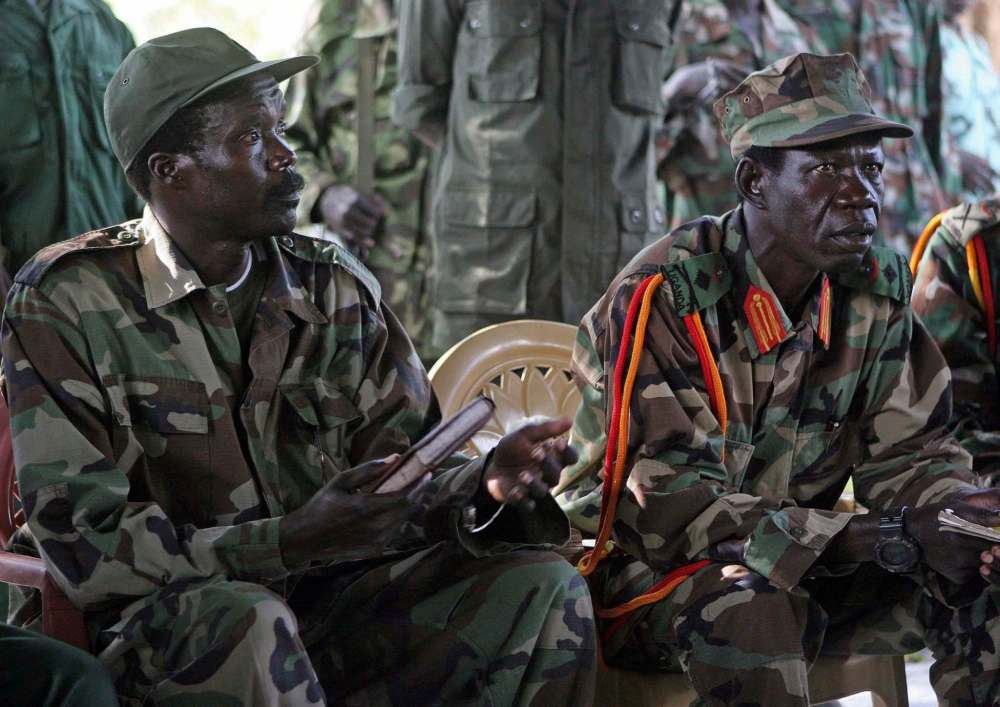
In this 2006 photo, Joseph Kony (left), leader of the Lord’s Resistance Army, and his deputy Vincent Otti sit inside a tent at Ri-Kwamba in southern Sudan.
Stuart Price / The Associated Press files In this 2006 photo, Joseph Kony (left), leader of the Lord’s Resistance Army, and his deputy Vincent Otti sit inside a tent at Ri-Kwamba in southern Sudan.

Born to Nigerian parents in the U.S., Okeowo visited Nigeria once as a child, and interned at a newspaper in Uganda (looking for adventure, she says) after growing up in Alabama and graduating from Princeton University. In America and Nigeria, Okeowo describes feeling “as an outsider in both places, an observer at the fringes.”

This “third-culture” perspective gives her observations of African issues simultaneously startling and dispassionate qualities, allowing the reader to experience the devastation endured, and sometimes transcended, by the “ordinary women and men” whose stories she tells.

The book opens with four introductory chapters, setting the personal and historical situations in Uganda, Mauritania, Nigeria and Somalia, through the lives and circumstances of particular people. Part two shows the aftermaths of these devastating experiences, and the desperate attempts to live “normal” lives in spite of the evils they have undergone.

In Uganda, Eunice’s story begins when she was kidnapped by the vicious Lord’s Resistance Army of Joseph Kony and forcibly married to LRA member Bosco. She was initially raped, but the two eventually committed to each other and to their children, and escaped back to freedom.

Their lives after the LRA show the ambivalence of their families and their culture to those who experienced — and committed — unspeakable atrocities.

The story of Haby, a Haratin (dark African) slave of lighter-skinned “white Moors” who form the upper-class oppressors in Mauritania, introduces Biram Dah Abeid, a Haratin working to free slaves, individually and collectively, against the racism of the white Moors and the failure of his beloved Islam to counter either racism or slavery.

Okeowo’s almost casual description of Mauritania’s entrenched, actually systemic race slavery provides an infuriating revelation to westerners, who have perhaps not even heard of the country. At one point she scoffs at a white Moor’s attempt to show equivalence between actual slavery and the high level of African-American incarceration in the U.S.

Biram’s first chapter ends with a cliffhanger, but the conclusion is a real-life anticlimax, frustrating for those who would like a storybook ending where Biram succeeds in eliminating slavery in his country.

The Nigerian story concerns two characters, Abba and Rebecca, whose parallel experiences eventually lead them to the vicious depredations of Boko Haram, and the attempts by Abba — now called “Elder” — to stand up to another extremist corruption of his understanding of Islam.

Aisha, a Somali woman, finds her bliss playing basketball in spite of fundamentalist opposition to sports and western culture in her country, both by the governing sharia of the Islamic Courts Union, and the militant al-Shabab — “the youth.”

The ability of people who have suffered such depraved wickedness to somehow continue to live, and sometimes even thrive, is a testament to human resilience which provides some hope even in the face of such suffering.

If Okeowo’s “outsider” perspective can awake more awareness and action in first-world readers, perhaps it will lead to even more hopeful progress.

Bill Rambo, a “third-culture kid” whose American parents grew up in India and took the family to live in the Congo during his formative years, has lived in Manitoba since 1990.

Report Error Submit a Tip

More Stories

Automation reaches new heights on farm

Laura Rance-Unger 4 minute read Preview

Automation reaches new heights on farm

Laura Rance-Unger 4 minute read Yesterday at 2:01 AM CDT

LANGHAM, Sask. — The thousands of farmers from across the Prairies who flock to the annual Ag in Motion show every July seem oblivious to the possibility the technology on display could one day replace many of them.

Families with children in tow, Hutterite colony workers, grandparents and young couples just starting out roamed through the 600 or more exhibitor displays, amazed at how everything about farming just keeps getting bigger, more efficient and increasingly more automated.

It’s now possible to seed using a 100-foot-wide drill — a 12-foot jump over the widest available a few years ago — provided the farmer can afford a tractor with enough horsepower to pull it. Those sell for around $850,000 and up.

Granted, the number of farms with enough acres to justify that kind of width and drawing power is still relatively small, but farms continue to grow. And it’s no secret the number of people who have the interest, skills and financial wherewithal to run them continues to shrink.

Read
Yesterday at 2:01 AM CDT

The strength to endure

Reviewed by Bill Rambo 4 minute read Preview

The strength to endure

Reviewed by Bill Rambo 4 minute read Saturday, Oct. 21, 2017

The meme “first-world problems” refers, sometimes flippantly, to insignificant inconveniences faced only by those who live in relative luxury in stable, free countries.

People in much of the rest of the world, meanwhile, have to deal with real problems.

New Yorker staff writer Alexis Okeowo examines four areas of Africa where real problems are a way of life in her gripping and sobering first book.

Born to Nigerian parents in the U.S., Okeowo visited Nigeria once as a child, and interned at a newspaper in Uganda (looking for adventure, she says) after growing up in Alabama and graduating from Princeton University. In America and Nigeria, Okeowo describes feeling “as an outsider in both places, an observer at the fringes.”

Read
Saturday, Oct. 21, 2017

Convicted sex offender awaits latest sentence

Dean Pritchard 4 minute read Preview

Convicted sex offender awaits latest sentence

Dean Pritchard 4 minute read Yesterday at 2:01 AM CDT

Prosecutors are seeking a 15-year prison sentence for a Red Lake, Ont., man who groomed two Indigenous girls online and drove nearly 500 kilometres to Winnipeg to sexually abuse one of them.

Scott Christopher Alcorn, 50, has pleaded guilty to one count each of child luring, sexual interference and possession of child sexual abuse material.

Alcorn was still on parole for child sex offences at the time of his April 2025 arrest, having been convicted four years earlier of providing a 16-year-old girl a bottle of alcohol in exchange for sex.

“Despite this (prior conviction)… Mr. Alcorn egregiously reoffended, this time to lure two children online and successfully groomed, manipulated and commodified one of (the victims),” Crown attorney Dayna Queau-Guzzi told provincial court Judge Robert Heinrichs at a sentencing hearing Thursday.

Read
Yesterday at 2:01 AM CDT

Selfie part of investigation into Grant Park football coach

Maggie Macintosh 4 minute read Preview

Selfie part of investigation into Grant Park football coach

Maggie Macintosh 4 minute read Friday, Jul. 24, 2026

A selfie of a high school football coach grinning beside a Free Press front-page story about the investigation into his professional conduct has become part of the case.

Doug Kovacs, a resource teacher at Grant Park High School who runs the Pirates football program, was put on leave in the spring.

The Winnipeg School Division employee is the subject of an investigation into allegations that athletes on his AAAA varsity team engaged in hazing that led to at least one player getting injured last year.

The Free Press has learned that on July 8 — the day it was revealed in print that Manitoba’s teacher commissioner had launched a third-party probe — a photo of Kovacs posing with a newspaper began circulating in the football community.

Read
Friday, Jul. 24, 2026

Puzzles Palace

1 minute read Monday, Jul. 13, 2026

To solve our puzzles, please subscribe with this special offer: |

Brown bombs as Bombers blasted

Taylor Allen 7 minute read Preview

Brown bombs as Bombers blasted

Taylor Allen 7 minute read Updated: Yesterday at 9:15 AM CDT

Winnipeg Blue Bombers quarterback Dru Brown took Friday night's ‘Christmas in July’ theme a little too seriously.

He wasn't carrying around a red sack, but he did gift-wrap four interceptions to the Calgary Stampeders in what ended up being a 52-30 loss for the Blue and Gold in front of a sold-out crowd.

The result dropped the Bombers, now 1-3 at home this season, to 4-3. Calgary improved to 3-4 and now have a chance to win the tiebreaker when the two sides meet for a final time on Oct. 10 at Princess Auto Stadium.

“Yeah, not nearly good enough...You certainly don't want to go get into a track meet against a good offence like that,” said Bombers head coach Mike O’Shea.

Read
Updated: Yesterday at 9:15 AM CDT