Martian mission marred by clumsy prose

Advertisement

Advertise with us

In the last decade or less, Mars has become cool again like it hasn’t been since the mid-1950s. Former U.S. presidents George W. Bush and Barack Obama both spoke of a manned mission to the Red Planet as space exploration’s next big leap, and two 2010 bipartisan policy pieces made it an official NASA goal to leave human footprints there by the 2030s. It’s an idea that is so tantalizingly close, space scientists and enthusiasts alike can taste it.

Read this article for free:


or

Already have an account? Log in here »

To continue reading, please subscribe:

Subscribe and receive a limited-edition Free Press branded hat or tote.

Digital Subscription

One year of digital access for only $205*

  • Enjoy unlimited reading on winnipegfreepress.com
  • Read the E-Edition, our digital replica newspaper
  • Access News Break, our award-winning app
  • Play interactive puzzles

*First annual payment billed as $205.00 + GST for one year. This annual subscription will automatically renew at $233.00 + GST every 52 weeks (10% off the regular annual price of $259.35). Offer available to new and qualified returning subscribers only. Cancel any time.

To continue reading, please subscribe:

Add Free Press access to your Brandon Sun subscription for only an additional

$1 for the first 4 weeks*

  • Enjoy unlimited reading on winnipegfreepress.com
  • Read the E-Edition, our digital replica newspaper
  • Access News Break, our award-winning app
  • Play interactive puzzles
Start now

*Your next Brandon Sun subscription payment will increase by $1.00 and you will be charged $17.95 plus GST for four weeks. After four weeks, your payment will increase to $24.95 plus GST every four weeks.

Hey there, time traveller!
This article was published 09/12/2017 (3202 days ago), so information in it may no longer be current.

In the last decade or less, Mars has become cool again like it hasn’t been since the mid-1950s. Former U.S. presidents George W. Bush and Barack Obama both spoke of a manned mission to the Red Planet as space exploration’s next big leap, and two 2010 bipartisan policy pieces made it an official NASA goal to leave human footprints there by the 2030s. It’s an idea that is so tantalizingly close, space scientists and enthusiasts alike can taste it.

Likewise in fiction. Andy Weir’s 2011 novel The Martian is both a milestone and a new high watermark for this long-running genre: a bestseller that became a box-office juggernaut and critical darling. On the big screen, Matt Damon played the titular stranded astronaut in a near-future almost indistinguishable from today. We’ve moved beyond the fantasies of both pre-Apollo works and the sporadic B-movie treatments of the ’80s, ’90s, and 2000s.

Veteran Australian novelist Peter Cawdron strives to add to this newer, more grounded period of Martian fiction — tonally similar to works such as The Martian or even Gravity, starring A-list dramatists, rather than fun and stupid romps like 2001’s Ghosts of Mars or 1990’s Total Recall, starring Ice Cube and Arnold Schwarzenegger, respectively. Has Cawdron been able to clear that bar?
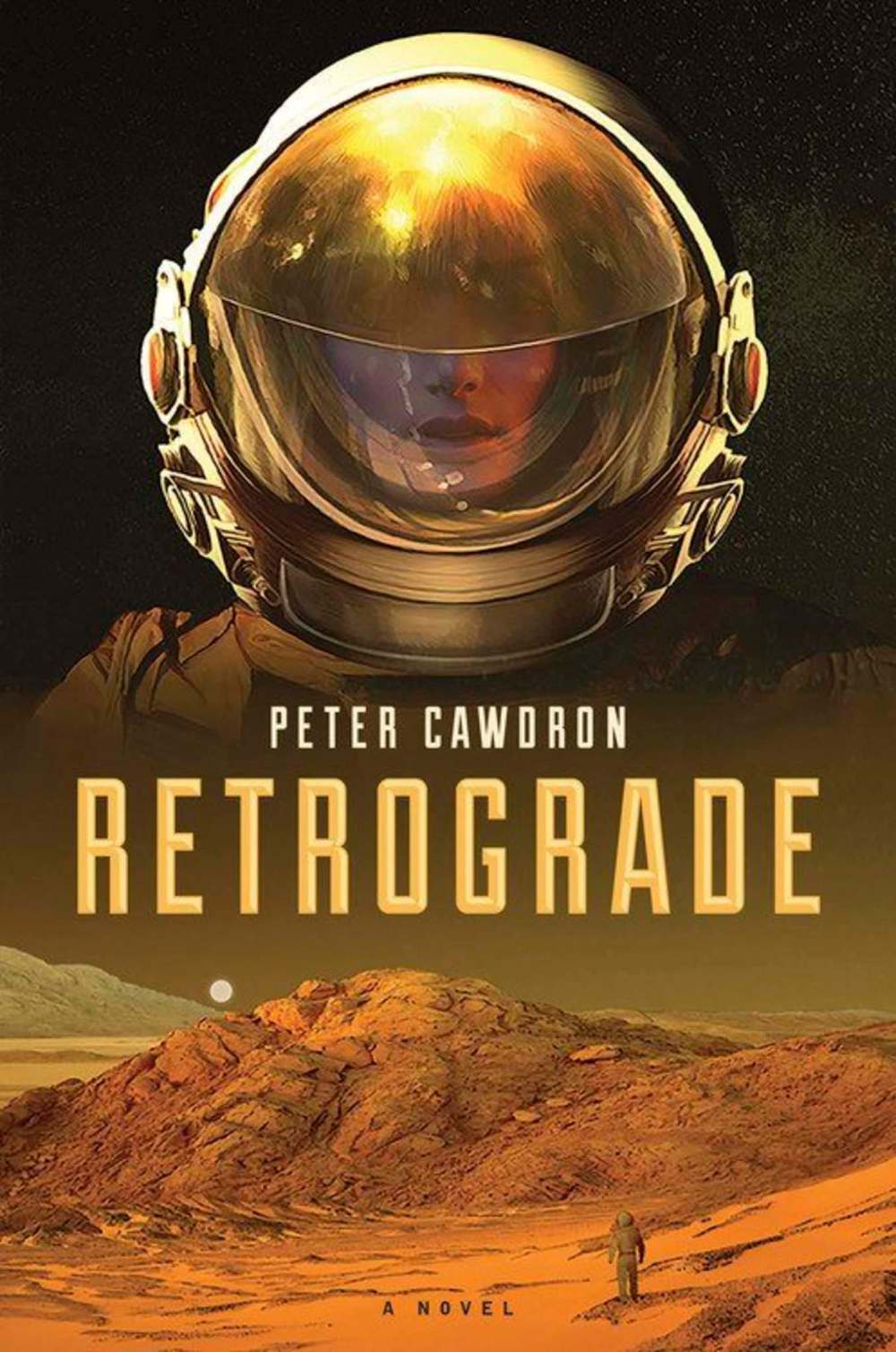
Sort of. The first 50-odd pages of the novel seem in line with Weir’s debut novel in that the setting — a 10-year Martian colony staffed by scientists, engineers and technicians — suggests neither a huge leap in time nor a leap in technology, with no wacky plot twists or characters. There are four autonomous modules staffed by international space agencies from the U.S., China and Russia.

The physical, political and organizational structure mirrors the real-life International Space Station, but the twist is that this global effort becomes undermined in the first pages when nuclear war breaks out on Earth, pitting the modules against one another.

This is a great concept and, by unhappy coincidence, a topical one. The characters in Cawdron’s novel have to deal with being left alone without much support or even communication from their various mission controls because of the vagaries of orbital mechanics.

There are a number of technical details to be worked out in terms of making supplies last for an indefinitely longer period, but this setup provides the added tension and narrative layer of nations suddenly in a state of war affecting the relationships of a few dozen people representing those nations in their small, fragile scientific outpost.

Where Retrograde starts to go off the rails is in a dramatic shift in plot near the halfway point of the novel. Without giving it away, suffice to say that the twist strains credulity in both the narrative and the motivations of the characters. The out-of-nowhere reveal of a deeper and more sinister force at work below the surface of these events is likely to break the suspension of disbelief for many readers.

In fact, the story is still reasonably compelling, but it’s a jarring shift for the reader. Story structure is a problem on the smaller scale as well, with an overuse of character-development flashbacks that kill the momentum of the scenes they were inserted into and feel shoehorned in.

Cawdron does a lot of things right, including a clever basic story concept, some decent character development and a solid technical grounding. The missed opportunity is that if the overall story logic were more cohesive and the unfolding of the narrative more organic, the result might have reached beyond the level of a decent beach read.

Joel Boyce is a Winnipeg writer and educator.
Report Error Submit a Tip

More Stories

50 years ago, we thought we could change the world

Robert Milan and Miriam Cooley 8 minute read Preview

50 years ago, we thought we could change the world

Robert Milan and Miriam Cooley 8 minute read Updated: Yesterday at 9:48 AM CDT

We began as a small loose unorganized group of teaching friends and educators who shared the same political and social convictions.

Read
Updated: Yesterday at 9:48 AM CDT

Northern style: WAG-Qaumajuq, CBC series partner for runway show

AV Kitching 8 minute read Preview

Northern style: WAG-Qaumajuq, CBC series partner for runway show

AV Kitching 8 minute read Yesterday at 6:10 PM CDT

Award-winning TV series North of North by Inuit filmmakers Stacey Aglok MacDonald (Qanurli, The Grizzlies) and Alethea Arnaquq-Baril (Angry Inuk, The Grizzlies) made a return to the small screen last week on APTN, CBC Gem and CBC TV with its second season première.

North of North is partnering with the Winnipeg Art Gallery-Qaumajuq to celebrate the way it has propelled authentic northern fashion into the global spotlight at the gallery’s special edition of Crafted on the Catwalk Tuesday night, featuring fashion and design from Manitoba, Nunavut, the Northwest Territories, Nunatsiavut and Nunavik.

Arnaquq-Baril and series stars Anna Lambe and Zorga Qaunaq spoke to the Free Press ahead of Tuesday’s catwalk show.

Free Press: The fashion in Season 1 set the bar so high. We’re barely into Season 2 and have already seen so many covetable, stunning looks. What story do the clothes tell the viewers?

Read
Yesterday at 6:10 PM CDT

Defenceman Morrissey focused on season ahead

Ken Wiebe 8 minute read Preview

Defenceman Morrissey focused on season ahead

Ken Wiebe 8 minute read Yesterday at 12:08 PM CDT

Josh Morrissey insists that a trade request from the franchise goalie doesn’t change his desire to be a lifelong Winnipeg Jet.

The top-pairing defenceman and alternate captain reinforced that view on Monday morning when speaking to a group of reporters prior to the Winnipeg Jets Golf Classic at St. Charles Country Club.

“At the end of the day, I love being here and I love being a Jet. That’s how I’ve always felt,” said Morrissey, who spoke for just over nine minutes on a variety of topics. “That doesn’t change because of somebody else’s decision. Nothing is finalized, so who knows, he could be back. My position doesn’t change.”

Morrissey has two years left on a contract that pays him US$6.25 million and he’s only eligible to sign an extension on July 1, but the future of the franchise pillar will be a topic of discussion as the Jets work to sort through the situation with franchise goaltender Connor Hellebuyck, which remains unresolved.

Read
Yesterday at 12:08 PM CDT

MMF walks away from bid to buy Fort Garry Hotel

Carol Sanders 3 minute read Preview

MMF walks away from bid to buy Fort Garry Hotel

Carol Sanders 3 minute read Yesterday at 3:03 PM CDT

The Manitoba Métis Federation won’t buy the historic Fort Garry Hotel, President David Chartrand said Monday.

Read
Yesterday at 3:03 PM CDT

Winnipeg venues saying no to AI-made advertisements

Sheldon Birnie 8 minute read Preview

Winnipeg venues saying no to AI-made advertisements

Sheldon Birnie 8 minute read Updated: Yesterday at 10:22 AM CDT

Although the days when telephone poles and notice boards across the city were thick with gig posters, either slopped up with wheat paste or wrapped tight with packing tape, are behind us, the art of making an appealing visual ad for live music events is still a vital part of the local creative scene.

However, a widespread backlash against a new kind of slop — the use of generative AI images — has been building, especially among creatives when it comes to promoting live music.

“Live music is and always has been a DIY type of scene, especially locally,” says Evan Simpson, who has been working as a graphic designer for nearly a decade.

“For years people have been making their own flyers, or if they have the budget, hiring a designer or artist to come up with some artwork for their flyers. It’s a whole ecosystem, a scene supporting itself. If you take away the visual side of it, the spark, individuality and uniqueness of each gig poster is lost. What a sad world it would be if all art were made by AI.”

Read
Updated: Yesterday at 10:22 AM CDT

A father and son arrested last month are accused of travelling across Canada — and using courier services and Canada Post — to supply their Winnipeg drug-trafficking operation, a recent court filing shows.