

Thrive and survive
Yellowstone's wolves, once led by a female alpha, are a conservation success story
Advertisement
Read this article for free:
or
Already have an account? Log in here »
To continue reading, please subscribe:
Monthly Digital Subscription
$1 per week for 24 weeks*
- Enjoy unlimited reading on winnipegfreepress.com
- Read the E-Edition, our digital replica newspaper
- Access News Break, our award-winning app
- Play interactive puzzles
*Billed as $4.00 plus GST every four weeks. After 24 weeks, price increases to the regular rate of $19.95 plus GST every four weeks. Offer available to new and qualified returning subscribers only. Cancel any time.
Monthly Digital Subscription
$4.99/week*
- Enjoy unlimited reading on winnipegfreepress.com
- Read the E-Edition, our digital replica newspaper
- Access News Break, our award-winning app
- Play interactive puzzles
*Billed as $19.95 plus GST every four weeks. Cancel any time.
To continue reading, please subscribe:
Add Free Press access to your Brandon Sun subscription for only an additional
$1 for the first 4 weeks*
- Enjoy unlimited reading on winnipegfreepress.com
- Read the E-Edition, our digital replica newspaper
- Access News Break, our award-winning app
- Play interactive puzzles
*Your next Brandon Sun subscription payment will increase by $1.00 and you will be charged $17.95 plus GST for four weeks. After four weeks, your payment will increase to $24.95 plus GST every four weeks.
Read unlimited articles for free today:
or
Already have an account? Log in here »
Hey there, time traveller!
This article was published 17/03/2018 (2978 days ago), so information in it may no longer be current.
This is not so much a book as an obituary.
O-Six was a wolf, a superstar of wolves, a Mensa of predators. What she called herself, if anything, we’ll never know.
Who knows what O-Six would have thought of Nate Blakeslee’s writing; she could read the weather, the landscape, the enemy, her pups, the pack, the prey and her mate, but not the words.
The Wolf is a blitzkrieg of emotion, 300-plus pages of love. It may even belong on the shelf with two bestsellers about animals: The Incredible Journey by the late Sheila Burnford of Thunder Bay, and Jonathan Livingston Seagull by American author Richard Bach.
The Incredible Journey is based on a true story, Seagull is make-believe and the animals in The Wolf are real. But there is the same magical factor in all three — the animals are described as you would humans, as individuals distinguished by attitude and conduct. This humanizing generates an intimate feeling of both empathy and altruism. There is a coming-together of reader and creature in the words of The Wolf and that is why.
Blakeslee lives in Austin, Texas, and is a writer for Texas Monthly. This is his second book.
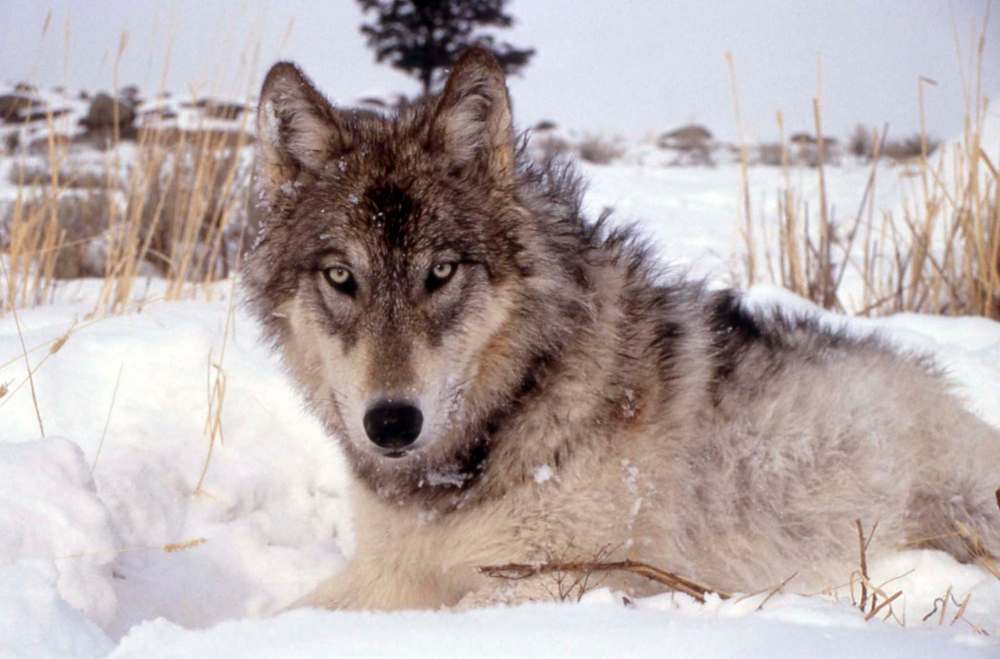
O-Six was magnificent — six feet tall on her haunches, 45 kilograms of living and killing, muscular yet sleek, intelligent and courageous, firm but charitable, an alpha female, a grey noble among wolves and, as a wolf, one of the greatest success stories in the history of evolution.
Her great-grandmother had been among 32 wolves brought down in 1995-96 from Western Canada to Yellowstone National Park in Wyoming. There hadn’t been any wolves in Yellowstone for 70 years. Those 32 imported Canadian wolves became 174 by 2003. O-Six was born in 2006.
One of the great attractions of Yellowstone was wolf-watching. And O-Six became the queen of tourism in the park due to her appearance, management skills, motherhood and confidence. At its peak, wolf-watching tourists numbered 30,000 a year, and the reintroduction program in Yellowstone was being called the greatest conservation success story of the previous 50 years.
But always, in the background, were hunters with guns (professional guides and ranchers) aching to kill when the wolves — who only respected the boundaries of other wolf packs — left the park. And a lot of state legislators (the park is federal land) supported them.
A couple of Blakeslee’s descriptions illustrate his success in describing wolves and their conduct. The first is his wonderful detailing of how a wolf employs the magnificent piece of anatomy called a nose: “His nose, at least 100 times more sensitive than a human’s, told him which direction (intruders, in his absence) had come from, how long they had stayed and where they were headed when they left.”
The second illustration is Blakeslee’s characterization of what O-Six thinks of a car — “to her, a car was like anything else on the landscape that was neither predator nor prey. It wouldn’t harm her, and she couldn’t eat it; it was a nonentity.”
But perhaps it was the drama of what could have been O-Six’s last stand — like the ambush of Butch Cassidy and Sundance — that clearly showed how strategic and superior O-Six was to the foreign pack of wolves called Mollies that surrounded her. As astonished wolf-watchers saw in their field glasses, in order to protect her pack O-Six, outnumbered 10 to one, charged the approaching Mollies, pierced their lines and, when they gave chase and thought they had her on the edge of a cliff, jumped across the chasm and landed on a lower ledge on the other side. She then, like a mountain goat, jumped down from ledge to ledge to the ground. It was a remarkable feat.
In December 2012, in the opening days of Wyoming’s first legal wolf hunt in decades — a win for the hunters’ and ranchers’ lobby — O-Six was shot outside Yellowstone Park. She died instantly; she was six years old. The hunter said the kill was a proud moment for him, but remained anonymous when her death unleashed a groundswell of anger and grief both in the United States and abroad.
Today O-Six’s descendants live in Yellowstone (there’s no hunting in the park) and people still come by the thousands to watch them. But there’s not another O-Six.
Meanwhile, upon her death, O-Six became the most famous wolf in the world. The New York Times ran her obituary.
The only thing Barry Craig hunts is his glasses.