

American ideals
Eisenhower, Warren often clashed on civil rights issues
Advertisement
Read this article for free:
or
Already have an account? Log in here »
To continue reading, please subscribe:
Monthly Digital Subscription
$1 per week for 24 weeks*
- Enjoy unlimited reading on winnipegfreepress.com
- Read the E-Edition, our digital replica newspaper
- Access News Break, our award-winning app
- Play interactive puzzles
*Billed as $4.00 plus GST every four weeks. After 24 weeks, price increases to the regular rate of $19.95 plus GST every four weeks. Offer available to new and qualified returning subscribers only. Cancel any time.
Monthly Digital Subscription
$4.99/week*
- Enjoy unlimited reading on winnipegfreepress.com
- Read the E-Edition, our digital replica newspaper
- Access News Break, our award-winning app
- Play interactive puzzles
*Billed as $19.95 plus GST every four weeks. Cancel any time.
To continue reading, please subscribe:
Add Free Press access to your Brandon Sun subscription for only an additional
$1 for the first 4 weeks*
- Enjoy unlimited reading on winnipegfreepress.com
- Read the E-Edition, our digital replica newspaper
- Access News Break, our award-winning app
- Play interactive puzzles
*Your next Brandon Sun subscription payment will increase by $1.00 and you will be charged $17.95 plus GST for four weeks. After four weeks, your payment will increase to $24.95 plus GST every four weeks.
Read unlimited articles for free today:
or
Already have an account? Log in here »
Hey there, time traveller!
This article was published 07/04/2018 (2957 days ago), so information in it may no longer be current.
Readers benumbed by gun violence in the U.S. — a consequence of the American Constitution’s reference to bearing arms — will appreciate the complexity of constitutional democracy after reading this latest comparative analysis of two personalities who dominated mid-20th-century America.
James Simon, former dean of New York Law School and author of several books on American history, law and politics, including What Kind of Nation (2001) and FDR and Chief Justice Hughes (2012), offers a lucid, refreshingly frank and often entertaining exposé of key individuals in the executive and judicial branches of government.
Their similarities, differences and regard for each other are revealed as Simon skilfully reconstructs major 1950s issues confronting the presidency and the Supreme Court, employing common language to highlight precedent-setting decisions.
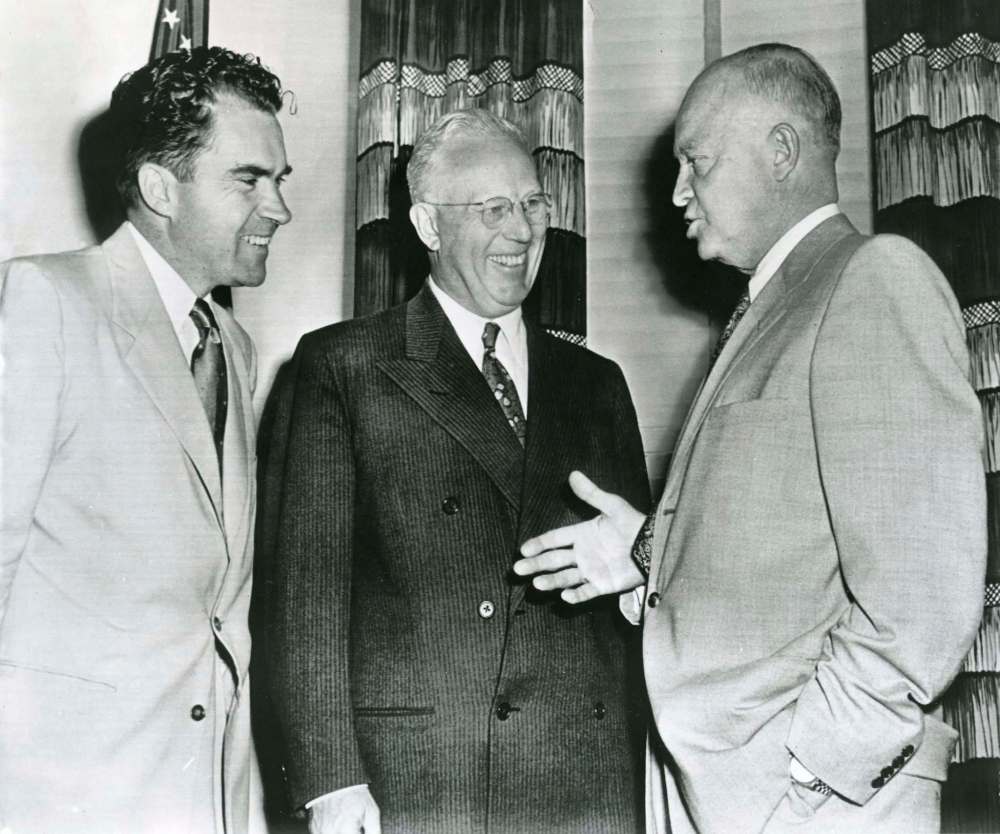
President Dwight D. Eisenhower and Chief Justice Earl Warren were contemporaries, both men born in the early 1890s. Eisenhower, five months older, was a West Point graduate, achieving heroic status commanding Allied forces in Europe during the Second World War and then riding his popularity into the White House in 1952.
Warren attended law school in California before enlisting in the army officers’ corps shortly before the 1918 armistice, but it was his success as a lawyer, district attorney and progressive-minded state governor that gave him national recognition and, like Eisenhower, opportunities for higher office.
It was Eisenhower who named Warren to fill a vacancy on the Supreme Court, a decision the president privately regretted, reportedly calling the chief justice a “dumb son of a bitch” for his strict views on equality and individual rights.
Simon discloses that Eisenhower’s preferred approach to issues such as civil liberties was a pragmatic “middle way,” a slower but hopefully peaceful process of coaxing racist elements to gradually accept the intent of the nation’s constitution.
While presenting a balanced view of the protagonists as patriotic Americans, Simon displays a bias toward the chief justice, lauding Warren’s liberal-minded court rulings, which reflected a firm belief that societal change required immediate — not gradual — adherence to the principles of equality and opportunity.
Revealing how the excesses of McCarthyism and the clamour for civil rights and liberties coalesced around one momentous court decision, Simon emphasizes the importance of one particular case precipitated by a growing demand to end segregation in America’s schools.
Filed in Kansas by the National Association for the Advancement of Colored People (NAACP), this legal challenge made its way through the courts as Brown v. Board of Education, eventually reaching the Supreme Court, which in 1955 unanimously ruled that all states take “immediate action” to dismantle the segregation of the public school system.
The case reflected a larger desire by blacks to be treated as equals everywhere — in restaurants, on buses and in the workplace — leading to Eisenhower’s watered-down Civil Rights Act and later to president Lyndon Johnson’s more inclusive Civil Rights legislation.

Readers are left to ponder the crux of Simon’s analysis: did Eisenhower’s lukewarm response to the Warren Court’s decision embolden segregationists and play a significant role in the ensuing violence in places such as Little Rock, Ark.? Or, alternatively, could the gradualist approach to equality preferred by the president have prevented racial unrest in the 1960s?
Simon agrees that honourable men can disagree about the pace and means of effecting social change, but adds that Warren’s “broad vision of the Constitution’s protection” for all citizens furthered equality in America, a vision evident again in the Supreme Court’s decision to expand Miranda rights to criminal defendants.
“Protecting individual rights in a time of national anxiety” is a core issue, according to Simon — one now resonating during the Trump presidency as the country faces a national divide over immigration and the National Rifle Association’s rabid interpretation of the Second Amendment.
Joseph Hnatiuk is a retired teacher in Winnipeg.