Schofield’s narrative brings shades of Beckett
Advertisement
Read this article for free:
or
Already have an account? Log in here »
To continue reading, please subscribe:

Digital Subscription
One year of digital access for only $205*
- Enjoy unlimited reading on winnipegfreepress.com
- Read the E-Edition, our digital replica newspaper
- Access News Break, our award-winning app
- Play interactive puzzles
*First annual payment billed as $205.00 + GST for one year. This annual subscription will automatically renew at $233.00 + GST every 52 weeks (10% off the regular annual price of $259.35). Offer available to new and qualified returning subscribers only. Cancel any time.
To continue reading, please subscribe:
Add Free Press access to your Brandon Sun subscription for only an additional
$1 for the first 4 weeks*
- Enjoy unlimited reading on winnipegfreepress.com
- Read the E-Edition, our digital replica newspaper
- Access News Break, our award-winning app
- Play interactive puzzles
*Your next Brandon Sun subscription payment will increase by $1.00 and you will be charged $17.95 plus GST for four weeks. After four weeks, your payment will increase to $24.95 plus GST every four weeks.
Read unlimited articles for free today:
or
Already have an account? Log in here »
Hey there, time traveller!
This article was published 22/06/2019 (2660 days ago), so information in it may no longer be current.
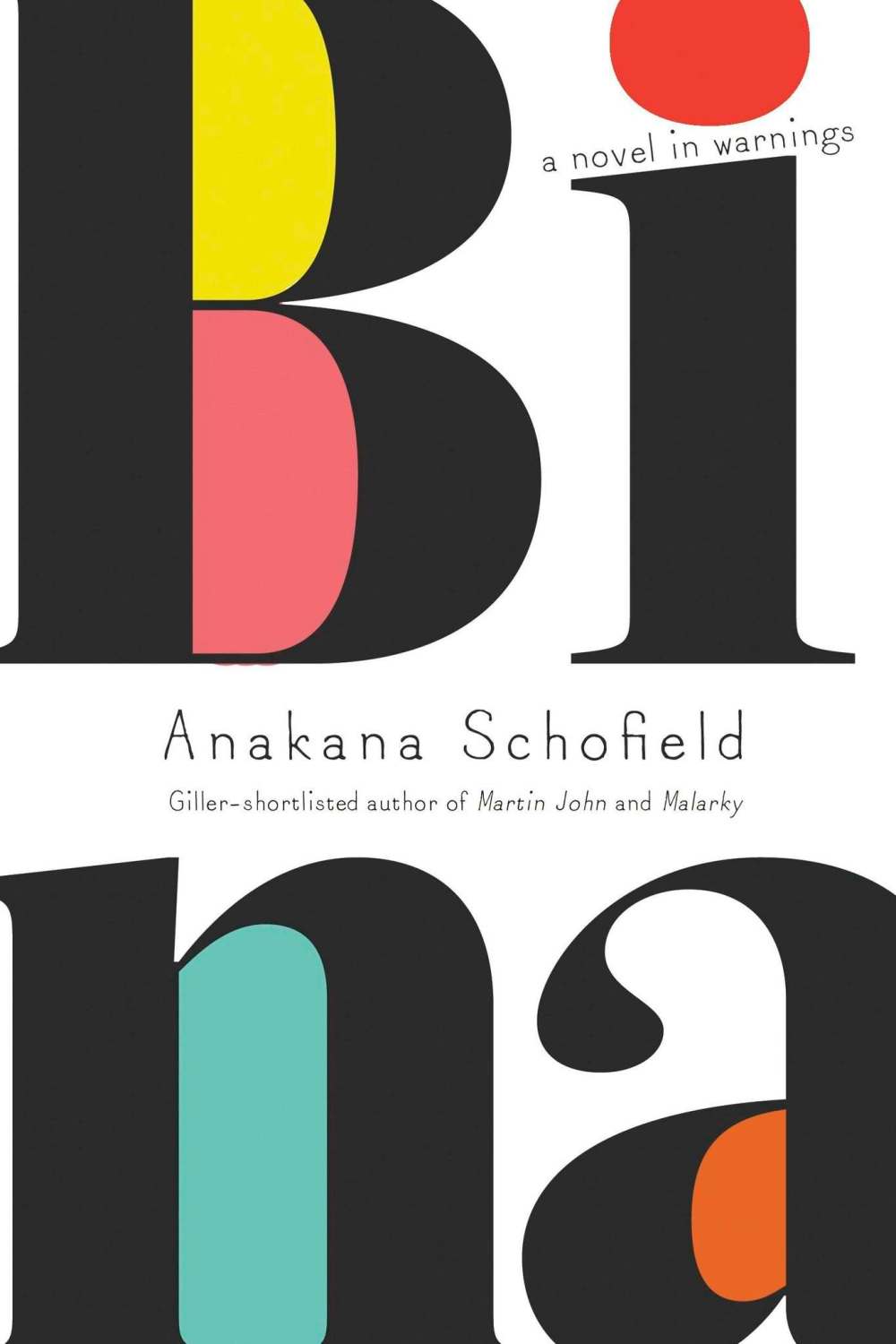
“My name is Bina,” speaks the narrator of Anakana Schofield’s third novel, continuing, “I am a modern woman with modern thoughts on modern things.” Bina “expect(s) you won’t listen,” a possibility for potential readers of Schofield’s debut with a multinational publisher.
The Irish-Canadian novelist’s previous book, Martin John (2015), was about a flasher and a groper, a euphemizer rendered in fractured stream-of-thoughtlessness, and managed to be sympathetic to its protagonist and to John’s female victims while also being, well, funny. Apart from the awards, which Canadian readers and publishers often confuse with an indication of quality, the real sign of something in the Irish brogue was the raves in the Guardian and New York Times. Those reviewers don’t necessarily care about a book getting shortlisted for an award sponsored by a Canadian bank, but they have functioning talent detectors.
If you laughed out loud at Martin John while being a bit disturbed at your own response, you will love Bina (pronounced “Bye-na,” as the narrator informs us). The titular character comes out of Schofield’s equally caffeinated debut, 2012’s Malarky. As with the two earlier novels, Schofield is willing to play with reader expectations in ways reminiscent of early modernism, harkening back more to Samuel Beckett’s novels than James Joyce or Virginia Woolf. The wordplay and dives off the realist board are not as extreme as Beckett’s, but Schofield does deliver pages written in short lines, like poems, and constant shifts between third- and first-person perspectives, tilted towards Bina. Those short lines have a realist excuse — Bina writes them on the back of the narrow bills of the Irish utility company ESB.
But Schofield knows she is having fun with us, going into self-mockery on her own behalf and her protagonist’s when she writes: “Bina’s not for difficult books. / Life is full of difficulty, so if she were ever to lie down and take up a book, it couldn’t be a difficult one.”
As for the storyline, it concerns Bina’s legal troubles as a result of her involvement with a voluntary-assisted-suicide group and her tangled relationship with Eddie, whom she took in when he was injured and kicked out when he became obnoxious and violent. There are only a few characters, little plot and not much in the way of conventional narration.
So, while Bina correctly reads her own narrative as one that is not “difficult,” not everyone will find this book easy. Those willing to simply enjoy the narrator’s voice will be amply rewarded, as in this medico-theological commentary: “I’ve no explanation as to why men are up piddling all night too, except perhaps it’s God’s subtle way of tormenting them. He goes straight for the pipe does our Saviour.”
Since the early 20th century and those aforementioned literary geniuses, the novel has bifurcated into two streams, one of which pretends that modernism never happened. Readers of the second stream, which floods Canadian literature, happily relive the innovations of Victorian novelists such as Charles Dickens, revelling in the latest epic family history in door-stopping and forest-killing packages.

Such readers may find it hard to engage emotionally with Bina, who not only has nocturnal visits from David Bowie, but also comments astutely, like the feisty feminist she is: “Find me the woman in Dickens who is allowed to be utterly miserable.” The rest of us will laugh and be warned.
Maurice Mierau is a Winnipeg writer who loves Dickens and Beckett.
History
Updated on Monday, June 24, 2019 9:50 AM CDT: Corrects spelling, punctuation error.