WEATHER ALERT

Choice cuts

Essays on human's animal consumption offer food for thought

Advertisement

Advertise with us

Do you ever consider that some foods you constantly crave come from animals purposefully killed for your consumption? Should you care that raising animals for food has become a factor in climate change?

Read this article for free:

or

Already have an account? Log in here »

To continue reading, please subscribe:

Subscribe and receive a limited-edition Free Press branded hat or tote.

Digital Subscription

One year of digital access for only $205*

  • Enjoy unlimited reading on winnipegfreepress.com
  • Read the E-Edition, our digital replica newspaper
  • Access News Break, our award-winning app
  • Play interactive puzzles

*First annual payment billed as $205.00 + GST for one year. This annual subscription will automatically renew at $233.00 + GST every 52 weeks (10% off the regular annual price of $259.35). Offer available to new and qualified returning subscribers only. Cancel any time.

To continue reading, please subscribe:

Add Free Press access to your Brandon Sun subscription for only an additional

$1 for the first 4 weeks*

  • Enjoy unlimited reading on winnipegfreepress.com
  • Read the E-Edition, our digital replica newspaper
  • Access News Break, our award-winning app
  • Play interactive puzzles
Start now

*Your next Brandon Sun subscription payment will increase by $1.00 and you will be charged $17.95 plus GST for four weeks. After four weeks, your payment will increase to $24.95 plus GST every four weeks.

Hey there, time traveller!
This article was published 13/06/2020 (2221 days ago), so information in it may no longer be current.

Do you ever consider that some foods you constantly crave come from animals purposefully killed for your consumption? Should you care that raising animals for food has become a factor in climate change?

These and other ethical, cultural and socio-ecological aspects of individual and group diets form part of another worthwhile addition to a growing list of food conscious eco-books focusing on the beef industry.

Although packaged as efficiently and attractively as barbecue-ready meat cuts, Green Meat? may similarly be an unfortunate disappointment to some consumers.

Jeff McIntosh / The Canadian Press files
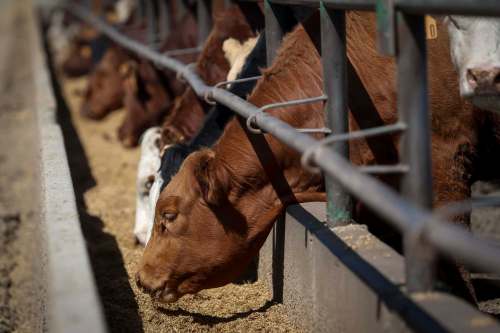
Raising animals such as cattle for human consumption has proven to be a major contributor to greenhouse gases.
Jeff McIntosh / The Canadian Press files Raising animals such as cattle for human consumption has proven to be a major contributor to greenhouse gases.

It does shine a bright light on the quandary posed by humans — we’re increasingly attracted to the taste of animal protein, yet at the same time raising these animals for our consumption is shown to be a major contributor to greenhouse gases.

Ryan Katz-Rosene is assistant professor at the University of Ottawa with an interest in climate policies; Sarah Martin researches the environmental impact of global food production and trade in animal feed at Memorial University in St. John’s, N.L.

The co-editors feel “green meat” means eating less meat, embracing dietary shifts from animal-based protein to plant-based protein and, most importantly, shifting away from a food system currently relying on mega-farms and giant, consolidated food distributors.

Contributors to this erudite study represent Canadian food producing regions and include food-system advocates, farm-training consultants, university professors and PhD candidates. They all share an interest in “sustainable animal agriculture” and were asked by the editors to address a three-part topic: “Think carefully about what you eat, where it comes from, and how it was produced.”

While copiously documented, their reports remind readers of the old adage concerning two opposing orators who leave the audience perplexed by their three opinions; in spite of carefully documented arguments — including the introductory and summative contributions by Katz-Rosene and Martin — the existential problem of maintaining a reliable supply of protein-rich food on a warming planet still begs a practical solution.

This extensive collection of reports confirms the difficulty in achieving what the subtitle suggests, since any solution to food sustainability lies in the complicated intertwining of billions of human protein eaters with even more billions of animals now sharing a home threatened by global warming.

One contributor suggests that increasing trends to consume animals merely represent the “meatification” of required protein people need to survive, reminding us that since 1960 the number of animals raised for food has quadrupled, with actual numbers killed annually “racing towards 120 billion.”

The increased consumption of animal protein is meticulously detailed, exposing animal husbandry’s negative effects on the environment and revealing how huge corporate farms put a strain on land areas and water resources, while sewage disposal problems and greenhouse gases emitted by ruminants add to climate change concerns.

A “grazing management” case study suggests there could be an alternative to factory farms, showing how smaller producers can keep animals fed on natural grasses instead of keeping them confined, force-feeding them on grain and then hurrying them to slaughterhouses.

Another report details how encouraging more Indigenous people worldwide to maintain traditional diets is economically and environmentally sustainable and higher in nutritional value than commercial foods, using the “eco-carnivore diet” of moose and fish as implemented in Manitoba’s Garden Hill First Nation as an example.

Ways of curtailing our reliance on animal protein are also touted, such as plant-based meat substitutes which, along with technological breakthroughs in “cellular agriculture” and “in-vitro meats,” show the potential for creating meat and dairy products without using actual animals.

Although raising animals for meat is shown to be unsustainable in its present form, alternatives offered in Green Meat? are just forks in the road toward a better future and require famed Yankee catcher and aphorism guru Yogi Berra’s practical wisdom.

Perhaps vegans are, in fact, taking the high road.

Joseph Hnatiuk is a retired teacher admittedly partial to bacon burgers.

Report Error Submit a Tip

More Stories

Steamy days and hot nights sizzle city

Marsha McLeod 4 minute read Preview

Steamy days and hot nights sizzle city

Marsha McLeod 4 minute read Updated: 7:55 AM CDT

Hot, humid temperatures continued to grip Winnipeg Sunday with “dangerous” heat — feeling like low to mid-40s — anticipated to last into Monday.

The nighttime temperature Sunday was expected to be close to record setting. The anticipated overnight low of 27 C would mark the second warmest on record in Winnipeg since a 28 C low was recorded during the Dust Bowl of the 1930s, said a Winnipeg-based meteorologist with Environment and Climate Change Canada.

“A hot day is one thing, but a hot night is a totally other thing. If you don’t have air conditioning, (Sunday’s) going to be the really hard night,” said Brad Vrolijk.

Vrolijk also said it’s unusual is for such high temperatures to be combined with high humidity, calling the mix a “dangerous heat.”

Read
Updated: 7:55 AM CDT

First-aid volunteers treat folk fest attendees suffering from heat

Eva Wasney and Jill Wilson 4 minute read Preview

First-aid volunteers treat folk fest attendees suffering from heat

Eva Wasney and Jill Wilson 4 minute read Yesterday at 11:16 PM CDT

Shade was at a premium at Birds Hill Provincial Park over the weekend as Winnipeg Folk Festival goers tried to keep cool during an extreme heat wave.

Heat warnings were issued across southern Manitoba and temperatures peaked at 35 C Sunday afternoon.

First-aid volunteers were seen administering cold compresses to several overheated attendees. STARS air ambulance responded to a medical call at the park on Saturday night, but did not transport the patient to hospital. By Sunday at noon, EMS had been called to the festival nine times.

“This is not an unusual number of calls for us or other events of our size,” festival executive director Valerie Shantz said.

Read
Yesterday at 11:16 PM CDT

Would-be mayors respond to extreme heat

Marsha McLeod 3 minute read Preview

Would-be mayors respond to extreme heat

Marsha McLeod 3 minute read 7:00 AM CDT

With Winnipeg in the midst of an intense heat wave, the city has yet to introduce maximum heat legislation for rental housing.

In 2023, the Free Press and the Narwhal reported on calls by tenants and environmental advocates to enact a law that would require indoor temperatures in rental units not exceed 26 C. It would be similar to how Winnipeg landlords, under the city’s neighbourhood livability bylaw, must maintain a minimum daytime temperature of 21 C during cold weather.

On Sunday, the Free Press emailed all nine registered mayoral candidates asking for their policy plans to tackle the dangers of extreme heat, and specifically, whether they would support a change to the city’s bylaw to create heat protections for renters.

Eight candidates responded, and of them, six — Noah Redden, Don Woodstock, Mazher Alam, Christopher Clacio, Michael Vogiatzakis and Umar Hayat — said they would support (or support exploring) a bylaw amendment to establish a maximum indoor temperature threshold.

Read
7:00 AM CDT

Former fashion mogul Peter Nygard found guilty of sexual assault in Montreal

Erika Morris, The Canadian Press 3 minute read Preview

Former fashion mogul Peter Nygard found guilty of sexual assault in Montreal

Erika Morris, The Canadian Press 3 minute read Updated: 2:14 PM CDT

MONTREAL -  A Court of Quebec judge in Montreal has found fashion mogul Peter Nygard guilty of sexual assault and forcible confinement.

The 84-year-old, who founded the now-defunct women's apparel company Nygard International, accepted a plea deal and did not present any evidence in his defence Monday. He appeared via video call from an Ontario prison.

The Quebec case is separate from Nygard's conviction in Toronto, where he was found guilty in 2023 of four counts of sexual assault and sentenced to 11 years in prison.

Quebec Crown prosecutor Jérôme Laflamme said Nygard's plea was unexpected and he was prepared for a 10-day trial before a judge only.

Read
Updated: 2:14 PM CDT

If it works in Ontario, why not in Manitoba?

James Wilt 5 minute read Preview

If it works in Ontario, why not in Manitoba?

James Wilt 5 minute read 2:00 AM CDT

Grid-scale battery storage has fundamentally changed the global energy landscape — and Manitoba needs to get on board.

Battery systems store large amounts of excess electricity for when it’s most needed. While they can be charged from any generation source, they are especially beneficial for integrating wind and solar power, which vary with weather and time of day. Batteries allow electrical grids to meet the need for firm, dispatchable and affordable capacity using renewable energy, rather than relying on coal, nuclear and fossil gas. They also provide numerous other benefits, including reducing overloading of transmission infrastructure and helping to regulate the grid’s frequency and voltage.

Average costs for grid-scale batteries plummeted by more than half between 2023 and 2025 and installations have skyrocketed in China, the U.S., Australia and Europe. Texas now has 16,500 megawatts (MW) of battery storage, while California has 15,200 MW. Closer to home, Ontario recently awarded 640 MW of contracts to three battery storage projects in a competitive auction, with batteries beating out fossil gas-fired power plants on cost every time. One of these projects will be built near Dryden, only four hours east of Winnipeg.

Each battery system will provide eight hours of capacity but will cost considerably less than Ontario’s previous battery procurements, which provide only four hours of capacity. With this latest auction, Ontario has now secured 3,600 MW of battery storage capacity, including the operational Oneida (250 MW), Hagersville (300 MW) and Napanee (250 MW) projects. Almost all have significant Indigenous participation, with the latest procurements boasting 50 per cent First Nations ownership.

Read
2:00 AM CDT

Former Manitoba MP charged with firearms offences

Tyler Searle 4 minute read Preview

Former Manitoba MP charged with firearms offences

Tyler Searle 4 minute read Updated: 12:10 PM CDT

A former member of Parliament from Manitoba has been charged after a stockpile of ammunition and firearms — including an antique cannon — and $300,000 in cash were seized from a Dauphin home last week.

Manitoba RCMP charged Inky Mark, 78, with a dozen firearms-related charges, including firearms trafficking, possession of property obtained by crime, unsafe storage and careless use of a firearm.

In total, RCMP seized 439 firearms from Mark’s property, Mounties said at a news conference Monday morning.

It is expected to take investigators weeks to sort through the arsenal and determine how many of the weapons were illegally possessed, but police have already identified three guns that are believed to have been illegally trafficked, and one that had a tampered serial number, RCMP Cpl. Barry Kirby said.

Read
Updated: 12:10 PM CDT