Dammed if you do
Transformation of Winnipeg River system had profound impact on Indigenous community
Advertisement
Read this article for free:
or
Already have an account? Log in here »
To continue reading, please subscribe:
Digital Subscription
One year of digital access for only $1.44 a week*
- Enjoy unlimited reading on winnipegfreepress.com
- Read the E-Edition, our digital replica newspaper
- Access News Break, our award-winning app
- Play interactive puzzles
*Billed as $5.77 plus GST every four weeks. After 52 weeks, price increases to the regular rate of $19.95 plus GST every four weeks. Offer available to new and qualified returning subscribers only. Cancel any time.
To continue reading, please subscribe:
Add Free Press access to your Brandon Sun subscription for only an additional
$1 for the first 4 weeks*
- Enjoy unlimited reading on winnipegfreepress.com
- Read the E-Edition, our digital replica newspaper
- Access News Break, our award-winning app
- Play interactive puzzles
*Your next Brandon Sun subscription payment will increase by $1.00 and you will be charged $17.95 plus GST for four weeks. After four weeks, your payment will increase to $24.95 plus GST every four weeks.
Read unlimited articles for free today:
or
Already have an account? Log in here »
Hey there, time traveller!
This article was published 23/01/2021 (2094 days ago), so information in it may no longer be current.
As a white settler male in Treaty 1 territory, I am highly aware that each time I turn on a light or use an appliance I am contributing to the degradation of the land and the peoples who have relied and thrived on this land for millenia. This realization runs parallel with my immense privilege, where I can pontificate about reconciliation and decolonization in theory. In the abstract.
But Anishinaabeg and University of Guelph scholar Brittany Luby forces the issue and compels settlers in Canada to think critically about the consequences of, in her words, “industrial enthusiasm and poor planning” in Treaty 3.
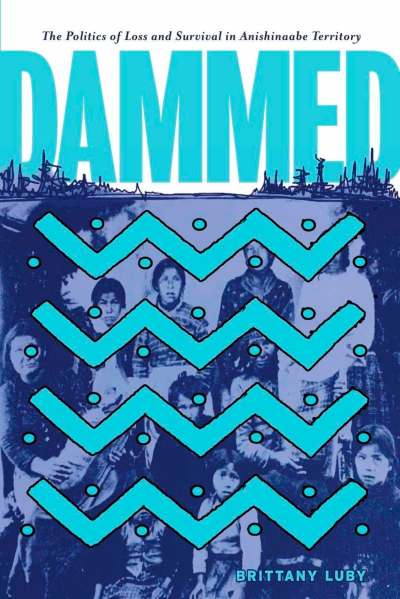
In Dammed: The Politics of Loss and Survival in Anishinaabe Territory, Luby offers a history, based on archival and oral resources, of the damming and transformation of the Winnipeg River system, all to the detriment of Indigenous people. A history of race, class, gender and labour, Dammed is also a compelling argument for an increased ability to think in systems and to think deeply about how a pathway to reconciliation needs to be bathed in historical reciprocity.

Drawing from archival work principally from the Kenora Daily Miner & News, church archives, autobiographical offerings, oral archives from elders from Dalles 38C (the author’s home reserve) and her own family, Luby surfaces how the damming of the Winnipeg River changed water levels, traditional ice roads, wild rice harvesting, family connection, labour practices and the toxicity of the water itself.
Through this, Luby dispels two myths. The first is one purported by historians such as Desmond Morton, Michael Bliss and J.M. Bumsted — that the postwar era was one of affluence for all Canadians. “Indigenous peoples did not form part of Canada’s affluent society after 1945,” Luby argues.
The second myth that is obliterated in Dammed is that the Anishinaabeg simply rolled over and submitted to colonization — that because there was no opportunity on the reserve, they succumbed to life in Kenora. According to Luby, her family and community not only sustained themselves on the land, even up to the 1950s, but also resisted colonization, despite being considered on the periphery by Ontario and Canada. Prior to major development in the mid 20th century, she writes, “[f]amilies responded creatively to settler-colonial activity, preserving the Anishinaabe Nation along a changed system until settler-colonists remodelled the river in 1950s.”
And it was in the 1950s, with the development of major hydroelectric projects along the Winnipeg River, that brought massive changes to the subsistence lifestyle that had existed for time immemorial. Not only did fish stocks begin to dwindle, but more industrialization raised mercury levels, forced men to work for HEPCO (Hydro-electric Power Commision of Ontario) and even altered the manner in which women could breastfeed. This resulted in the abandonment of reserves, such as Luby’s home of Dalles 38C, and the perpetual issues at Grassy Narrows due to critical levels of mercury.
And this is nothing new. Luby argues that in the 20th century, Anishinaabe world views were not taken into consideration, that “Anishinaabe men and women were to function as auxiliary — not foundational — members of national plans for economic growth.” We see this in the Canadian government’s present doublespeak when it comes to reconciliation and fossil fuel extractions. When Indigenous peoples resist in Canada, they are met with violence, while trivialized apologies are offered in posh and gilded cathedrals of justice.

Reconciliation is simply as a buzzword if settlers are not actively engaged in providing everyone with the means for a decent life. As Luby argues, “[u]nless we think critically about how continued energy use floods reserve lands, we risk thinking an apology is a cure.” Land grabs, poisoning, industrialization and ignorance have all benefited white settlers around Lake of the Woods and those who benefit from the “clean energy.”
Coming to terms with reconciliation means truly understanding the causes and consequences of western racial capital coupled with a desire on the part of settlers to remove barriers towards Indigenous reclamation. In Dammed, Brittany Luby illuminates the reality that settlers then and now “sought to harness the water for hydroelectricity, whereas the Anishinaabeg worked to uphold Treaty 3 and protect the environmental relationships that it guaranteed.”
Perhaps our work is to be accomplices in the upholding of all treaties. Now and forever.
Matt Henderson is assistant superintendent of Seven Oaks School Division.