Stitching together a city
Garment trade fuelled gains in Winnipeg's commerce, wages and, oddly, workers' rights
Advertisement
Read this article for free:
or
Already have an account? Log in here »
To continue reading, please subscribe:

Digital Subscription
One year of digital access for only $205*
- Enjoy unlimited reading on winnipegfreepress.com
- Read the E-Edition, our digital replica newspaper
- Access News Break, our award-winning app
- Play interactive puzzles
*First annual payment billed as $205.00 + GST for one year. This annual subscription will automatically renew at $233.00 + GST every 52 weeks (10% off the regular annual price of $259.35). Offer available to new and qualified returning subscribers only. Cancel any time.
To continue reading, please subscribe:
Add Free Press access to your Brandon Sun subscription for only an additional
$1 for the first 4 weeks*
- Enjoy unlimited reading on winnipegfreepress.com
- Read the E-Edition, our digital replica newspaper
- Access News Break, our award-winning app
- Play interactive puzzles
*Your next Brandon Sun subscription payment will increase by $1.00 and you will be charged $17.95 plus GST for four weeks. After four weeks, your payment will increase to $24.95 plus GST every four weeks.
Read unlimited articles for free today:
or
Already have an account? Log in here »
Hey there, time traveller!
This article was published 19/06/2021 (1874 days ago), so information in it may no longer be current.
Excerpt from Winnipeg historian Jim Blanchard’s Thinking Big: A History of the Winnipeg Business Community to the Second World War (Great Plains Publications). A virtual book launch is scheduled for July 7, 7 p.m.
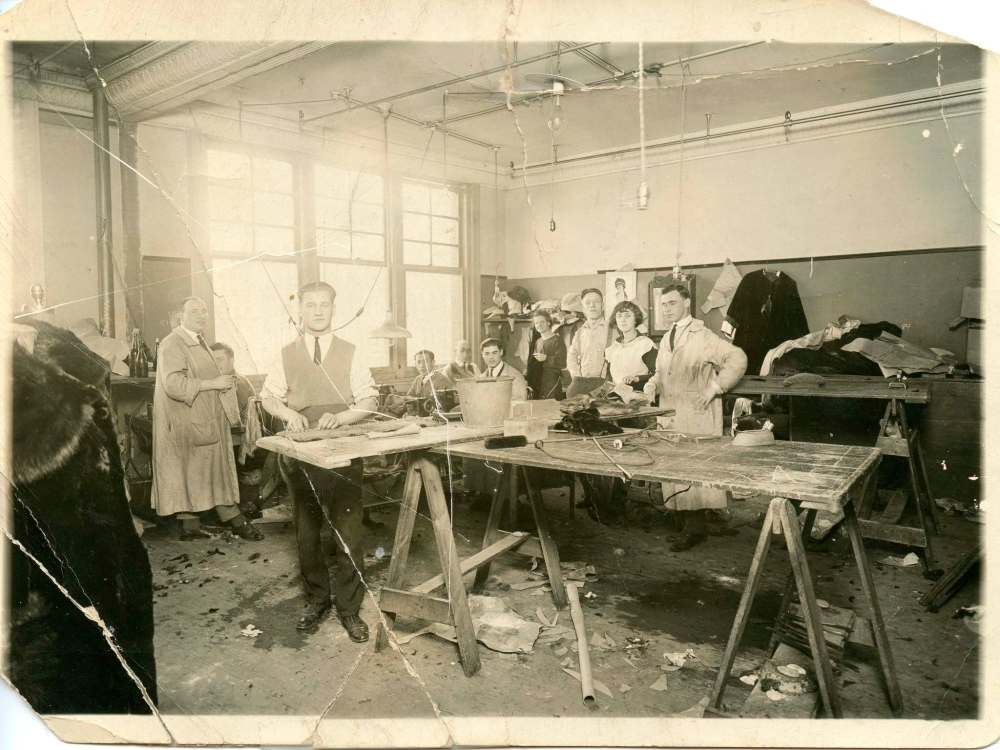
The first three decades of the 20th century saw a remarkable growth in Winnipeg. The centre of the city developed as a wholesale, retail, banking, garment and grain industry district. The large warehouses proved to be ideal for the small factories that now began to locate in the area. The manufacturers of candy, biscuits, cigars and clothing found homes in the warehouses. But the most important tenants in the big warehouses were the garment industry firms that became increasingly common in the district. The garment trade flourished in Winnipeg because workers skilled in the clothing business were available.
● ● ●
By 1929, there were more than 200 firms in operation. Most were concentrated in the area bounded by Notre Dame, William, and Portage avenues and Hargrave and Main streets. The area farther west, along McDermot as far as Dagmar, Ellen, and Lydia was home to fewer businesses. East of Main Street the area bounded by Main and the Red River along Market, Higgins and Pioneer avenues had only about 20 factories. During the 1920s, the local industry survived and grew in spite of eastern factories in Montreal and Toronto dumping their surplus production here. The market for work clothes declined somewhat and Winnipeg factories turned to men’s and ladies’ ready-to-wear clothing, although Winnipeg-made overalls were still sold all across the West.
During the 1930s, the garment industry was one of the few areas that saw growth in Winnipeg. It doubled in size in the number of workers, wages paid and production. There were many more firms belonging to Jewish owners in the 1930s. Many factories were located close to one another in the area between Main and Hargrave, Portage and Higgins so the managers tended to meet often over lunch. Although they were competitors, they worked together in the Garment Manufacturers Association (GMA) to discourage unionization and to co-operate in areas such as cloth purchases. Because they had a common background, Jewish business owners tended to support each other and they worked together to support institutions in the Jewish community.
In the 1930s the garment firms were faced with competition from the Eaton’s garment factory, a large producer of clothes located in the company’s Catalogue Department on Graham Avenue. The Hudson’s Bay Company also maintained a special clothing shop for railway workers in the basement of their store. Smaller chain stores, such as Woolworths, came to dominate clothing retail in the 1930s and their buyers had the power to push down prices, forcing some of the smaller factories out of business by demanding lower prices.
Retailers in the 1930s preferred to make small orders to lower the amount of money tied up in merchandise at any one time. They tended to deal with local Winnipeg manufacturers who could provide them with small shipments and who were knowledgeable about their needs. Eastern firms, struggling because of the Depression, dumped their products in the west at low prices but this threat was met by the GMA firms co-operating on prices.
Unionization became an important issue for the industry. In the early 1930s, many of the garment workers belonged to the Industrial Union of Needle Trades Workers (IUNTW). This union was affiliated with the Communist party and tried to address problems such as layoffs, poor working conditions and wage cuts, which were used by the garment industry to cut costs. There was a sense of camaraderie in the union and, as historian Jodi Giesbrecht has shown, union activities were a way for immigrant women to join forces with fellow workers and become more integrated into the community.
Many manufacturers did not want unions in their factories. Jacob and Crawley said they preferred to negotiate with a committee of their workers and not with the union organizers. A story told by Jacob Weinberg, a Jacob and Crawley employee, illustrates why the workers wanted unions. Weinberg checked his pay envelope one payday and found that instead of $29, his usual wage, he was paid $24. He went to see Ben Jacob who told him he could leave if he did not like the pay. Weinberg found another job that paid $32. When he got back to Jacob and Crawley, Jacob asked why he wanted to go and told him he could not leave. He said the managers had an agreement that they would not hire staff away from each other. This was confirmed by his new boss who told him he could not hire him because of the agreement. So he stayed on at Jacob and Crawley. The partners had been negative about unionization. When tailors working for Jacob had earlier tried to unionize he simply locked them out.
In February 1931 there was a strike at the Jacob and Crawley factory in the Keewayden Building on Portage Avenue East. The issues were wage cuts the management had imposed as well as the firing of several employees. The cloak makers went on strike first and then were followed by dressmakers. The strike was organized by I. Minster of the IUNTW. After three weeks, on Feb. 20, there was a meeting of the two sides. Ben Jacob and J.H. Crawley came with S. Hart Green, a lawyer who often represented the garment manufacturers.
The meeting was not a success. On Feb. 17, city council had set up a committee to help with negotiations. It consisted of Mayor Webb, and included aldermen John Blumberg and Morris Gray.
Two days later the union held a mass meeting in the Queen’s Theatre on Selkirk Avenue. Minster hinted about having approval for a general strike in the industry. In the end the union decided conditions were not right for such a strike. The next day J.H. Crawley announced that as far as he was concerned the strike was over. New workers had been hired to replace the strikers and production was in “full swing.” He said he did not see any point in wasting more time meeting with delegates who were just “stalling.” He informed the mayor that the company was withdrawing from further attempts to settle the dispute. Webb expressed regret at the abrupt end of negotiations.
Some of the striking workers had not returned to work, but Crawley said that with 30 per cent to 40 per cent of positions filled the company could resume work without them. He told strikers they would be taken back as jobs became available but people hired during the strike would be kept on.
In 1934 there was another strike involving a number of the local garment factories and a total of 450 workers. Once again the issues were working conditions, the union demands being wage increases of 15 per cent for workers earning more than $20 a week and 20 per cent for those earning less than $20. They were asking for time and a half pay for overtime and for work on legal holidays. And they wanted the firms to formally recognize the workers’ shop committees and their right to organize with a union of their choice. The strike lasted over a month and tempers became frayed. Several strikers were charged for attempting to prevent workers from entering the various factories to go to work.
The fact that the IUNTW had connections to the Communist party was again used to attack the organization. Mayor Webb said he was happy to work for fair wages for garment workers but he warned the strikers not to listen to the “poisonous schemes of the Communists.”
The strike failed and was called off after six weeks and once again, no gains were made by the workers and employees hired as replacements during the strike were kept on. Wages continued to be among the lowest in Canada. Workers were expected to work overtime without additional pay.
At the end of 1934, an organizer for the International Ladies Garment Workers’ Union (ILGWU) arrived in Winnipeg. One account claims that he was invited to come by leaders of the workers and by some of the owners of firms. The ILGWU was affiliated with the American Federation of Labour, and was less radical in its approach than the Communist unions. The Winnipeg Trades and Labour Congress supported their campaign to sign up members and they were eventually successful in replacing the IUNTW in Winnipeg.
Sam Herbst, the local organizer for the international union, met with factory owners and held out the prospect of there being no more strikes if all the workers were represented by his union. Herbst’s less militant style was criticized for being too friendly with the bosses. He was, however, successful in organizing most of the Winnipeg workforce. One of the first contracts he negotiated was with Jacob and Crawley and it included a $1 raise for all workers, a 44-hour week, dropping to 42 hours in the second year, plus time and a quarter payments for overtime. Other owners were soon happily leaving labour relations to Herbst so the endless labour strife would end. Herbst often worked with former Communist union executives, using their organizational skills to get the locals set up.
The firms that managed to survive the Depression profited during the Second World War. The larger firms such as Jacob and Crawley won contracts for uniforms and battle dress from the armed forces.
Their factory produced a total of 75,000 great coats in the Keewaydin Building on Portage Avenue East. Firms began to use assembly line methods in order to handle large orders and subcontracted work to other garment manufacturers. They were paid well and used their profits to modernize their factories and buy new equipment. The industry continued to flourish and by the 1960s the Winnipeg garment sector was the third largest in Canada after Toronto and Montreal.