Power play
Putin’s rise to power chronicled in incisive graphic novel

Advertisement
Read this article for free:
or
Already have an account? Log in here »
To continue reading, please subscribe:

Digital Subscription
One year of digital access for only $205*
- Enjoy unlimited reading on winnipegfreepress.com
- Read the E-Edition, our digital replica newspaper
- Access News Break, our award-winning app
- Play interactive puzzles
*First annual payment billed as $205.00 + GST for one year. This annual subscription will automatically renew at $233.00 + GST every 52 weeks (10% off the regular annual price of $259.35). Offer available to new and qualified returning subscribers only. Cancel any time.
To continue reading, please subscribe:
Add Free Press access to your Brandon Sun subscription for only an additional
$1 for the first 4 weeks*
- Enjoy unlimited reading on winnipegfreepress.com
- Read the E-Edition, our digital replica newspaper
- Access News Break, our award-winning app
- Play interactive puzzles
*Your next Brandon Sun subscription payment will increase by $1.00 and you will be charged $17.95 plus GST for four weeks. After four weeks, your payment will increase to $24.95 plus GST every four weeks.
Read unlimited articles for free today:
or
Already have an account? Log in here »
Hey there, time traveller!
This article was published 26/02/2022 (1677 days ago), so information in it may no longer be current.
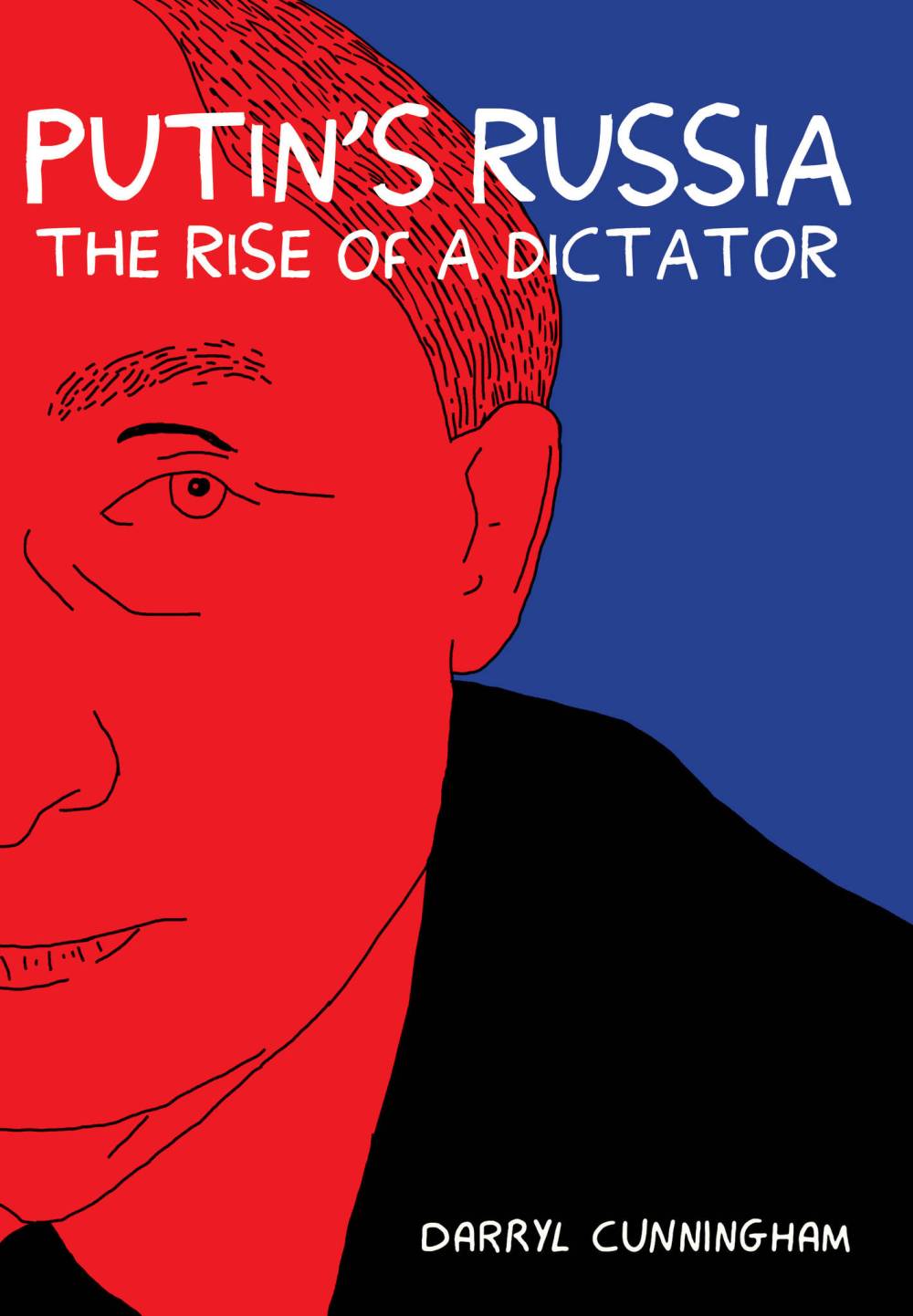
You’d be hard pressed to find a more timely release than Darryl Cunningham’s Putin’s Russia: The Rise of a Dictator. As Russian forces push into Ukraine, the situation changing hour by hour as the death toll rises, Cunningham combines starkly drawn images with no-nonsense text (and, admirably, a bit of humour) in a pull-no-punches account of Vladimir Putin’s rise to prominence and iron-fisted grip on power.
Granted, it’s not like Putin is just landing in the headlines for the first time as a result of actions ranging from questionable (see: various shirtless photo ops) to abhorrent. For years the 69-year-old Putin has been doing and taking what he wants, when he wants it, no matter what the cost — perhaps we in the West simply haven’t paying enough attention.
Cunningham’s 2021 graphic novel, Billionaires: The Lives of the Rich and Powerful honed in on Amazon’s Jeff Bezos, oil and gas men David and Charles Koch and media tycoon Rupert Murdoch. In his latest, the British cartoonist and author’s sights are squarely set on a man whose net worth is estimated at $200 billion, but is likely far higher.
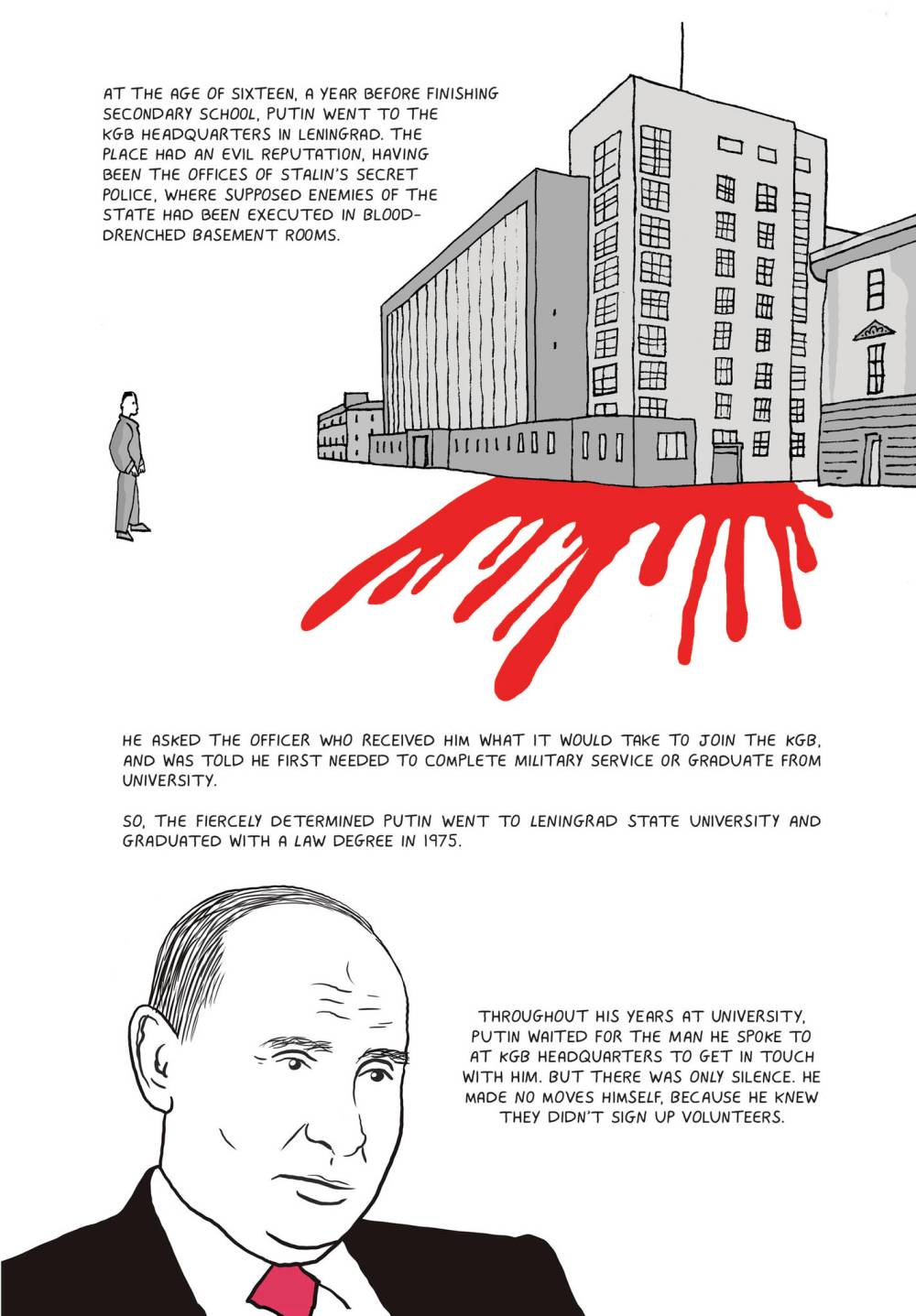
Working mostly chronologically through Putin’s life, Cunningham makes clear that little is known for certain about the early years — the bulk of what is known comes from a series of interviews Putin gave in 2000 and his subsequent memoir, First Person. Born Vladimir Vladimirovich Putin in 1952 in St. Petersberg (then Leningrad), young Putin was short in stature but scrappy and prone to vicious tactics when in a tussle.
Following in his father’s footsteps, Putin joined the KGB in 1975 after earning a law degree. After 10 years he was transferred to the KGB’s foreign espionage division and shipped to Dresden in what was then East Germany. Working with the East German secret police (the Stasi), Putin recruited people in business and science to pass along technological information that was then sent back to the Soviet Union.
After the fall of the German Wall in 1989 and the reunification of East and West Germany, Putin and his wife Lyudmila returned to Russia, where Putin worked in academia before beginning his political career in the Leningrad city council. The Soviet Union under Mikhail Gorbachev was crumbling thanks in large part to sweeping reforms made by the president. In late 1991 Gorbachev left office and Boris Yeltsin took over what was left of the former Soviet Union, now the Russian Federation.
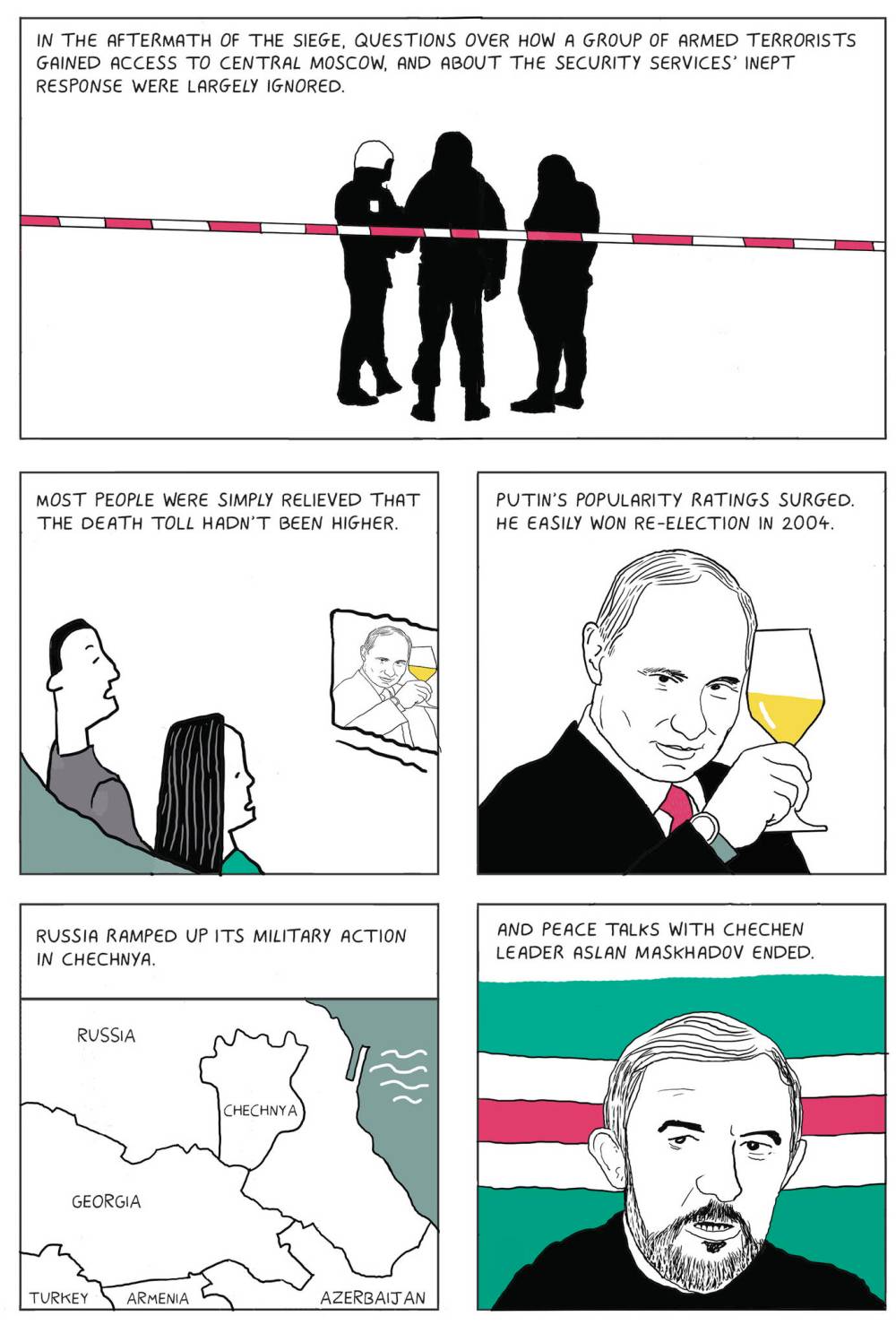
Putin returned to Moscow in the mid-1990s, dodging allegations of corruption running rampant through Leningrad civic politics. And as Yeltsin spiraled downward through a haze of alcohol, health issues, an attempted impeachment and the Chechen War, he turned to Putin, then the head of the Federal Security Service (the KGB’s successor), as a potential successor. In 1999 Putin was appointed prime minister. Yeltsin resigned late that year, appointing Putin as president — and his reign of power and terror officially began.
Five years later, Putin flexed his political muscles in ordering the annexation of the Crimean Peninsula from Ukraine. While the section on Ukraine in Cunningham’s book is a relatively small piece of Putin’s Russia, it offers a swift primer on the seeds of current invasion’s origins. (For an interview with Cunningham and to see the pages on Ukraine, website The Tyee has both online to read at wfp.to/thetyee.)
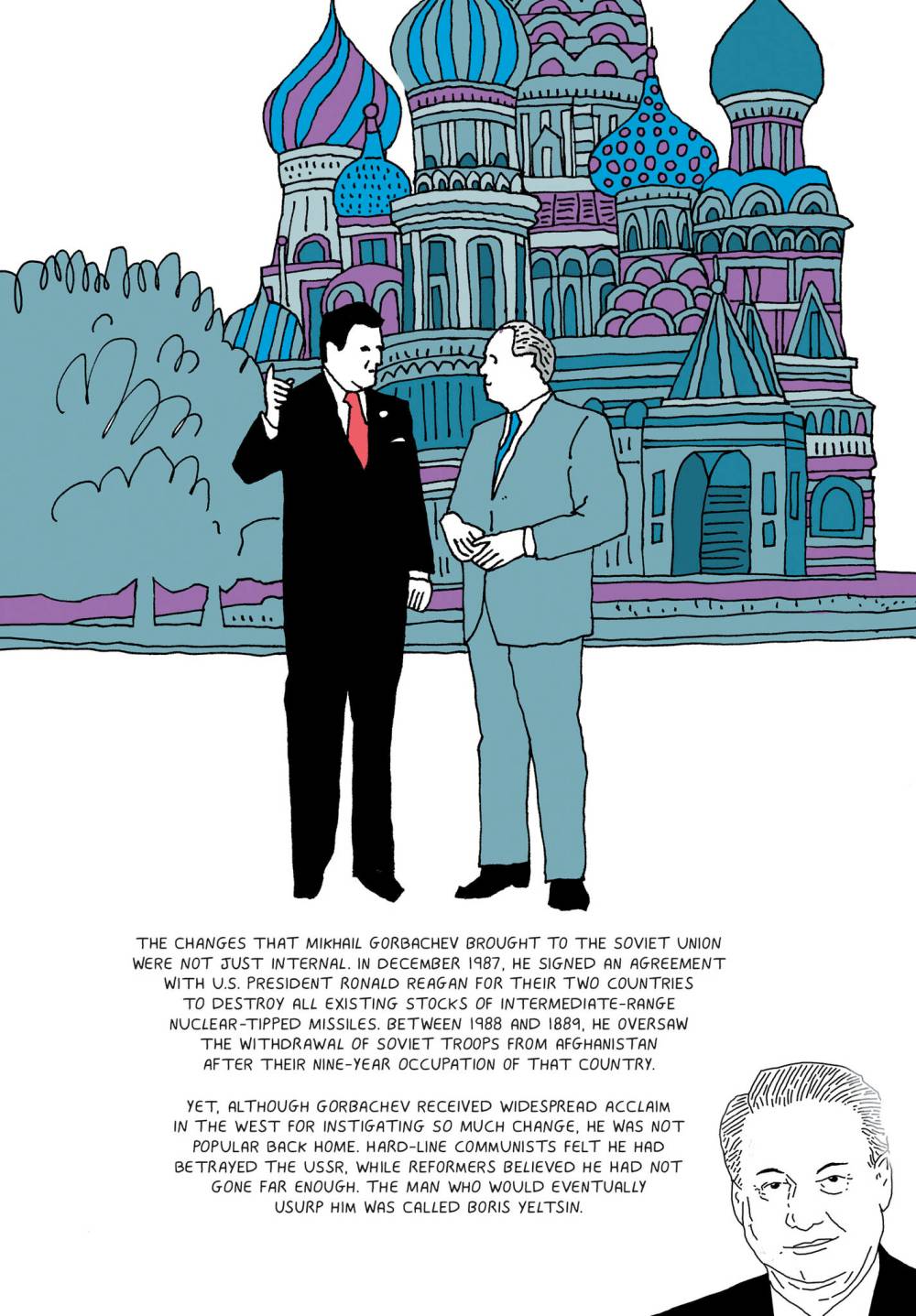
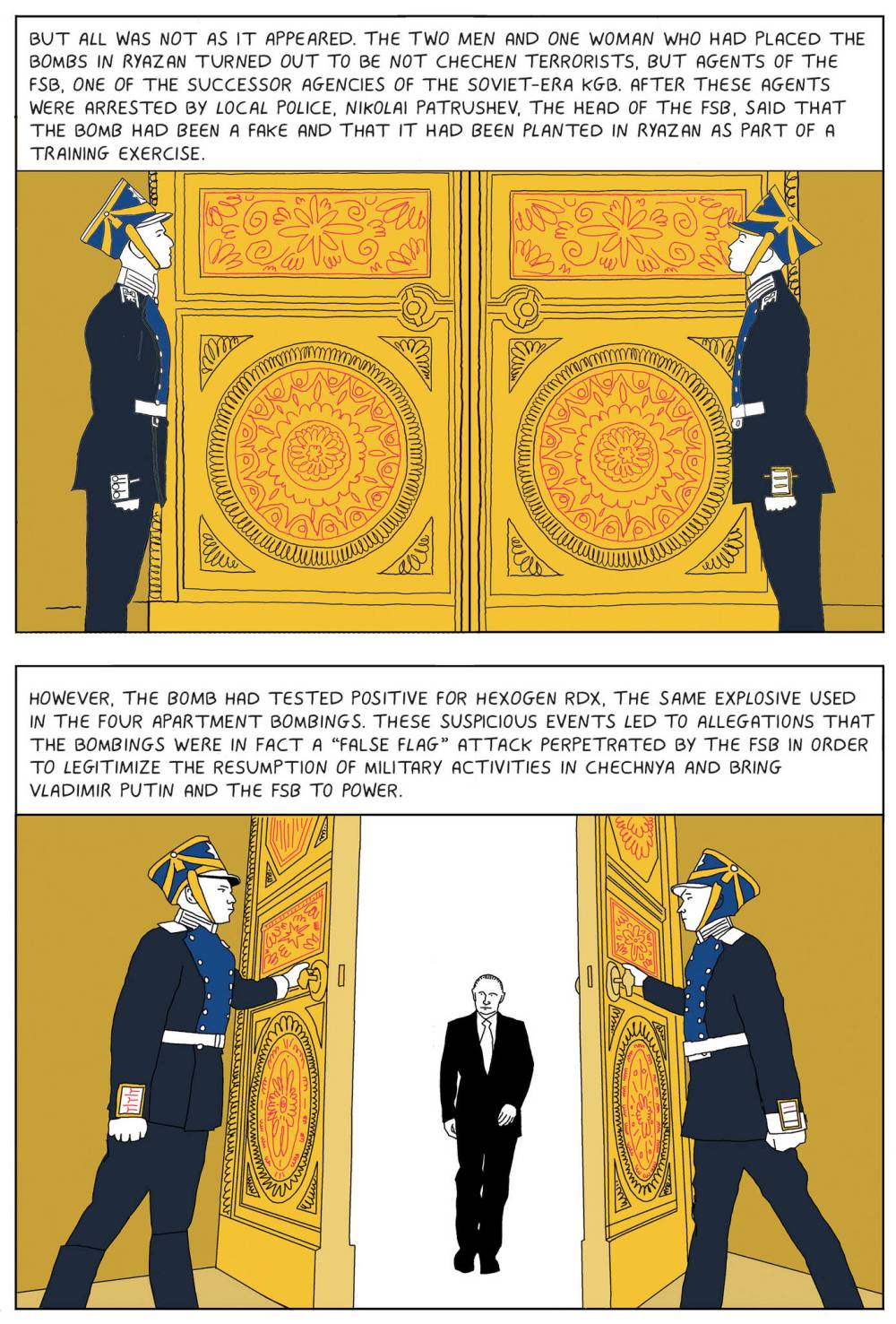
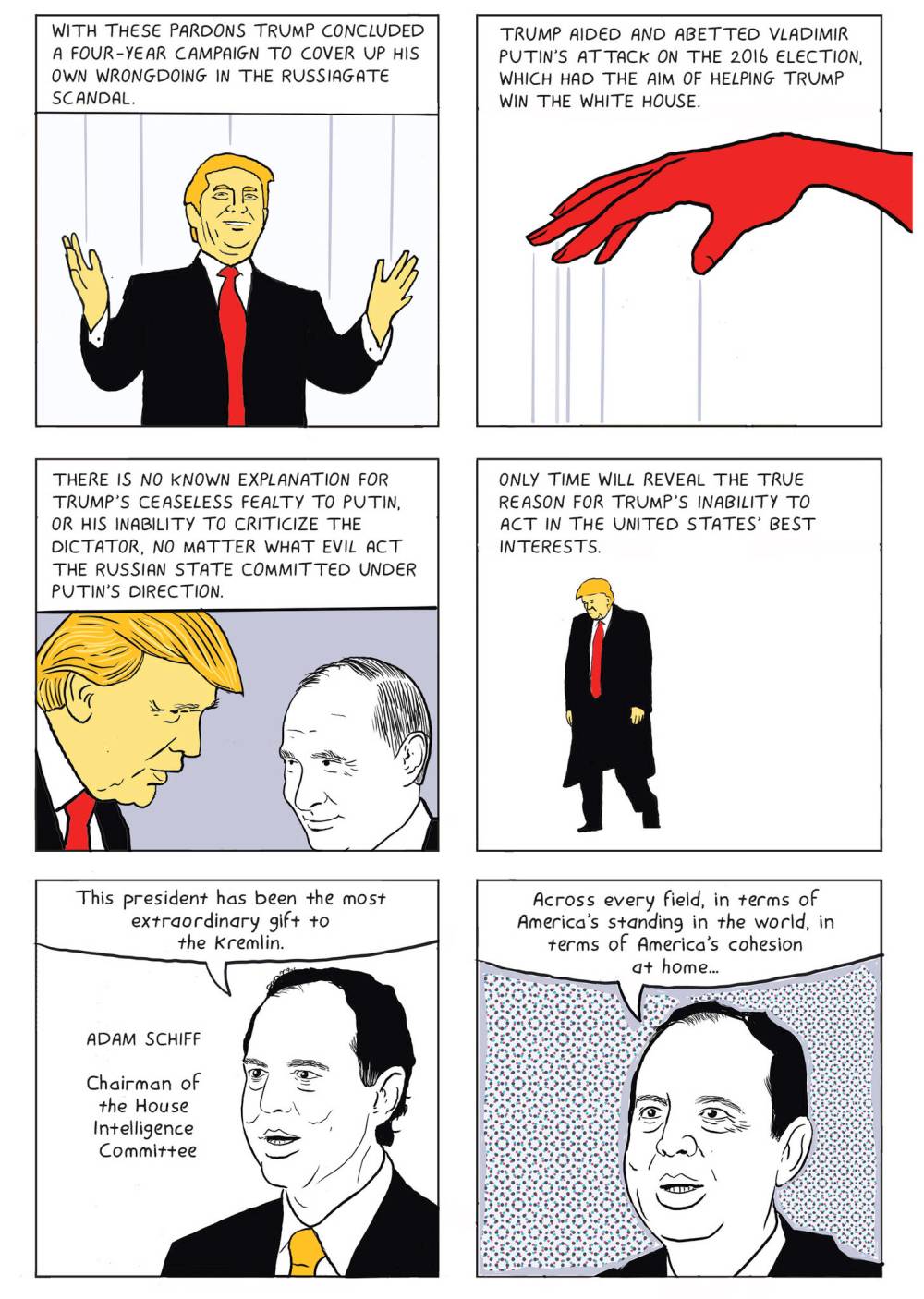
Throughout Putin’s Russia, Cunningham’s drawings vary between stunningly lifelike and realistic portrayals of specific key individuals and more abstract, angular caricatures of larger crowds, everyday people and the like. Splashes of colour highlight particular scenes, with primarily black-and-white faces drawn simply but evocatively. And while the amount of text in this graphic novel might initially seem excessive, it’s clear, well-written and, when combined with the visuals and panel layouts, makes for a propulsive read.

It doesn’t ever take long for those who suffer Putin’s disapproval or stop fulfilling specific needs to turn up dead — some from apparent heart attacks, others poisoned, others still gunned down in the street. Throughout Cunningham’s book bodies of former allies, Russian oligarchs, political opponents and other key characters pile up, sometimes splayed out near or atop blood-red splashes of colour after meeting a grisly end. All the while, in stark black and white Putin looms large over the political maneuverings and killings throughout the book, often smirking and peering across the pages menacingly.
One of the few primary actors to make an appearance in colour — a yellowish-orange, of course — is former U.S. president Donald Trump who, incredibly, deemed Russia’s invasion of Ukraine “genius” and Putin “savvy” just days ago. The 2016 election interference mess south of the border is given a quick look, with Trump’s supporting cast trotted out page by page and with the ex-president portrayed as a literal puppet of the Russian leader. It appears some things never change.
Cunningham offers a convincing, well-written, thoroughly researched and scathing take down of Vladimir Putin that’s visually gripping and easy to read. It’s as much a history lesson as it is a case against Putin, an ideal primer for anyone looking for background on how we got where we are today, and what we in the West may not have known or understood about the Russian president — if we were even paying attention at all.
Just don’t expect to come away from Putin’s Russia with much hope or optimism that the bloodshed in the current situation will be minimal.
Ben Sigurdson is the Free Press literary editor.

Ben Sigurdson
Literary editor, drinks writer
Ben Sigurdson is the Free Press‘s literary editor and drinks writer. He graduated with a master of arts degree in English from the University of Manitoba in 2005, the same year he began writing Uncorked, the weekly Free Press drinks column. He joined the Free Press full time in 2013 as a copy editor before being appointed literary editor in 2014. Read more about Ben.
In addition to providing opinions and analysis on wine and drinks, Ben oversees a team of freelance book reviewers and produces content for the arts and life section, all of which is reviewed by the Free Press’s editing team before being posted online or published in print. It’s part of the Free Press‘s tradition, since 1872, of producing reliable independent journalism. Read more about Free Press’s history and mandate, and learn how our newsroom operates.
Our newsroom depends on a growing audience of readers to power our journalism. If you are not a paid reader, please consider becoming a subscriber.
Our newsroom depends on its audience of readers to power our journalism. Thank you for your support.
Book review
Putin’s Russia:
The Rise of a Dictator
By Darryl Cunningham
Drawn & Quarterly, 164 pages, $30
Ben Sigurdson
Literary editor, drinks writer
Ben Sigurdson is the Free Press‘s literary editor and drinks writer. He graduated with a master of arts degree in English from the University of Manitoba in 2005, the same year he began writing Uncorked, the weekly Free Press drinks column. He joined the Free Press full time in 2013 as a copy editor before being appointed literary editor in 2014. Read more about Ben.
In addition to providing opinions and analysis on wine and drinks, Ben oversees a team of freelance book reviewers and produces content for the arts and life section, all of which is reviewed by the Free Press’s editing team before being posted online or published in print. It’s part of the Free Press‘s tradition, since 1872, of producing reliable independent journalism. Read more about Free Press’s history and mandate, and learn how our newsroom operates.
Our newsroom depends on a growing audience of readers to power our journalism. If you are not a paid reader, please consider becoming a subscriber.
Our newsroom depends on its audience of readers to power our journalism. Thank you for your support.
Advertisement Advertise With Us
Advertisement Advertise With Us