Mosienko’s life lauded in top-shelf account
Advertisement
Read this article for free:
or
Already have an account? Log in here »
To continue reading, please subscribe:
Digital Subscription
One year of digital access for only $1.44 a week*
- Enjoy unlimited reading on winnipegfreepress.com
- Read the E-Edition, our digital replica newspaper
- Access News Break, our award-winning app
- Play interactive puzzles
*Billed as $5.77 plus GST every four weeks. After 52 weeks, price increases to the regular rate of $19.95 plus GST every four weeks. Offer available to new and qualified returning subscribers only. Cancel any time.
To continue reading, please subscribe:
Add Free Press access to your Brandon Sun subscription for only an additional
$1 for the first 4 weeks*
- Enjoy unlimited reading on winnipegfreepress.com
- Read the E-Edition, our digital replica newspaper
- Access News Break, our award-winning app
- Play interactive puzzles
*Your next Brandon Sun subscription payment will increase by $1.00 and you will be charged $17.95 plus GST for four weeks. After four weeks, your payment will increase to $24.95 plus GST every four weeks.
Read unlimited articles for free today:
or
Already have an account? Log in here »
Hey there, time traveller!
This article was published 30/04/2022 (1635 days ago), so information in it may no longer be current.
Driving north on Winnipeg’s Main St. at Redwood Ave., it’s hard to miss the mural on the south-facing wall of the brick-clad bowling alley Billy Mosienko Lanes. The mural features a smiling hockey player from a bygone era holding three pucks in his right hand and his hockey stick in his left.
That hockey player, of course, is Billy Mosienko, a native Winnipegger who holds one of hockey’s most enduring — and least likely to be broken — records of scoring three goals in 21 seconds in a late-season game against the New York Rangers on March 23, 1952.
In Mosienko: The Man Who Caught Lightning in a Bottle, Winnipeg author Ty Dilello, an accredited writer with the International Ice Hockey Federation and member of the Society for International Hockey Research, shines a well-earned light on one of the Original Six era’s most dynamic players.
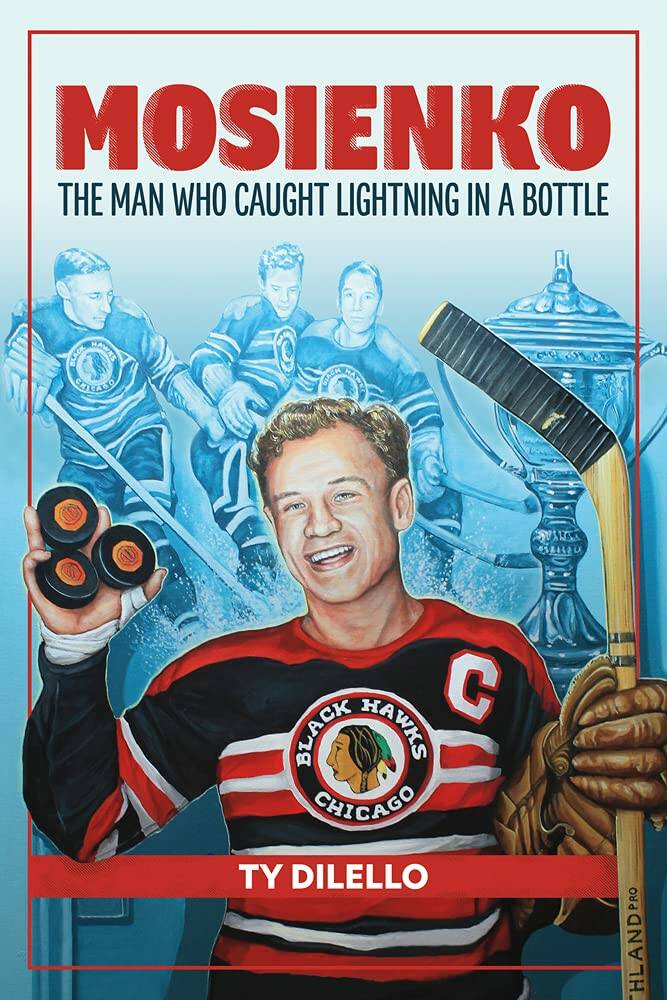
Dilello has left no stone unturned is researching Mosienko. The author traces Mosienko’s roots to his parents’ origins in Ukraine (his father) and Russia (his mother). Dilello provides a detailed account of the hardships and tragedies endured by the Mosienkos and their children as they immigrated to Canada, specifically Winnipeg, from Eastern Europe in 1912.
In November 1921, William Mosienko, the third-youngest of 13 children in the family, was born in the family’s North End home. While his life and Hockey Hall of Fame career are the focus of Dilello’s book, he does a great job of giving Mosienko’s life context.
From Mosienko’s earliest days as a sports-mad child who couldn’t be kept off the rink that was conveniently located across the street from the family’s Selkirk Ave. home to his final days in his hometown, Mosienko is rich with details about the career of the speedy under-sized forward from a working-class immigrant family who proved how wrong those who thought he was too small to play top-level hockey were.
Not only does Dilello plumb the archives for anecdotes and statistics about a career that ended more than 60 years ago, he tracks down and interviews seemingly everyone who is still alive who may have played with or against Mosienko, in addition to including information gleaned from extensive interviews with Mosienko’s children and other relatives.

The end product of Dilello’s hard work is an intriguing look not only at a somewhat-overlooked hockey legend, but also how the game was played and its culture in the mid-20th century.
As for Mosienko the man, the reader is left with the impression that as great a hockey player he was, he was also an incredibly decent, kind and generous person throughout his career and afterward, very much deserving of his spot in the Hockey Hall of Fame and having an arena on Winnipeg’s Keewatin St., not far from the stomping grounds of his childhood and youth, named in his honour.
Readers whose knowledge of Billy Mosienko is limited to the smiling face on the North End mural and his 21-second hat trick scored more than 70 years ago will find Mosienko: The Man Who Caught Lightning in a Bottle an interesting, informative look into an individual who beat the odds to skate out of Depression-era Winnipeg and carve out an impressive career in the National Hockey League.
Whether it was Dilello’s intention or not, readers may also find it an inspiring story of the success of a first-generation Canadian who rose to the top of his field through dedication and hard work, while making many friends and few, if any, enemies along the way.
Gilbert Gregory twice scored three goals in rec league hockey games.