Mise en place
TV chef’s supporting cast of characters become the main dish in well-researched account

Advertisement
Read this article for free:
or
Already have an account? Log in here »
To continue reading, please subscribe:

Digital Subscription
One year of digital access for only $205*
- Enjoy unlimited reading on winnipegfreepress.com
- Read the E-Edition, our digital replica newspaper
- Access News Break, our award-winning app
- Play interactive puzzles
*First annual payment billed as $205.00 + GST for one year. This annual subscription will automatically renew at $233.00 + GST every 52 weeks (10% off the regular annual price of $259.35). Offer available to new and qualified returning subscribers only. Cancel any time.
To continue reading, please subscribe:
Add Free Press access to your Brandon Sun subscription for only an additional
$1 for the first 4 weeks*
- Enjoy unlimited reading on winnipegfreepress.com
- Read the E-Edition, our digital replica newspaper
- Access News Break, our award-winning app
- Play interactive puzzles
*Your next Brandon Sun subscription payment will increase by $1.00 and you will be charged $17.95 plus GST for four weeks. After four weeks, your payment will increase to $24.95 plus GST every four weeks.
Read unlimited articles for free today:
or
Already have an account? Log in here »
Hey there, time traveller!
This article was published 04/06/2022 (1583 days ago), so information in it may no longer be current.
Julia Child is having a moment right now. Celebrating her ebullient personality and her influential body of work, which helped change attitudes to cooking and eating in postwar North America, we have a recent documentary (2021’s Julia), as well as a new dramatized series (also called Julia and showing on Crave).
This latest entry into the Child bibliography is thorough and detailed, sometimes a lot of high-spirited fun but sometimes a trifle dry. If you are new to the cult of Julia, you might want to start with something more general, with a bit more whoosh. For Julia completists, however, this well-researched work, which involves a careful sifting of primary sources, will be a must-read.
Helen Lefkowitz Horowitz conveys a vivid sense of Julia Child’s talent for cooking, her passionate persistence and determination, and her hard-headed business sense. But the American cultural historian goes against the so-called Great Man Theory — or even Great Woman Theory — of history, to widen her focus.
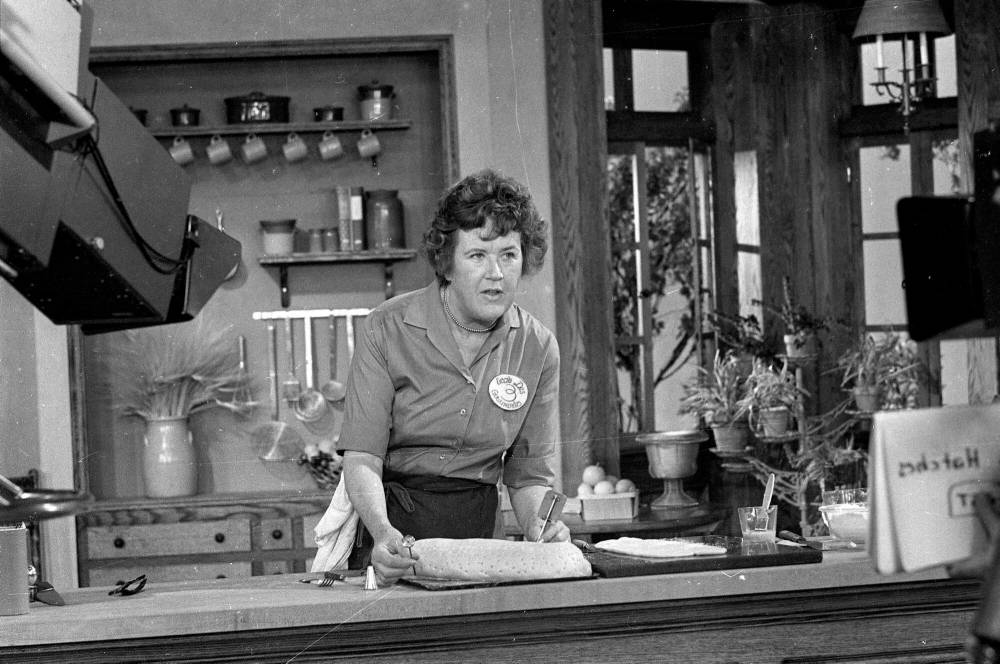
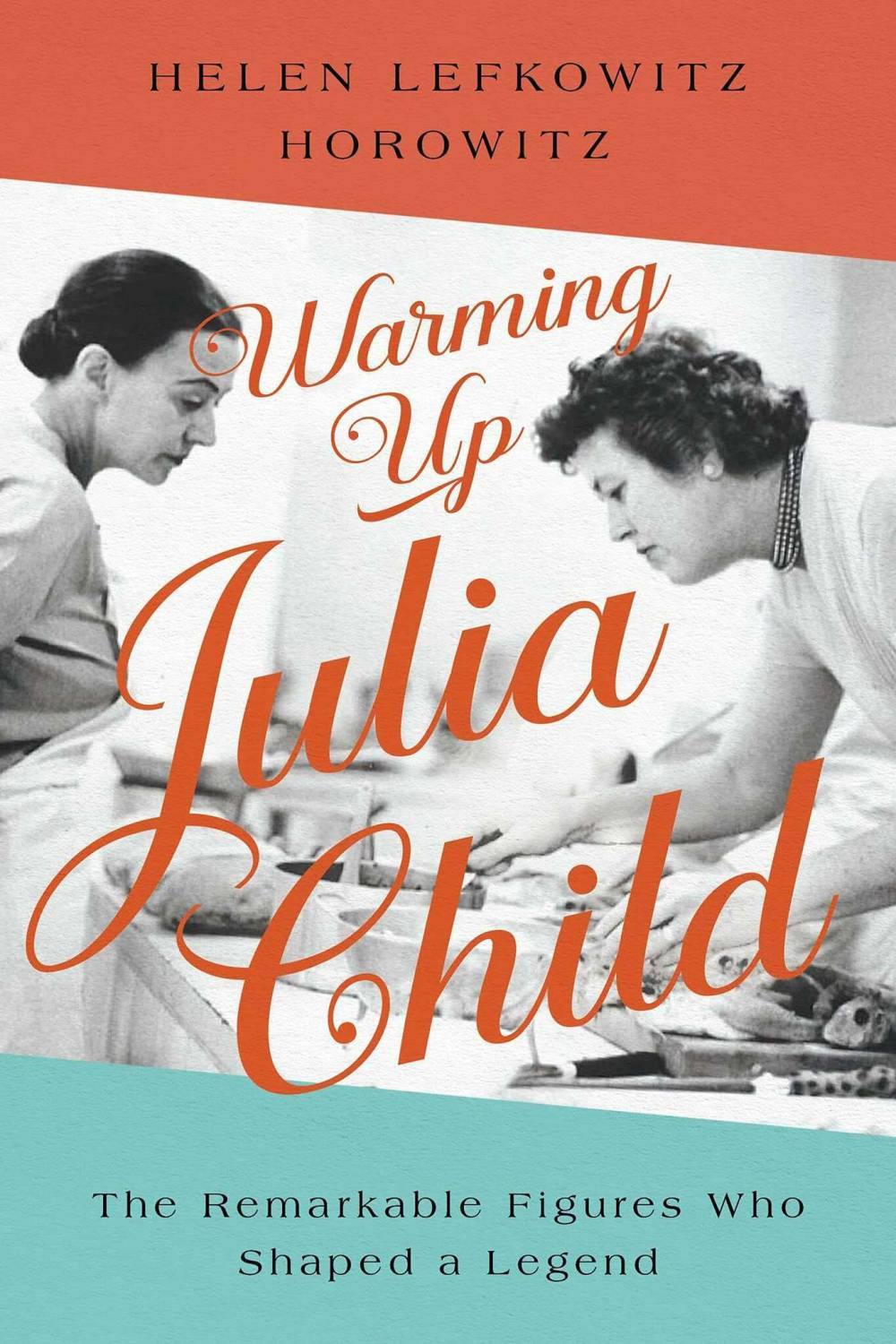
According to Horowitz, two of Julia’s greatest assets were her genius for friendship and her gift for collaboration. In a sense, Warming Up Julia Child tells us about its central figure by telling us about six key figures who surrounded and supported her — what Horowitz calls “Julia’s team” — first as she worked on the revolutionary cookbook Mastering the Art of French Cooking and later on her ground-breaking TV show, The French Chef.
“In the beginning, there was Paul,” Horowitz writes. Paul Child was a creative, encouraging and adoring spouse, and in a reversal of the usual gender dynamics of the 1950s and ‘60s, his work often supported his wife’s professional career. Simone (Simca) Beck was Julia’s French collaborator. When things were going well, Julia called her “our soeur [sister] — but better than a blood-born soeur, because you are of our own choosing.” When things weren’t going well, as when the two wrangled over something like adding bread to soupe au pistou, Simca was “an old goat.”
Avis DeVoto, who started writing to Julia as part of her husband’s quest for a truly sharp kitchen knife, developed a close friendship with Julia before they ever met in person. Judith Jones and Bill Koshland both worked at Julia’s publishing house, while Ruth Lockwood was a producer at WGBH, the Boston-based public broadcaster.
Horowitz gives some sense of the larger cultural context, but mostly her emphasis is on her characters’ close interactions, much of it through their correspondence, with letters packed with idiosyncratic expressions, fun period slang and Paul and Julia’s frequent misspellings. (The term “[sic]” gets quite a workout here.) The book’s 20 pages of endnotes are almost all references to letters, particularly the voluminous amount of mail flying between Julia and Simca, Avis and Julia, and Paul and his twin brother Charlie.
We see Julia and her team take the rigour and long tradition of French cooking and translate it for the supermarkets and kitchens of the American home cook — the “servantless” home cook, as Julia often pointed out. This wasn’t always easy, as when Simca wondered how one could possibly make cassoulet without preserved goose, or Julia struggled with the recipe for a very simple — but also very tricky — rolled omelette.

As Horowitz follows what became a 10-year process of backing and forthing, many readers might find themselves thinking, why is this cookbook taking so long? Or perhaps even, why is this book about the cookbook taking so long, as Horowitz’s middle section falls into a bit of a lull.
And ironically, for a book about a book that was endlessly edited, corrected, checked and argued over, Warming Up could have used another once-over. There are some repetitions of quotations mere pages apart and occasional spelling slips (Cordon “Blue” instead of “Bleu”).
Still, Horowitz ends with a flourish, moving from the cookbook to the wild adventure of live-to-tape television, during which Julia’s warbling delivery and magnificent handling of her occasional flubs and failures endeared her to the viewing public.
With her TV show, Horowitz suggests, Julia Child would become not just a cooking authority but a beloved personality, “known and remembered simply as ‘Julia.’”
Alison Gillmor has not managed to make Julia’s famous 14-second rolled omelette.
Studying at the University of Winnipeg and later Toronto’s York University, Alison Gillmor planned to become an art historian. She ended up catching the journalism bug when she started as visual arts reviewer at the Winnipeg Free Press in 1992.
Our newsroom depends on a growing audience of readers to power our journalism. If you are not a paid reader, please consider becoming a subscriber.
Our newsroom depends on its audience of readers to power our journalism. Thank you for your support.
Book review
Warming Up Julia Child:
The Remarkable Figures Who Shaped a Legend
By Helen Lefkowitz Horowitz
Pegasus Books, 304 pages, $37
Studying at the University of Winnipeg and later Toronto’s York University, Alison Gillmor planned to become an art historian. She ended up catching the journalism bug when she started as visual arts reviewer at the Winnipeg Free Press in 1992.
Our newsroom depends on a growing audience of readers to power our journalism. If you are not a paid reader, please consider becoming a subscriber.
Our newsroom depends on its audience of readers to power our journalism. Thank you for your support.
Advertisement Advertise With Us
Advertisement Advertise With Us