Architect’s thoughtful memoir built on solid foundation
Advertisement
Read this article for free:
or
Already have an account? Log in here »
To continue reading, please subscribe:

Digital Subscription
One year of digital access for only $205*
- Enjoy unlimited reading on winnipegfreepress.com
- Read the E-Edition, our digital replica newspaper
- Access News Break, our award-winning app
- Play interactive puzzles
*First annual payment billed as $205.00 + GST for one year. This annual subscription will automatically renew at $233.00 + GST every 52 weeks (10% off the regular annual price of $259.35). Offer available to new and qualified returning subscribers only. Cancel any time.
To continue reading, please subscribe:
Add Free Press access to your Brandon Sun subscription for only an additional
$1 for the first 4 weeks*
- Enjoy unlimited reading on winnipegfreepress.com
- Read the E-Edition, our digital replica newspaper
- Access News Break, our award-winning app
- Play interactive puzzles
*Your next Brandon Sun subscription payment will increase by $1.00 and you will be charged $17.95 plus GST for four weeks. After four weeks, your payment will increase to $24.95 plus GST every four weeks.
Read unlimited articles for free today:
or
Already have an account? Log in here »
Hey there, time traveller!
This article was published 09/07/2022 (1517 days ago), so information in it may no longer be current.
Who is A.J. (Jack) Diamond? If that’s a question better left to Jeopardy! whiz Mattea Roach, perhaps it is helpful to think about who or what is Diamond Schmitt Architects Inc. (DSAI).
Winnipeggers should know this Toronto-based firm as, in recent months, two cutting-edge structures designed by DSAI, in collaboration with Winnipeg’s Number Ten Architectural Group, have come to grace our city’s dazzling building stock: the Red River College Polytech’s Manitou a bi Bii daziigae (the Ojibwe term for “where the creator sits and brings light,” formerly known as the Innovation Centre Project) at 319 Elgin Ave.; and the National Research Council’s Advanced Manufacturing Program Building at 2690 Red Fife Rd., near the corner of Inkster Boulevard and Route 90.
These structures exemplify principles and ethics of DSAI’s founding partner, A.J. Diamond, through their materials (ample glass promoting transparency and inclusion, a democratizing of space), plan (including gathering spaces and expansive sightlines, fostering personal interaction), sensitivity to their surroundings (the research building’s massing and cladding emphasize the horizontal, paralleling the adjacent landscape) and commitment to environmental sustainability (the college building, for instance, aiming at net-zero energy use). These ideas are discussed in Diamond’s recent memoir Context & Content.

The title references his architectural ideal — that functional and socially responsible buildings must have appropriate content and context. The text is sprinkled with his approaches from various works. These concepts, too, are evident in Diamond’s sweeping personal and professional story — from whom and where he came (his own context) and his beliefs, vision and motivations (content, character).
There is no preface or introduction giving context for why Diamond is releasing his memoir now. He will, however, be 90 years old this November, and his life has been full and fruitful.
As the subtitle suggests, this is a testament of gratitude.
It is also an urgent call to action. Diamond argues that social inequality and the existential threat of climate change can be alleviated by architects, other professionals, governments, private business and active, vigilant citizens working together to realize sustainable building and city planning solutions.
Comfortably paced chapters cover Diamond’s Jewish European ancestors, his upbringing and education in his native South Africa, his postgraduate studies in Oxford, England, and at the University of Pennsylvania and his ultimate emigration to Canada. Toronto has been home since 1963. Other chapters highlight his major works (the Mariinsky Theatre II in Saint Petersburg, Russia, and city hall in Jerusalem), specific issues such as the challenges of designing concert halls and the vagaries of architectural competitions.
Famous people make cameo appearances. For example, a young Diamond attends a house party for artist Marc Chagall. Jackie Kennedy visits an office where he works, seeking a designer for the Kennedy library. That office is headed by the famous architect Louis Khan; Diamond provides several delicious tidbits about his brilliant and quirky colleague. Vladimir Putin and his steadfast crony, conductor Valery Gergiev, are instrumental in the building of the Mariinsky II. The 2013 photo of Diamond with these two is cringe-worthy today.
Most of the two dozen photographs in the book are of the Diamond family, a couple are of Diamond at professional events and just one is of a Diamond building — his first project, under construction in 1958, a restaurant in Durban, South Africa.
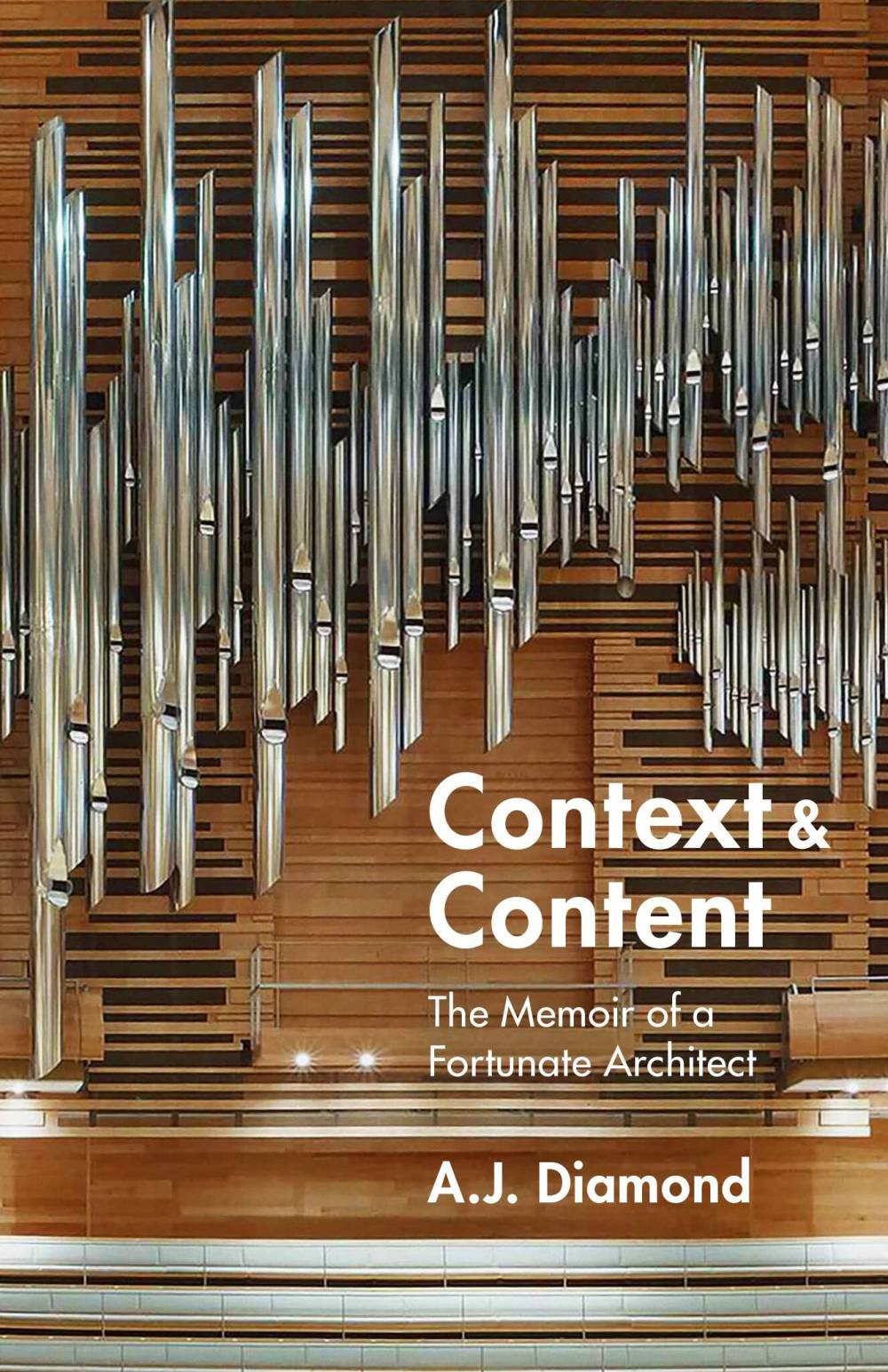
It is unusual for an architect not to promote his portfolio. As clear and effective as Diamond is in describing his works, project photographs would have been helpful (annoyingly, a picture is worth a thousand words). Readers will no doubt want to explore internet images.
But this is the essence of A.J. Diamond. He is strong-minded but not big-headed. He is a family man and man of ideas. He believes his art serves a higher cause. A commitment to community cannot be photographed.
But it can be felt. To know A.J. Diamond is to read this thoughtful autobiography and to experience his firm’s buildings, just around the corner, first-hand.
Gail Perry is currently writing a book on early Winnipeg architect John D. Atchison.