
Doctor delves into ‘death dilemma’

Advertisement

Advertise with us

At long last, doctors are writing about and revealing the dilemmas and stresses of a highly competitive profession that sooner or later affect us all.

Read this article for free:


or

Already have an account? Log in here »

To continue reading, please subscribe:

Subscribe and receive a limited-edition Free Press branded hat or tote.

Digital Subscription

One year of digital access for only $205*

  • Enjoy unlimited reading on winnipegfreepress.com
  • Read the E-Edition, our digital replica newspaper
  • Access News Break, our award-winning app
  • Play interactive puzzles

*First annual payment billed as $205.00 + GST for one year. This annual subscription will automatically renew at $233.00 + GST every 52 weeks (10% off the regular annual price of $259.35). Offer available to new and qualified returning subscribers only. Cancel any time.

To continue reading, please subscribe:

Add Free Press access to your Brandon Sun subscription for only an additional

$1 for the first 4 weeks*

  • Enjoy unlimited reading on winnipegfreepress.com
  • Read the E-Edition, our digital replica newspaper
  • Access News Break, our award-winning app
  • Play interactive puzzles
Start now

*Your next Brandon Sun subscription payment will increase by $1.00 and you will be charged $17.95 plus GST for four weeks. After four weeks, your payment will increase to $24.95 plus GST every four weeks.

Hey there, time traveller!
This article was published 01/10/2022 (1473 days ago), so information in it may no longer be current.

At long last, doctors are writing about and revealing the dilemmas and stresses of a highly competitive profession that sooner or later affect us all.

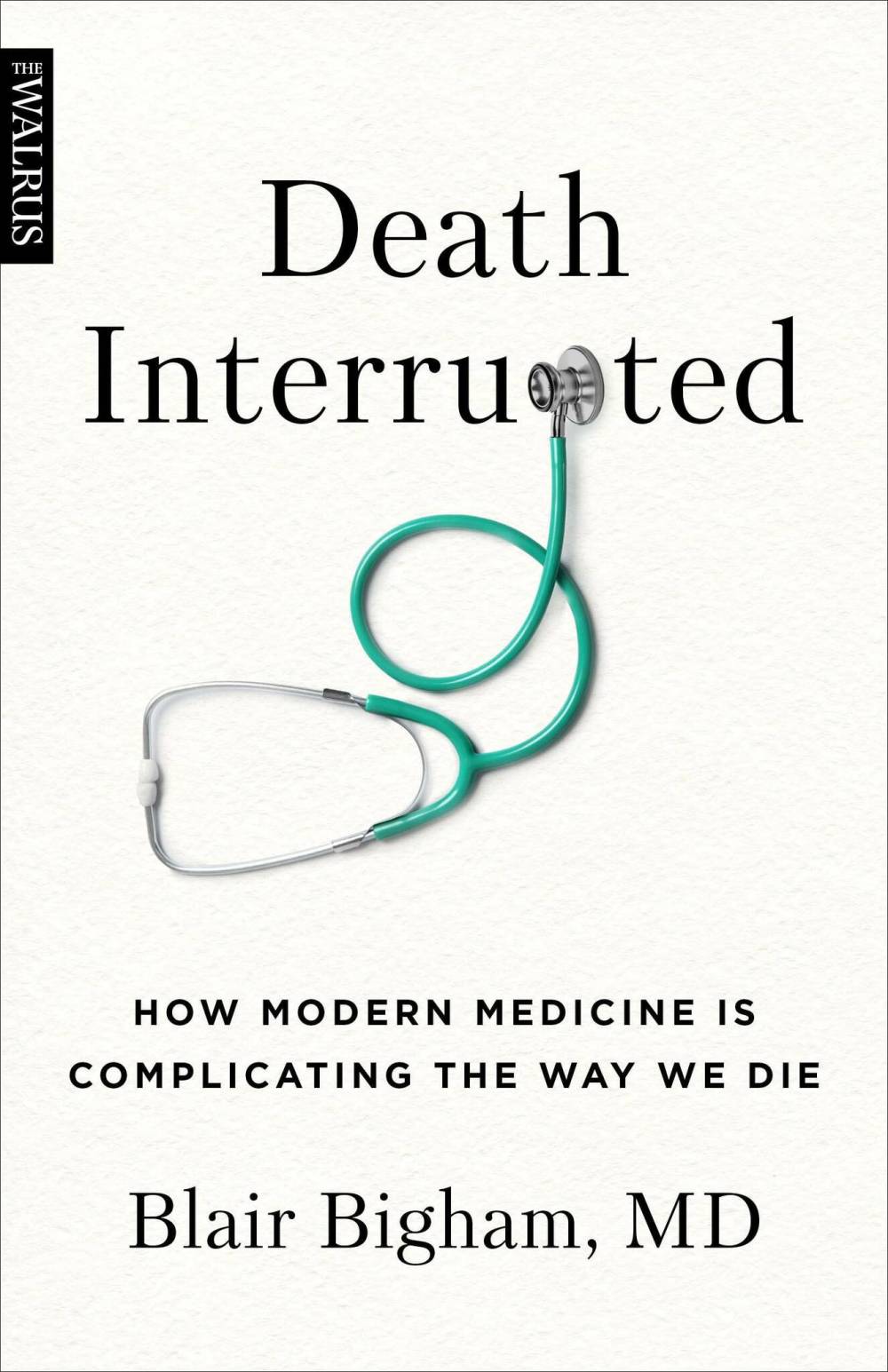
We Are All Perfectly Fine by Winnipeg internist Jillian Horton showed how the unreasonable demands on interns and residents can throw them into survival mode, where empathy with patients suffers. In Death Interrupted, Blair Bigham’s concern centres on the ICU, where efforts to save patients’ lives sometimes only prolong their suffering.

Bingham, who studied medicine at McMaster and Stanford, was a paramedic for 10 years before becoming a doctor and specialist in resuscitation. As a paramedic, he could celebrate simply getting a patient to the hospital alive. Now he works in a very different space, where the pressing question is often when to remove life support.
Death Interrupted

Death Interrupted

The “death dilemma,” as he calls it, is for him a personal problem as well as a systemic one. And it is relatively new. Between 1850 and 1950, mortality rates declined dramatically in Europe and North America, largely owing to improved sanitation, vaccinations and antibiotics. In the 1950s and ’60s came the use of CPR, portable defibrillators, ambulance services and ventilators.

One hundred years ago, death was accepted as a common experience, with few choices to be made. Could today’s abundance of choices be the cause of the present-day death dilemma? Is that why some families hesitate to remove life support, or even go to court to maintain it, when the patient is brain dead?

Bingham consults a number of experts in the field as well as combing his own experiences. Everyone agrees that families need time to digest bad news and build trust in the doctor giving it. But sometimes it is the doctor who wants to keep the machines running, even when the chances of recovery are nil. According to Bingham, surgeons are particularly aggressive in this respect, whereas oncologists are inclined to recommend palliative care.

The field is also complicated by legal definitions of death, by requirements for organ donations and, in the U.S., by the need for an organ recipient to live for a year in order for the transplant to be considered successful.

Bingham’s determination to explore all the repercussions of life support in both Canada and the U.S. (where he is currently working) leads readers in a number of directions. We learn that in the U.S., long-term acute care hospitals (LTACHs) are big money makers, yet another reason not to pull the plug.

He even takes a detour into exploring medical assistance in dying (or MAID) in Canada, which seems a little off-topic when it comes to decisions made in ICUs but is certainly related to the “death dilemma.”

What Bingham doesn’t provide are statistics on the ages and illnesses of those in ICUs in the two countries. What proportion are victims of traffic accidents, heart attacks, strokes, cancer? Although he describes a few cases, this information would be useful.

Bingham’s subtitle, How Modern Medicine Is Complicating the Way We Die, is certainly appropriate. His book explores a relatively new issue for which there are no easy answers — except for all of us, no matter what age, to write advance directives, or at least have a discussion on the issue with our families. At the moment, only 20 per cent of North Americans have written directives.

Faith Johnston is a Winnipeg writer old enough to have encountered the death dilemma several times.

Report Error Submit a Tip

More Stories

Late philanthropist, family fill Harvest’s Empty Bowls with record-setting $5-M donation

Morgan Modjeski 3 minute read Preview

Late philanthropist, family fill Harvest’s Empty Bowls with record-setting $5-M donation

Morgan Modjeski 3 minute read Friday, Oct. 9, 2026

It was a record-breaking night for Harvest Manitoba made possible by a genuine Winnipeg hero and his family.

The organization’s annual Empty Bowls Celebrity Auction Dinner on Thursday raised $6.5 million to support Manitobans facing hunger and food insecurity.

And it was a $5-million legacy donation from late city philanthropist Doug Harvey and his family that will see the event go down in the history books as the largest gala fundraising total ever recorded in Manitoba.

“There was literally nothing that lit my dad up more than contributing himself, but even more so, inspiring others to give,” his daughter Lauren Harvey said Friday.

Read
Friday, Oct. 9, 2026

Gianmarco Soresi coming to Winnipeg

1 minute read Yesterday at 2:26 PM CDT

Stand-up comedian and actor Gianmarco Soresi is set to perform at Club Regent Event Centre in the spring.

Soresi's The Misery Loves Tour stops in Winnipeg May 28, 2027. The New York-based comedian released his debut comedy special Thief of Joy on YouTube last year.

Tickets go on sale Oct. 16 at ticketmaster.ca.

Manitoba e-scooter legislation changes set to impose speed limit, age restrictions, sidewalk ban

Matthew Frank 5 minute read Preview

Manitoba e-scooter legislation changes set to impose speed limit, age restrictions, sidewalk ban

Matthew Frank 5 minute read Sunday, Oct. 11, 2026

People riding e-scooters and other personal electric vehicles in Manitoba will have to strap on a helmet, stay off sidewalks and follow new age limits once new provincial rules for the devices take effect next year.

The vehicles, which also include electric skateboards, hoverboards and unicycles, will fall under The Highway Traffic Act starting in 2027, according to the province’s website. E-bikes are excluded from the new rules, according to the province’s frequently-asked-questions page.

All riders must be at least 16 years old and wear properly fitting helmets — that goes for passengers, too, the province said.

The proposed new legislation sets a speed limit of 25 km/h and would prohibit personal electric vehicles from sidewalks unless signs specifically allow sidewalk use. Riders would be using shared paths or roads with speed limits of 50 km/hr or less. They won’t be allowed to operate the vehicles under the influence of alcohol or drugs and they must use hand signals and obey traffic signs.

Read
Sunday, Oct. 11, 2026

Collaros turns back the clock in crucial win over Stamps

Taylor Allen 7 minute read Preview

Collaros turns back the clock in crucial win over Stamps

Taylor Allen 7 minute read Sunday, Oct. 11, 2026

It was around this time seven years ago that the Winnipeg Blue Bombers officially became Zach Collaros’s team.

Making his first start in blue and gold after being acquired via trade, Collaros ran backwards to escape a collapsing pocket before rolling to his right and firing a perfect pass to Darvin Adams in the back corner of the south end zone during a home game against the Calgary Stampeders.

The play marked the beginning of the Collaros era in Winnipeg.

And a similar play Saturday night, once again against the Stampeders, served as a reminder that the 38-year-old pivot isn’t done just yet.

Read
Sunday, Oct. 11, 2026

Backstreet Boys extend Toronto residency to 11 nights

The Canadian Press 2 minute read Preview

Backstreet Boys extend Toronto residency to 11 nights

The Canadian Press 2 minute read Sunday, Oct. 11, 2026

TORONTO - Hit '90s boyband The Backstreet Boys are adding more tour dates to their Toronto residency.

What was first announced as a four-night run at Rogers Centre has swelled to 11 shows, with the band's recent announcement they're adding concerts on March 5 and 6.

The band says on its website the new dates were added "due to overwhelming demand."

Dubbed “Into the Millennium – Homecoming: Live in Canada,” the residency will kick off on Feb. 12.

Read
Sunday, Oct. 11, 2026

Comparing the Iran and Vietnam Wars

Peter McKenna 5 minute read Preview

Comparing the Iran and Vietnam Wars

Peter McKenna 5 minute read 2:00 AM CDT

The other day I asked my students in U.S. foreign policy to think about the relevance of the Vietnam War in relation to the ongoing war in Iran. More specifically, I wanted them to identify the similarities and differences between the two wars.

What is immediately striking is how domestic politics played such a seminal role in both conflicts. While American public opinion was generally in favour of U.S. military involvement in Vietnam in the early years, things started to turn very sour after U.S. soldiers started arriving stateside in flag-draped coffins and body bags. As for Iran, just about every single poll and TV newscast since the first few weeks of the war have illustrated an overwhelming public repudiation of President Trump’s military adventurism.

The electoral implications were also quite apparent for the two wars. The U.S.-Iran War is clearly having a positive effect on the Democratic Party’s electability, as it looks set to capture both the House of Representatives and the Senate in the Nov. 3 midterm elections. Democratic President Lyndon Johnson, reading the political tea leaves from the Vietnam fallout, opted not to contest the 1968 U.S. presidential election.

Equally interesting, the U.S. press had a crucial, and mostly negative, impact on both the Vietnam and Iran conflicts. Who could forget Gen. William Westmoreland — the commander of U.S. forces in Vietnam (1964-1968) — maintaining that it was the media’s fault the U.S. lost the war in Vietnam. While I take issue with his thesis, I do believe the news coverage and visuals of the first televised war served to raise serious concerns about why the U.S. was at war in Southeast Asia.

Read
2:00 AM CDT



