Border duo’s historical biography insightful
Advertisement
Read this article for free:
or
Already have an account? Log in here »
To continue reading, please subscribe:

Digital Subscription
One year of digital access for only $205*
- Enjoy unlimited reading on winnipegfreepress.com
- Read the E-Edition, our digital replica newspaper
- Access News Break, our award-winning app
- Play interactive puzzles
*First annual payment billed as $205.00 + GST for one year. This annual subscription will automatically renew at $233.00 + GST every 52 weeks (10% off the regular annual price of $259.35). Offer available to new and qualified returning subscribers only. Cancel any time.
To continue reading, please subscribe:
Add Free Press access to your Brandon Sun subscription for only an additional
$1 for the first 4 weeks*
- Enjoy unlimited reading on winnipegfreepress.com
- Read the E-Edition, our digital replica newspaper
- Access News Break, our award-winning app
- Play interactive puzzles
*Your next Brandon Sun subscription payment will increase by $1.00 and you will be charged $17.95 plus GST for four weeks. After four weeks, your payment will increase to $24.95 plus GST every four weeks.
Read unlimited articles for free today:
or
Already have an account? Log in here »
Hey there, time traveller!
This article was published 22/04/2023 (1255 days ago), so information in it may no longer be current.
Unheralded lives are only unheralded until someone chronicles them.
American writer Timothy Cochrane believes the lives of John (a.k.a. Jack) and Tchi-Ki-Wis Linklater, a married Métis and Anishinaabe couple who lived in the Canada-U.S. border north woods near Lake Superior, have remained unheralded for too long.
He’s remedied the perceived default by penning their joint biography.
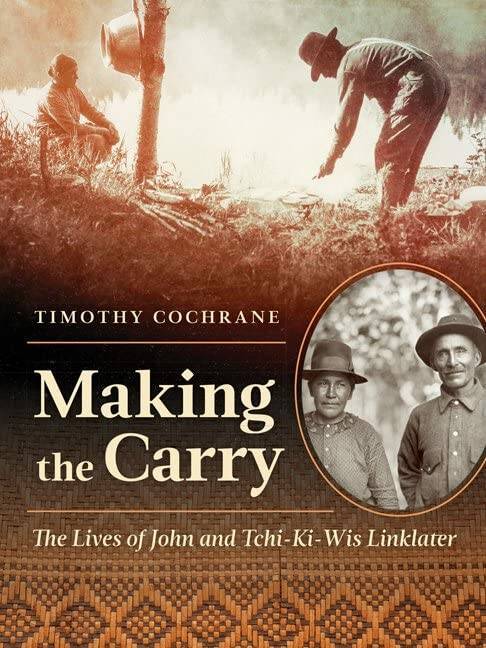
Making the Carry
Cochrane’s written two previous books about the region where the Linklaters lived and work from the 1870s to the 1930s. And for 20 years he was superintendent of the Grand Portage National Monument on the Minnesota side of Superior’s north shore, located a short cross-border drive down the highway from Thunder Bay.
He has a nice touch. The Linklaters’ personal stories are interwoven with finely rendered backdrops of the histories of northwestern Ontario, northeastern Minnesota and, though to a lesser degree, Manitoba and the Red River basin.
The “carry” of title is a synonym for portage. Indigenous people and the 18th/19th-century voyageurs who travelled via canoe from Quebec to Western Canada plying the fur trade commonly used the phrase, Cochrane explains.
Later, he turns it into a metaphor for the Linklaters’ lives, allowing that the couple regularly “made the carry” by “crossing social, cultural and economic borders.”
Besides being well written, the book is generously illustrated — with 65 black-and-white period-piece photos, 21 colour plates and four historical regional maps.
Cochrane gives a candid accounting of the historical issues of race and prejudice the couple encountered, but less so than one might have expected of the place and time. A good deal of that lack of prejudice can be chalked up to the great esteem the Linklaters were held in by much of local “white” society, an esteem duly earned.
Jack Linklater was, variously, a guide, a hunter, a trapper, a state game warden and a de facto environmentalist before the word ever entered the English language. His knowledge of the lakes and red and white pine forests of Superior’s border region was legendary.
Tchi-Ki-Wis was an extraordinary craftswoman who made everything from parkas and beaded moccasins to sled-dog harnesses and birch bark canoes.

Linklater’s sudden death at age 65 in a canoeing accident in July 1933 is foreshadowed throughout the biography, but still comes as a bit of a shock.
Sixteen months later, Tchi-Ki-Wis died. The official cause of death was myocarditis. A close friend’s diagnosis was a “broken heart.”
Unless you’re an aficionado of native beadwork, clothing and canoe-construction techniques, there are moments when the narrative sags. But on the whole, this is a captivating biography — redolent of not only respect for the Linklaters but a love of Lake Superior’s north woods.
It’s also a portrait of a singular marriage. Intentionally or not, what repeatedly comes through is how, as a couple, Jack and Tchi-Ki-Wis so aptly complemented each other.
Douglas J. Johnston is a Winnipeg lawyer and writer. He has visited the Grand Portage National Monument on the U.S. side of Lake Superior’s north shore several times, and hiked its nearby trails.