In full bloom
Welsh gardener reflects on childhood, retirement in latest memoir
Advertisement
Read this article for free:
or
Already have an account? Log in here »
To continue reading, please subscribe:

Digital Subscription
One year of digital access for only $205*
- Enjoy unlimited reading on winnipegfreepress.com
- Read the E-Edition, our digital replica newspaper
- Access News Break, our award-winning app
- Play interactive puzzles
*First annual payment billed as $205.00 + GST for one year. This annual subscription will automatically renew at $233.00 + GST every 52 weeks (10% off the regular annual price of $259.35). Offer available to new and qualified returning subscribers only. Cancel any time.
To continue reading, please subscribe:
Add Free Press access to your Brandon Sun subscription for only an additional
$1 for the first 4 weeks*
- Enjoy unlimited reading on winnipegfreepress.com
- Read the E-Edition, our digital replica newspaper
- Access News Break, our award-winning app
- Play interactive puzzles
*Your next Brandon Sun subscription payment will increase by $1.00 and you will be charged $17.95 plus GST for four weeks. After four weeks, your payment will increase to $24.95 plus GST every four weeks.
Read unlimited articles for free today:
or
Already have an account? Log in here »
Hey there, time traveller!
This article was published 22/04/2023 (1263 days ago), so information in it may no longer be current.
Marc Hamer is the Wales-based author of three gardening memoirs, the latest of which is Spring Rain: A Life Lived in Gardens.
Spring Rain nips at the heels of How to Catch a Mole (2019) and Seed to Dust (2021), all of which cover similar ground: how a homeless young man from the north of England makes a life and a living as a gardener at a country estate in Wales. Along the way, he grounds himself in nature, ruminating on the meaning of work and success, rejecting pesticides and his father’s toxic masculinity.
Seed to Dust was a hefty book that recounted Hamer’s last year as a gardener, reflecting on the world and his place in it but also content to reside in the here and now. He referenced his lonely childhood and the tumultuous times after his mother died and his father kicked him out, but the book was largely about his relationship to (and his distance from) the elegant and elderly Miss Cashmere, to labour and to capitalism.

Travis Elborough photo
In his third memoir, Mark Hamer covers some ground similar to his previous books, enlarging and expanding on themes and scenes from 2019’s How to Catch a Mole and 2021’s Seed to Dust.
Miss Cashmere owns the estate and is the only one who gets to see the garden and the products of Hamer’s labour. Hamer, who considers himself an anarchist, thinks there’s something wrong with that concentration of wealth and beauty, but has to work somewhere and loves the garden, which is, in many ways, his.
This outing has two timelines and narrators. “Gardener” is the freshly retired Hamer, writing, reading poetry and renewing the small garden at the back of his yard. “Rain” follows Hamer from childhood through to early adulthood, where he mostly spends his time trying to survive his family.
“I’m thinking more about the boy at the moment, perhaps because I am letting go of the past and I want to start again,” Hamer writes early in the book. “It is not in my nature to look back, but unusually I find myself doing it.”
Like so many unhappy children, Rain finds solace in books, in this case a partial set of encyclopedias he finds at one of the rental houses they live in. He buries himself like a seed in its volumes until his father “loses them” in their next move.
If Rain is a seed, Gardener is a mature plant, with retirement pruning away the things he no longer needs. So instead of deadheading roses in the grubby gardening clothes he wore for 20 years, Hamer sports silk bow ties and waits outside the library for his wife Peggy with a bouquet of flowers. Except the flowers are as much for him as they are for her: Gardener considers himself to be a kind of flower.
Luckily, one of the things Hamer has kept is his lush prose, focused on plants and animals, gardens and books. As he shifts from being a professional gardener responsible for the grounds of a large estate to an amateur gardener with a small backyard, as he shifts into a different phase of life, Hamer is still most interested in beauty:
“I hope I have made a beautiful thing with these words. That’s all I wanted: to add a little more to the wonder. As always, I struggle with making beauty in an age of brutality, and even more with the ethics of focusing my attention on the wonder of life when there is so very much that needs changing.”
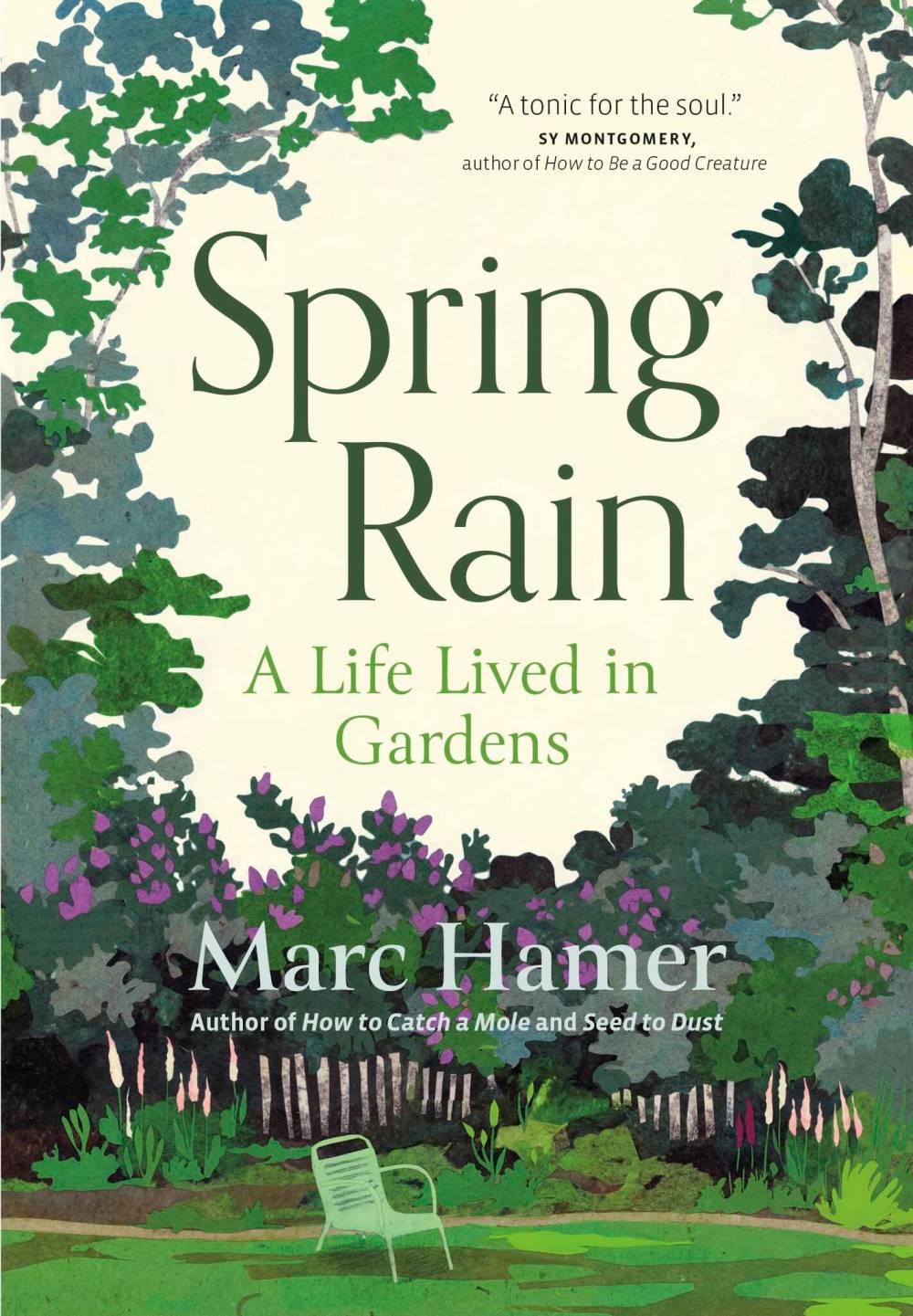
Spring Rain
The real question here: does Spring Rain stand on its own, or is it only the hastily written third book in a three-book deal? Luckily, the answer is yes and no. There’s some repetition of themes and scenes, but Hamer enlarges and expands on them in ways that are interesting. He’s even added some of his own drawings to the mix.
So if you’ve read and loved Hamer the gardener in his previous two books, you’ll enjoy this, especially in these months of seed-starting and spring snowstorms.
If not, the juxtaposition of the very young and the newly old is an interesting way to frame a memoir. And if you like Spring Rain, there are two more books waiting for you, which is the literary equivalent of discovering a good show with three seasons of episodes just waiting for you.
Ariel Gordon’s next book is Siteseeing: Writing nature & climate across the prairies, a collaboration with Brenda Schmidt.