Beyond the headlines
Analysis of Postmedia moves, media report mired in dubious theories
Advertisement
Read this article for free:
or
Already have an account? Log in here »
To continue reading, please subscribe:

Digital Subscription
One year of digital access for only $205*
- Enjoy unlimited reading on winnipegfreepress.com
- Read the E-Edition, our digital replica newspaper
- Access News Break, our award-winning app
- Play interactive puzzles
*First annual payment billed as $205.00 + GST for one year. This annual subscription will automatically renew at $233.00 + GST every 52 weeks (10% off the regular annual price of $259.35). Offer available to new and qualified returning subscribers only. Cancel any time.
To continue reading, please subscribe:
Add Free Press access to your Brandon Sun subscription for only an additional
$1 for the first 4 weeks*
- Enjoy unlimited reading on winnipegfreepress.com
- Read the E-Edition, our digital replica newspaper
- Access News Break, our award-winning app
- Play interactive puzzles
*Your next Brandon Sun subscription payment will increase by $1.00 and you will be charged $17.95 plus GST for four weeks. After four weeks, your payment will increase to $24.95 plus GST every four weeks.
Read unlimited articles for free today:
or
Already have an account? Log in here »
Hey there, time traveller!
This article was published 08/07/2023 (1162 days ago), so information in it may no longer be current.
The Postmedia Effect: How Vulture Capitalism is Wrecking Our News provides an overview of the reality of newspaper concentration. Marc Edge addresses the ongoing debate regarding the ineffectiveness of the Competition Bureau to break up Canada’s media concentration and the push by News Media Canada to save local journalism, ending with a look at the Online News Act which has just now become legislation.
The trouble is, Edge provides relatively little new in his analysis. Rather than taking the time to conduct his own interviews and analysis, the University of Malta graduate and media columnist for Canadian Dimension relies on secondary resources, largely media interviews, to understand what has happened in the last 20 years in the newspaper industry. The result is an uneven and at times messy overview of the state of the newspaper industry that lacks a strong central thesis.
Full disclosure: as a consultant I have held contracts with News Media Canada with work on the Local Journalism Initiative, and I am currently a freelance editor with Policy Options, an online magazine run by the Institute for Research on Public Policy, a think tank headquartered in Montreal.
Most savvy news consumers know the acquisition history of Postmedia and its newspapers, including a troubling switch between Postmedia and Torstar which led to the closure of community newspapers in Ontario. It signalled yet another failure of the Competition Bureau to significantly act in Canadians’ best interest in terms of regulating anti-trust behaviour. (Torstar and Postmedia have reportedly entered talks about merging as of late.) Edge gets credit for competently laying out this history in a timeline that takes up the bulk of the book.
The Postmedia Effect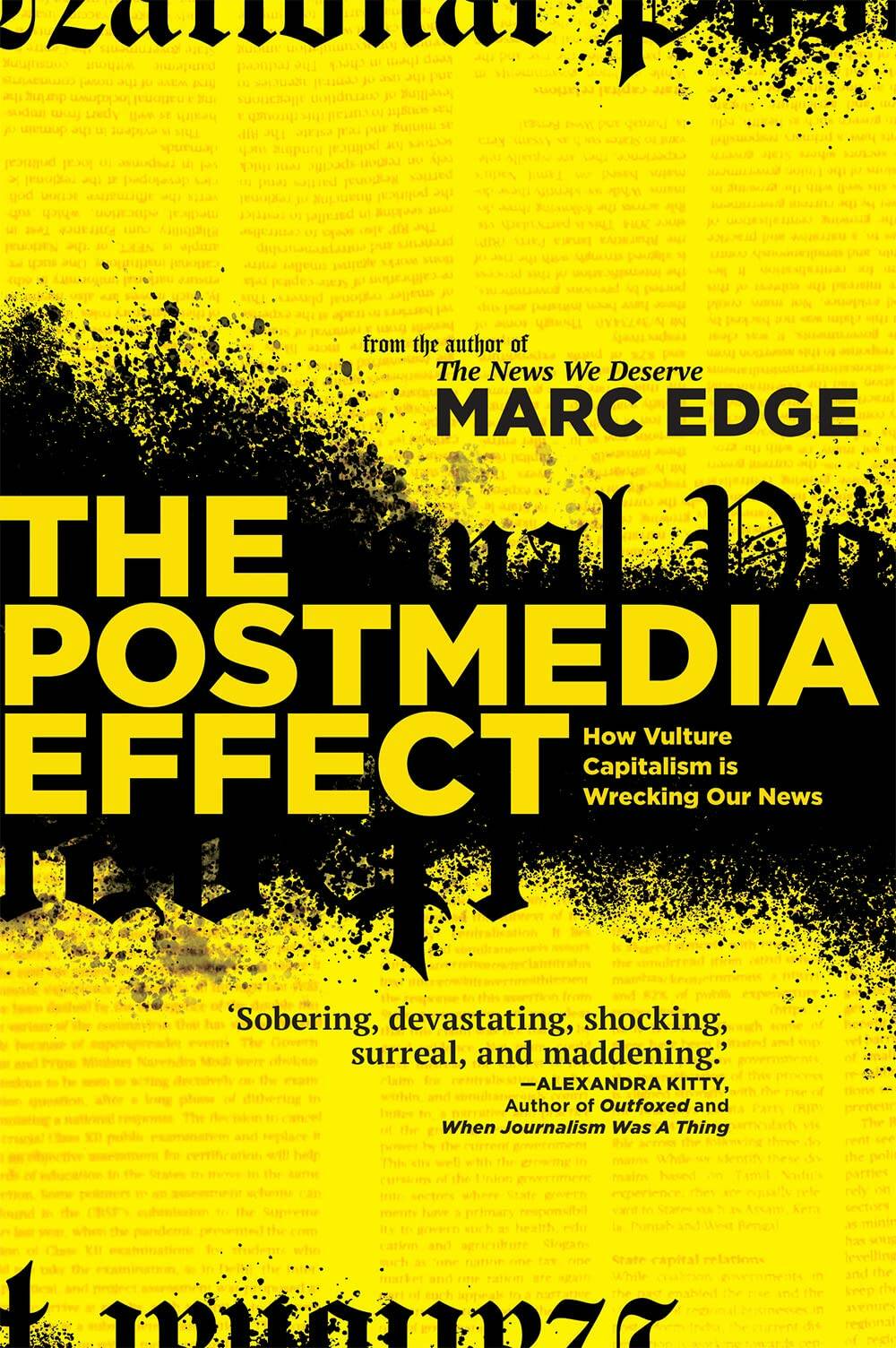
But he veers off into some strange territory in terms of critiques, making it difficult to truly comprehend his overall point. Edge takes aim at the Public Policy Forum’s (PPF) The Shattered Mirror: News, Democracy and Trust in the Digital Age final report released in 2017. Edge cites Carleton University’s Dwayne Winseck, who has suggested the figures used to suggest the number of jobs lost relies on flawed data. Fair enough. There are always discussions and disputes amongst academics about data and numbers — this is nothing new. But anyone working in a newsroom in Canada can point to an empty series of desks to say there are far fewer people working than used to be.
Then Edge takes his book into conspiracy theory territory. He points out that April Lingren, the Velma Rogers Research chair at Toronto Metropolitan University and the academic behind the Shattered Mirror report, is married to PPF’s Edward Greenspon, a former editor at the Globe and Mail. Greenspon and The Shattered Mirror were then part of an alliance with News Media Canada to lobby the Canadian government on a “1.375-billion bailout proposal” of the newspaper industry. Edge intimates that by becoming part of that alliance, it puts the research independence of The Shattered Mirror report into question.
Edge then goes further to suggest that think tanks like the PPF operate as agents of propaganda (lumping all think tanks into the territory, including Policy Options and the Fraser Institute) and writes: “The Shattered Mirror was a masterpiece. It was a triumph of selective presentation that was rife with distortions, fabrications, exaggerations, and even censorship… some of the biggest problems afflicting Canada’s local news media, such as ownership concentration and foreign ownership were never mentioned or summarily dismissed.”
Except that The Shattered Mirror did talk about ownership concentration, albeit with a different focus. It was hardly censorship.
Adrian Wyld / The Canadian Press files
Edge ends with a recommendation that Postmedia be allowed to fail completely rather than have government continue bailouts to foreign hedge fund owners. There are few journalists in this country who haven’t suggested that the National Post has been a sinking ship since it first began publishing in 1998, and it has been allowed to continue to the detriment of the other papers in its chain.
But Edge fails to comprehend or address the ongoing concerns on the loss of democracy if Edmonton, Calgary, Vancouver, Saskatoon and Regina all lost their newspapers in one fell swoop. That’s a pretty big hole in his analysis.
Shannon Sampert is a media consultant and a retired political science professor who has published in both national and international peer-reviewed academic journals on the topic of media and politics.
Read more
The Postmedia Effect: How Vulture Capitalism is Wrecking our News
By Marc Edge
New Star Books, 288 pages, $25
Related Articles
Postmedia, Toronto Star owner end merger talks
Advertisement Advertise With Us
Advertisement Advertise With Us