Dryden’s account of high-school chums gets top marks

Advertisement

Advertise with us

Have you ever wondered about your elementary and high school classmates? Whatever happened to what’s-her-name, what’s-his-name or (nowadays) what’s-their-name? Surely, he ended up in jail; she always wanted to be a nurse. Hm.

Read this article for free:


or

Already have an account? Log in here »

To continue reading, please subscribe:

Subscribe and receive a limited-edition Free Press branded hat or tote.

Digital Subscription

One year of digital access for only $205*

  • Enjoy unlimited reading on winnipegfreepress.com
  • Read the E-Edition, our digital replica newspaper
  • Access News Break, our award-winning app
  • Play interactive puzzles

*First annual payment billed as $205.00 + GST for one year. This annual subscription will automatically renew at $233.00 + GST every 52 weeks (10% off the regular annual price of $259.35). Offer available to new and qualified returning subscribers only. Cancel any time.

To continue reading, please subscribe:

Add Free Press access to your Brandon Sun subscription for only an additional

$1 for the first 4 weeks*

  • Enjoy unlimited reading on winnipegfreepress.com
  • Read the E-Edition, our digital replica newspaper
  • Access News Break, our award-winning app
  • Play interactive puzzles
Start now

*Your next Brandon Sun subscription payment will increase by $1.00 and you will be charged $17.95 plus GST for four weeks. After four weeks, your payment will increase to $24.95 plus GST every four weeks.

Hey there, time traveller!
This article was published 21/10/2023 (1075 days ago), so information in it may no longer be current.

Have you ever wondered about your elementary and high school classmates? Whatever happened to what’s-her-name, what’s-his-name or (nowadays) what’s-their-name? Surely, he ended up in jail; she always wanted to be a nurse. Hm.

Ken Dryden satisfied this probably universal and natural curiosity with his latest (ninth) book, The Class: A Memoir of a Place, A Time, And Us. In January 2020 he began interviewing as many of his 34 high school classmates as he could find. They were members of the “Selected Class,” the best and the brightest of Etobicoke Collegiate Institute between 1960 and 1965. Some called them, not always charitably, the Brain Class.

Dryden as a non-fiction writer has always been interested in history. He writes about present-day people and events but always within their contexts — thus the importance of “Place” and “Time” in his subtitle. His most famous book, the bestseller and widely praised The Game (1983), provides a history of the way hockey came to be the game it is.
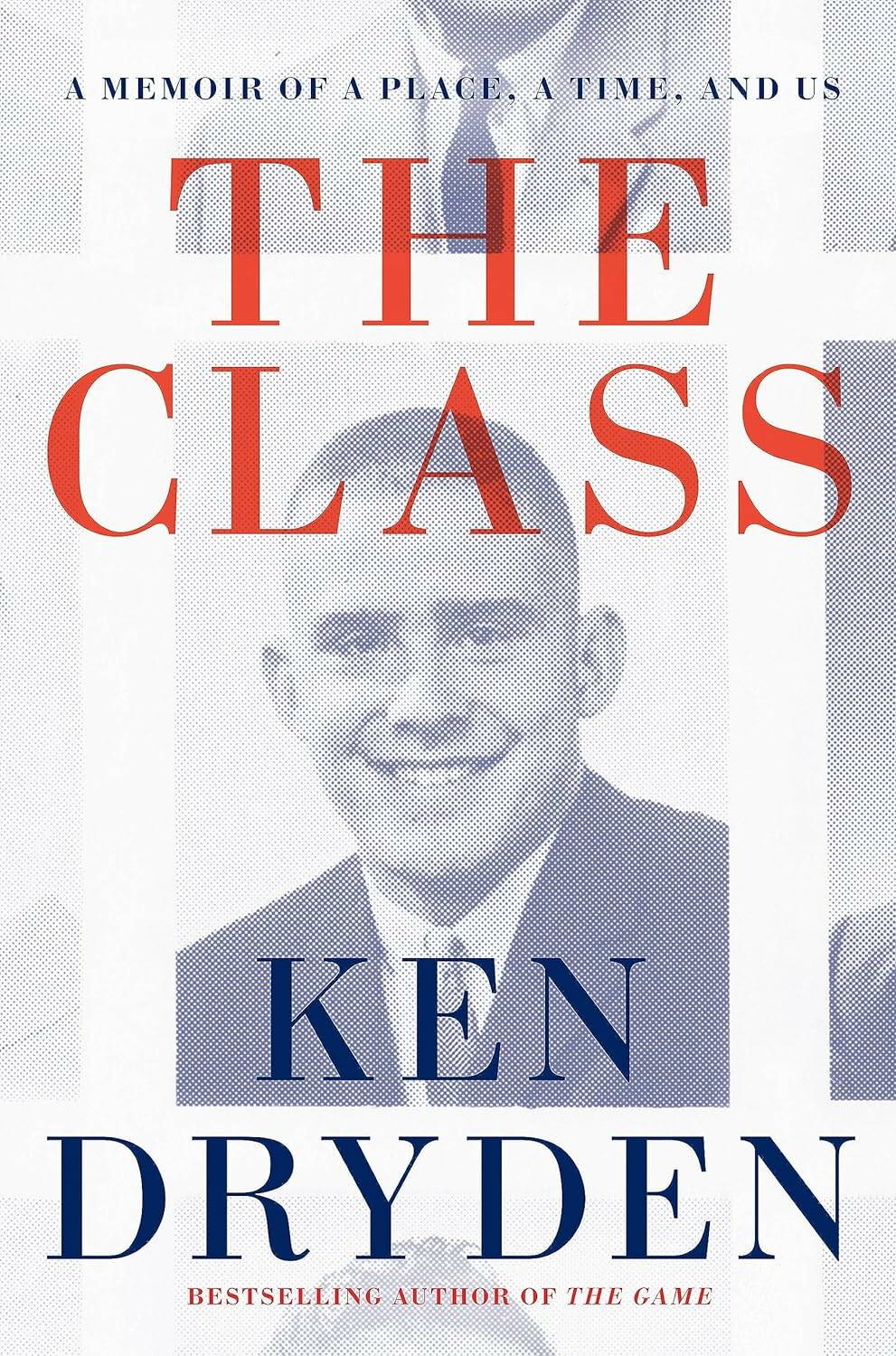
The Class

The Class

As a Vezina Trophy winner — voted best goalie in the NHL — on a Montreal Canadiens team that won six Stanley Cups, Dryden is well-respected as an author on hockey topics. But he’s not just remembered as an ex-hockey player and as a writer he’s not been restricted to just that field.

Two early books, The Moved and The Shaken: The Story of One Man’s Life (1993) and In School: Our Kids, Our Teachers, Our Classrooms (1995) point the way to The Class. The former is a story about the life of “an average Joe” from school to late middle age; the latter about the importance of education to Canadian society.

The Class, he confesses at the outset, has been on his mind for 30 years, putting it right back alongside these two books. He also references Michael Apted’s Up documentary series as an influence.

The Class is divided into eight sections, each devoted to a different era of Canadian history — from “The Early Years” (post-war 1940s and 50s) to the time of “The Big Changes” (1980s) to “Getting to Here” (retirements and deaths in the 21st century). His history is mainly generalizations spiced with pertinent, brief stories about events in the lives of relevant classmates to illustrate each era.

Dryden seems to have strong observational powers and an astonishing memory. His introductory characterizations are brilliantly precise, if not models of good sentence variety. Peggy Clark, for instance, “was this fun, tidy little person who took up no more space than she needed. She wasn’t much over five feet tall, probably weighed a hundred pounds. She had short hair. She liked to talk and laugh, but not too loud or too much. She was eager without being annoying, upbeat without being exhausting, nice but not teeth-achingly so, capable and competent without being anal.” Such thumbnail sketches bring everyone to life.

Not every student gets equal coverage. Dryden is carefully complimentary to them all (it’s like a hagiography with no mention anywhere at all of acne, sex, drugs, illicit love affairs or even teenage hijinks), but some of their life stories merit a mere page or two. Those classmates whose lives are more varied and richly dramatic get as many as 10 or 12 pages.

Dryden recounts moments from his own life to cap off each era. He tries to be modest, spending a few scanty paragraphs on such things as his Canadiens career and his Liberal Party years. But he’s a man of varied and interesting accomplishments, so he invariably tops almost all of the others — though some of their lives are more dramatic.

The Class is like an anthropology text — an insider writing about a tribe of white, suburban Baby Boomers during an important era of Canadian history. It’s contemplative, thoughtful and revealing, probably best appreciated by other Boomers or their kids.

Gene Walz is not a suburban Toronto Baby Boomer, but he could relate to many of their experiences.

Ken Dryden launches The Class on Monday at 7 p.m. at McNally Robsinson Booksellers’ Grant Park location, where he’ll be joined in conversation with Free Press editor Paul Samyn.

Report Error Submit a Tip

More Stories

Obsessed stalker who shot, killed young woman at bus stop in 1993 dies behind bars at age 74

Erik Pindera 3 minute read Preview

Obsessed stalker who shot, killed young woman at bus stop in 1993 dies behind bars at age 74

Erik Pindera 3 minute read 5:53 PM CDT

A Winnipeg man who stalked a woman for several years before shooting her dead in the street in 1993 has died in Stony Mountain prison.

On Monday, 74-year-old Ronald Edd Bell died of apparent natural causes at the federal prison just north of Winnipeg, the Correctional Service of Canada said.

Bell had been in prison since May 30, 1994, when he was given a life sentence with no chance of parole for 18 years for killing Terry-Lyn Babb, 25, on Jan. 21, 1993.

Bell walked up behind an unsuspecting Babb, who was waiting at a bus stop at Sherbrook Street and Wolseley Avenue, and shot her in the head with a pistol in front of horrified witnesses, says the Free Press report of his sentencing hearing.

Read
5:53 PM CDT

Orange Shirt Day project fits students to a tee

Maggie Macintosh 5 minute read Preview

Orange Shirt Day project fits students to a tee

Maggie Macintosh 5 minute read Yesterday at 6:57 PM CDT

On the eve of Orange Shirt Day, hundreds of black T-shirts will be handed out to teenagers at Elmwood High School — and there wasn’t a mixup in the clothing procurement process.

The student-run business behind the initiative wanted to make a statement about “truth and reconciliation” being a year-round activity, said Daniel Concepcion, a Grade 12 student.

Daniel said given that black is a staple in the wardrobe of teenagers, he hopes these shirts won’t sit on hangers for 364 days of the year.

“Every child matters, every part of the day, every day,” the 17-year-old said.

Read
Yesterday at 6:57 PM CDT

Manitoba PC leader Khan survives confidence vote

Carol Sanders 3 minute read Preview

Manitoba PC leader Khan survives confidence vote

Carol Sanders 3 minute read Updated: Yesterday at 8:33 PM CDT

Manitoba Progressive Conservative Leader Obby Khan survived a confidence vote last week.

Caucus communications director Alison Sutherland confirmed the vote was held Friday and that Khan still has “the full confidence” of the PC caucus.

She did not provide further details.

The party under Khan’s leadership is floundering, a recent poll suggests.

Read
Updated: Yesterday at 8:33 PM CDT

Completely separating inmates unrealistic, inquest judge says in report on three Stony Mountain slayings

Erik Pindera 5 minute read Preview

Completely separating inmates unrealistic, inquest judge says in report on three Stony Mountain slayings

Erik Pindera 5 minute read 1:43 PM CDT

Nothing short of keeping inmates separated at all times could have prevented three unrelated prisoner-on-prisoner killings several years ago in Stony Mountain Institution’s maximum-security unit, an inquest judge has found.

Provincial court Judge Lindy Choy made the finding after overseeing an inquest earlier this year into the slayings of Adrian Fillion, 42, Michael Monney, 27, and Nolan Thomas, 26, all of which occurred at the hands of fellow maximum-security inmates in the federal prison just north of Winnipeg. The killings occurred when cells were unlocked, allowing inmates to briefly move around to other areas in the cell block.

“The overall impression I was left with from the (Stony Mountain Institution) witnesses was that management of inmates in a custodial facility is a very complex undertaking. There are clearly multiple levels of oversight involved in any decisions that are made and it is all done in a very structured manner,” Choy wrote in her report on the inquest, which was made public Tuesday.

“While maintaining complete physical distance between inmates at all times would have prevented the homicides from occurring, we know that from a social and psychological perspective, this is not generally realistic nor acceptable.”

Read
1:43 PM CDT

Wab Kinew as ‘communicator in chief’

Paul G. Thomas 6 minute read Preview

Wab Kinew as ‘communicator in chief’

Paul G. Thomas 6 minute read Yesterday at 2:00 AM CDT

Premier Wab Kinew and his party have been riding high in the polls longer than normal for a government one year or less away from its first re-election contest. One reason is his ubiquitous, dominating communications presence as NDP leader and premier.

The argument here is that Kinew has supplemented his prerogatives as premier and party leader (such as appointing cabinet ministers and approving party nominations) with the skilful use of communications to advance his policy agenda, boost his personal popularity and maintain the competitive advantage of his party over the opposition Progressive Conservatives.

Communications has always been a significant part of politics and policy making. However, in the contemporary political and media environments, communications considerations have moved from the background to the foreground of decision-making by political parties, including when they are performing in the role of government. Campaigning and governing now overlap in what has been described as a permanent election campaign.

Political parties use communications strategies for several purposes: to establish an image of the leader which makes a positive emotional connection with voters; to promote a coherent message and to keep party members on message; and to gain favourable media coverage for its policies and other actions on almost a daily basis.

Read
Yesterday at 2:00 AM CDT

Klein vows to freeze water, sewer rate for next two years

Joyanne Pursaga 5 minute read Preview

Klein vows to freeze water, sewer rate for next two years

Joyanne Pursaga 5 minute read 6:09 PM CDT

Mayoral candidate Kevin Klein is promising to cancel a water and sewer rate hike proposed for next year and freeze the fee for two years.

Klein said Winnipeggers are simply paying far too much for the utility.

“I think we have to freeze them right now because we’ve seen (a substantial increase) in the last four years. We are facing some of the most difficult financial times for families right now,” he said.

He would also ask the provincial Public Utilities Board to set Winnipeg’s future water and sewer rates, a power currently held by city council.

Read
6:09 PM CDT