
Increase in metal mining brings elements of danger

Advertisement

Advertise with us

As more and more technology is replaced by renewable sources, metal, which makes “most technology, industry, and lifestyle comforts possible,” Christopher Pollon notes, will become increasingly essential to human existence.

Read this article for free:


or

Already have an account? Log in here »

To continue reading, please subscribe:

Subscribe and receive a limited-edition Free Press branded hat or tote.

Digital Subscription

One year of digital access for only $205*

  • Enjoy unlimited reading on winnipegfreepress.com
  • Read the E-Edition, our digital replica newspaper
  • Access News Break, our award-winning app
  • Play interactive puzzles

*First annual payment billed as $205.00 + GST for one year. This annual subscription will automatically renew at $233.00 + GST every 52 weeks (10% off the regular annual price of $259.35). Offer available to new and qualified returning subscribers only. Cancel any time.

To continue reading, please subscribe:

Add Free Press access to your Brandon Sun subscription for only an additional

$1 for the first 4 weeks*

  • Enjoy unlimited reading on winnipegfreepress.com
  • Read the E-Edition, our digital replica newspaper
  • Access News Break, our award-winning app
  • Play interactive puzzles
Start now

*Your next Brandon Sun subscription payment will increase by $1.00 and you will be charged $17.95 plus GST for four weeks. After four weeks, your payment will increase to $24.95 plus GST every four weeks.

Hey there, time traveller!
This article was published 28/10/2023 (1083 days ago), so information in it may no longer be current.

As more and more technology is replaced by renewable sources, metal, which makes “most technology, industry, and lifestyle comforts possible,” Christopher Pollon notes, will become increasingly essential to human existence.

Procuring ever more metal is at the heart of the conflicts described in pessimistic detail by the Vancouver independent journalist in his new book.

Cobalt, copper and lithium, as well as many rare earth elements crucial to batteries for electronics and vehicles, demand huge expenditures of energy and labour. Seductive profits attract investment — and corrupt governments — in developed and developing countries.
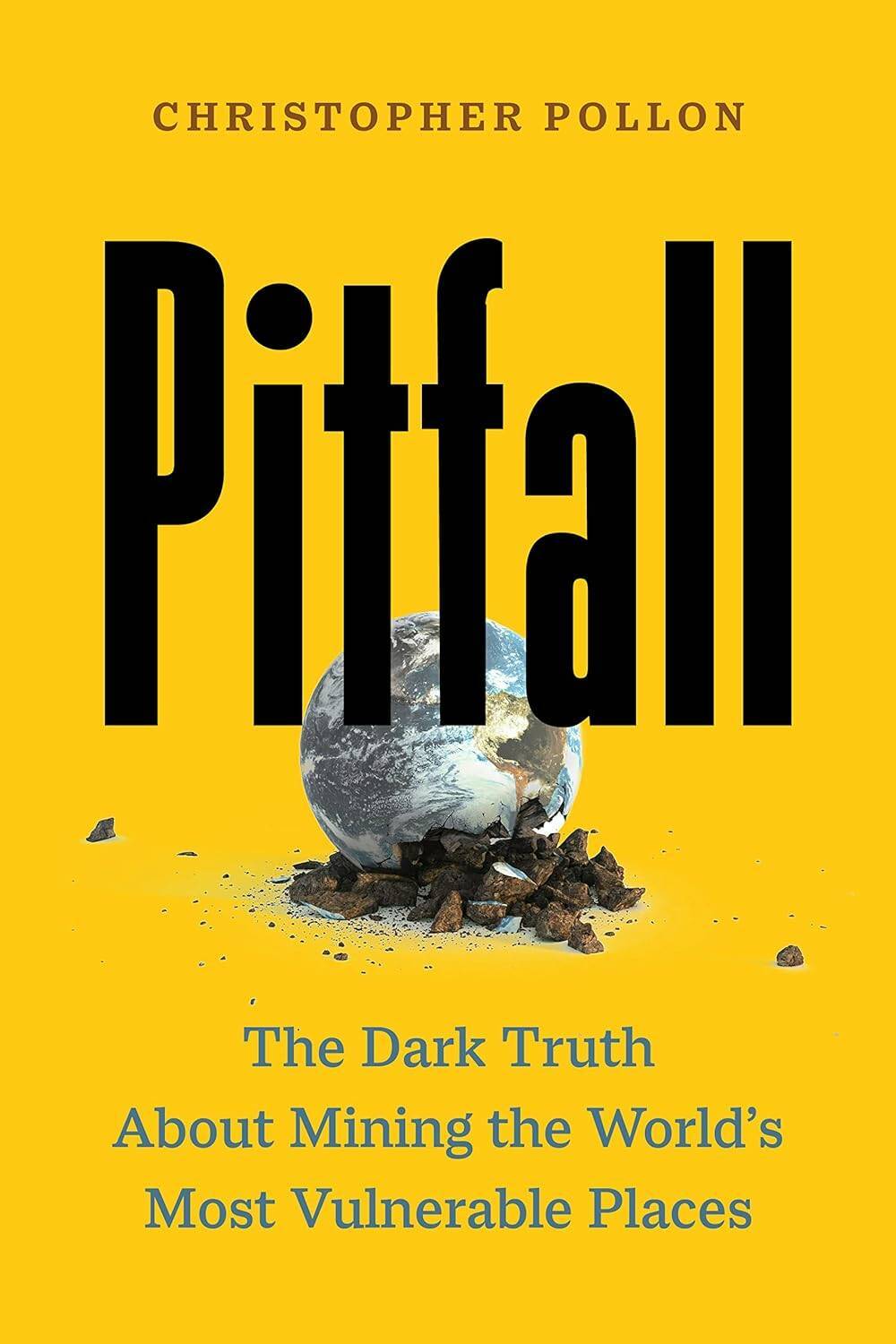
While Canada and other modernized nations move to less and less carbon-intensive technologies, the metals necessary for that transition are being wrenched from the earth with increasing difficulty. These efforts cause almost unimaginable damage to the environment, and to the societies and people living near thousands of mines worldwide.

Pollon focuses mostly on the global south, “low- and middle-income nations in Africa, Asia, Oceania and Latin America,” where mines are operated by a dizzying cast of companies and corporations, almost half of which have Canadian connections.

Pollon has written for National Geographic, the Walrus and the Globe and Mail, and is a contributing editor at the Tyee. His 2016 book The Peace in Peril examined potential consequences of the Site C dam on the Peace River. He chose the overwhelming subject of mining after the 2014 collapse of the tailings dam at Mount Polley, B.C.

Criss-crossing the global south, Indonesia and Papua New Guinea, the Democratic Republic of the Congo (DRC), Australia, Chile, Guatemala and many more, Pollon exposes the difficulties of mining and the resulting “sacrifice zones,” where environmental destruction continues to affect governments, international entities, local societies and people.

Mind-boggling descriptions rely on facts, not sensationalism, for effect, but are altogether chilling.

Huge consortiums, wealthy speculators and the vast majority of “artisanal” or individual miners (who produce about 10 per cent of the world’s metal) all play their part in the destructive tradeoffs. The whole book discusses nuanced complications — pitfalls — of modern lifestyles.

Chinese involvement — owners of 80 per cent of cobalt mines in DRC and 80 per cent owners of Indonesian nickel smelters — is probably only partly understood, as mining problems within that country cannot be adequately investigated.

DRC cobalt mining problems are worrisome; nickel is one alternative. However, Indonesian coal power for “the process required to create battery-grade nickel from low-grade Indonesian ore is raising serious questions about what it really means to be green,” Pollon writes.

“Building out just the first generation of a fully transitioned clean energy society will require almost five billion tons of copper alone,” he notes. “Meeting such targets is not possible… but the real danger will come when the world’s mining companies, emboldened by their new role as climate saviours, try to do it nonetheless.”

Pollon also notes possible futures of mining, some of them still virtually science fiction: robots working deeper and deeper in the earth and under the sea, eventual mining of the moon or asteroids.

However, such developments would require more educated supervision, and throw desperate workers out of currently inadequate jobs, continuing to devastate impoverished people financially, if not physically.

Pollon does mention the possibility of “degrowth” as a mitigation of environmental damage inflicted by mining. However, arresting growth in developed countries would also halt progress in poorer parts of the world like the global south.

One possible solution, or dystopian outcome, would be urban mining: reclaiming metal and other resources already produced. Pitfall indicates that intensified reuse, recycling and other social changes cannot come too soon.

Bill Rambo is a retired teacher living in Landmark.

Report Error Submit a Tip

More Stories

Hit the brakes on driving lessons from mate

Maureen Scurfield 5 minute read 2:00 AM CDT

DEAR MISS LONELYHEARTS: I’ve been trying to learn to drive in busy traffic. My boyfriend said he would teach me, but he gets too playfully amorous while I’m trying to drive his new car in busier areas like downtown. He thinks it’s a big joke, but when I yelled that he was distracting me, he said, “Good.”

So I pulled over, slammed on the brakes and got out, thinking he would get back into the driver’s seat and drive us home, but he didn’t budge. He was being a real jerk.

I got back in, drove us to my place in silence, left the keys in the ignition and went inside and locked my door. Now we’re not talking and neither one of us is apologizing. What do you think?

— Still Mad, St. James

Jets top line powers win over Wild

Ken Wiebe 7 minute read Preview

Jets top line powers win over Wild

Ken Wiebe 7 minute read Tuesday, Oct. 13, 2026

Cole Perfetti has made it clear he doesn’t want to get ahead of himself.

The Winnipeg Jets winger has first-hand knowledge on how humbling the NHL can be, coming off a quiet campaign as he worked his way back from a high ankle sprain.

But with the benefit of a full summer of training and a return to health, Perfetti has taken advantage of his promotion to the top line and quickly shown he belongs.

The latest proof came Tuesday, with Perfetti scoring a pair of goals — including the game-winner — in a 5-2 victory over the Minnesota Wild at Canada Life Centre.

Read
Tuesday, Oct. 13, 2026

Liberal MLA’s autism strategy bill gains all-party backing

Carol Sanders 3 minute read 2:00 AM CDT

Manitoba could soon have an autism strategy for the first time, thanks to a private member’s bill that’s garnered rare all-party support in the legislature.

Liberal MLA Cindy Lamoureux’s Bill 232, the Autism Strategy Act introduced in March, would require the government to establish a policy designed to improve the screening and diagnosis of autism spectrum disorder and support research.

It would identify ongoing supports and services needed by people with autism and their families and caregivers. It calls for annual reports tracking the implementation of the measures identified in the strategy, with a mandatory review and updates of the legislation every five years.

The bill goes before the legislature’s standing committee on social and economic development committee Friday. As of Wednesday, 87 private citizens and organizations registered to weigh in on the proposed legislation.

‘We know we’re not going to beat Mother Nature’: Ice prep begins at Princess Auto Stadium for Heritage Classic

Mike McIntyre 6 minute read Preview

‘We know we’re not going to beat Mother Nature’: Ice prep begins at Princess Auto Stadium for Heritage Classic

Mike McIntyre 6 minute read Tuesday, Oct. 13, 2026

Derek King typically has ice in his veins.

But the Manitoban admits there may be a few more butterflies than usual as he prepares for the ultimate home game — the 2026 Heritage Classic between the Winnipeg Jets and Montreal Canadiens.

“This is so exciting to be back,” King, the NHL’s vice-president of hockey operations and facilities operations, said Tuesday afternoon.

“It’s definitely going to be a fun event to be part of.”

Read
Tuesday, Oct. 13, 2026

Chief says minister offered money to remove highway checkstop

Kelly-Anne Riess 5 minute read Preview

Chief says minister offered money to remove highway checkstop

Kelly-Anne Riess 5 minute read Yesterday at 5:53 PM CDT

The chief of the Bloodvein River First Nation says a Manitoba cabinet minister offered up to $250,000 for economic development as he was trying to persuade her to remove a highway checkstop that has outraged hunters.

Chief Lisa Young said Ian Bushie, the minister of Indigenous futures, raised the money in a private conversation in September, also telling her the First Nation would receive a letter directing it to move the checkstop because it’s on a provincial highway.

Young said Bushie described the money as support for economic development in the community.

“I really felt like I was being pushed into a corner. I also felt that I was being bribed,” Young said in an interview. “It may not have come off that way. But he even further said, ‘And I’m not bribing you.’ So, I really didn’t know what to say.”

Read
Yesterday at 5:53 PM CDT

Developer ‘anxiously’ awaits judge’s decision on Granite Curling Club construction

Joyanne Pursaga 4 minute read Preview

Developer ‘anxiously’ awaits judge’s decision on Granite Curling Club construction

Joyanne Pursaga 4 minute read Tuesday, Oct. 13, 2026

The developer of a hotly debated project that would add 110 housing units to the Granite Curling Club’s parking lot has begun investigative work at the site while awaiting a judge’s decision on construction.

While some digging took place at the city-owned property last week, its developer said construction has yet to begin.

“I would call (the digging so far) investigative site work. It’s not preparing in any way for construction, other than to ensure that the reports that are required for any site have been completed,” said Jeremy Read, chief executive officer of UWCRC 2.0 Inc.

A heritage resources impact assessment will determine if the site has archeological significance. That work will check for everything from fossils to unmarked graves, said Read.

Read
Tuesday, Oct. 13, 2026

