Writing in the wake
Lubrin grapples with French king’s decrees in visceral, disruptive debut fiction
Advertisement
Read this article for free:
or
Already have an account? Log in here »
To continue reading, please subscribe:
Digital Subscription
One year of digital access for only $1.44 a week*
- Enjoy unlimited reading on winnipegfreepress.com
- Read the E-Edition, our digital replica newspaper
- Access News Break, our award-winning app
- Play interactive puzzles
*Billed as $5.77 plus GST every four weeks. After 52 weeks, price increases to the regular rate of $19.95 plus GST every four weeks. Offer available to new and qualified returning subscribers only. Cancel any time.
To continue reading, please subscribe:
Add Free Press access to your Brandon Sun subscription for only an additional
$1 for the first 4 weeks*
- Enjoy unlimited reading on winnipegfreepress.com
- Read the E-Edition, our digital replica newspaper
- Access News Break, our award-winning app
- Play interactive puzzles
*Your next Brandon Sun subscription payment will increase by $1.00 and you will be charged $17.95 plus GST for four weeks. After four weeks, your payment will increase to $24.95 plus GST every four weeks.
Read unlimited articles for free today:
or
Already have an account? Log in here »
Hey there, time traveller!
This article was published 23/03/2024 (942 days ago), so information in it may no longer be current.
Respected, celebrated poet Canisia Lubrin has turned her attention to fiction in her striking new work, Code Noir: Metamorphoses, which takes on King Louis XIV’s infamous set of decrees, Les Codes Noir, that determined the conditions of chattel slavery throughout the French colonial empire — the effects of which continue to resonate today.
King Louis XIV’s original Code had 59 articles, and Lubrin’s book contains 59 fictions that vary in length, setting, perspective and genre. Lubrin’s fictions play with form, time and polyvocality; they are always already grounded in the making and unmaking of historical narratives of Black diasporic experience, a thematic undercurrent evident in Lubrin’s previous lauded, award-winning poetry collections, Voodoo Hypothesis and The Dyzgraphxst.
One cannot read Lubrin for long without encountering the ideas and influence of Christina Sharpe, whose ground-breaking 2016 work, In the Wake: On Blackness and Being, takes up the word “wake” referring to the disturbance that follows a boat’s movement through water, and posits that we are all still “in the wake” — the aftermath, the lasting effects, the lingering traces — of the Middle Passage, the slave ship.

Rachel Eliza Griffiths photo
The 59 fictions in Canisia Lubrin’s new book are grounded in the making and unmaking of historical narratives of the Black diasporic experience.
How, then, does one create in the wake? Lubrin’s response in Code Noir is astonishing, challenging, disruptive. Her stories at times are aware of themselves, generating a kind of conjuring and slippage of time.
The reader of Code Noir will not be passively entertained, as is suggested by the opening (“keep pace with what is about to happen in these pages”) and closing remarks (“now that you have read all the early drafts, prepare for consequences from friends, lovers and enemies”).
A beautiful way into Lubrin’s work is to listen to her reading it. Something of the text comes alive, her voice strong and musical and feeling where the pauses need to be.
But the Code Noir audiobook should come with a proviso: don’t miss out on the extraordinary visual art by Torkwase Dyson included in the text version. Each of Lubrin’s fictions is preceded by an article from the actual Code, and Dyson has created original works of charcoal on paper that subvert, obscure and transform the black-and-white historical text.

During a rich, unhurried conversation with David Naimon on the esteemed Between the Covers podcast, St. Lucian-born Lubrin describes her first encounter with the work of Dionne Brand as the irrevocable, life-altering moment in which she recognized a shared frequency, could hear her own innermost voice and realized that she too could create literature.
Lubrin and Brand, both now Ontario-based, have since collaborated over the years. The two were co-winners among eight international authors in 2021 of the prestigious Windham-Campbell Prize, and both have been recipients of the OCM Bocas Prize for Caribbean Literature. When Brand was appointed head of Knopf Canada’s Alchemy program, Lubrin took over as poetry editor for McClelland & Stewart.
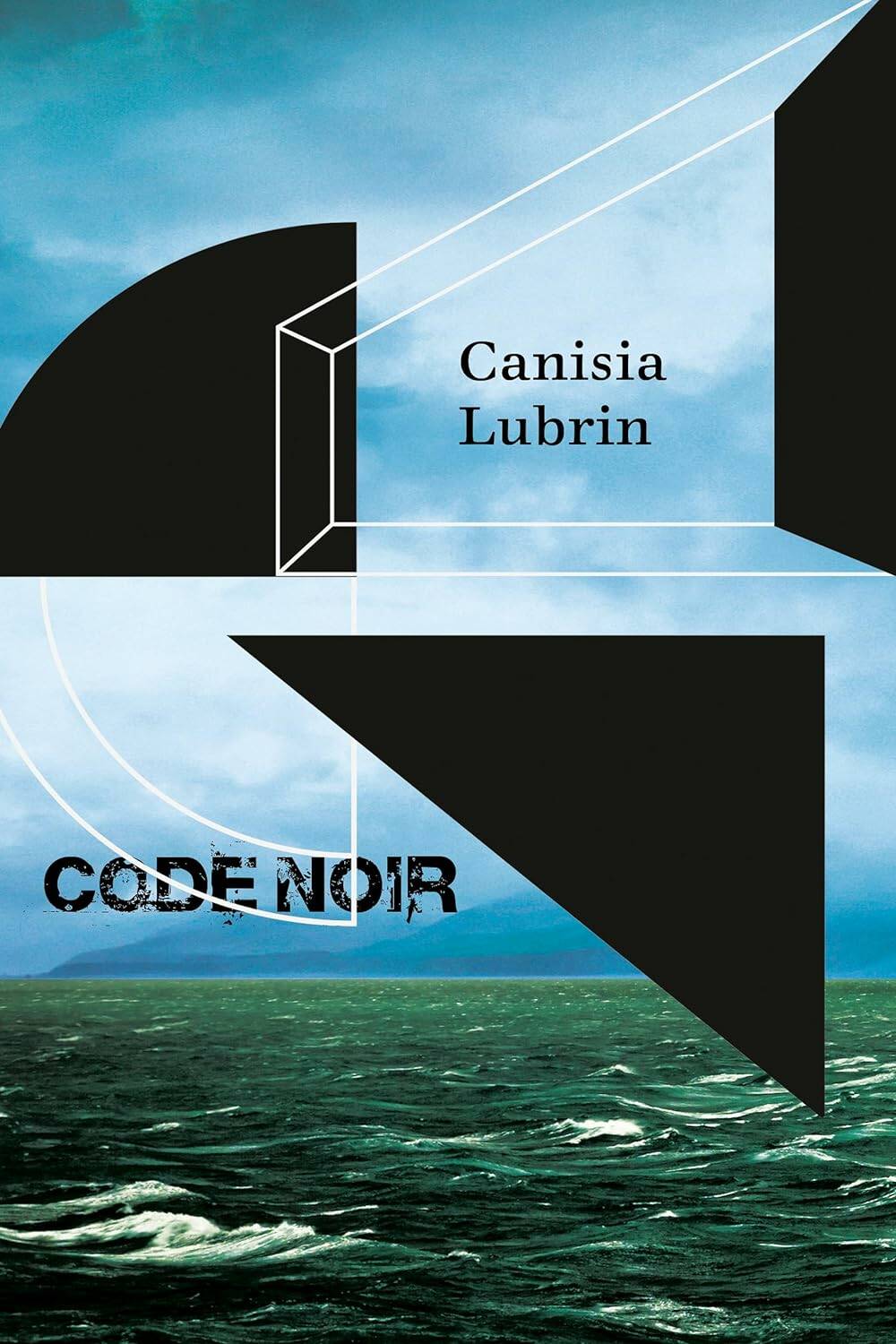
David Naimon concludes his impressively researched, comprehensive introduction to Lubrin’s Code Noir by quoting Brand’s in-depth blurb of the novel. And, given the value Lubrin places on collaboration — with Dyson, Sharpe, Brand and others — this review follows Naimon’s lead in bringing in other voices and giving Brand the last word:
Code Noir is storytelling at its deepest and most intimate. The stories take you into their confidences — confidences that are knowing, but at the same time defamiliarizing. You have to meet their speakers wherever they are in their lives. These speakers know things they shouldn’t know and, uncannily, they know things that you know. Things about lullabies and dogs and elephants. The stories say, loneliness is nostalgia; they listen to Billie Holiday during a war; they know the decrees of Code Noir, that 17th century rulebook for Black life; they know the realm of time, where best friends drown in rivers. Some of these stories are like looking through blue sea glass, some are like drinking strong liquor, some are like a whiff of smoke and then an orange light. These stories are magic and you must enter them as if you, too, are wondrous.
Sara Harms is a Winnipeg editor.