The head and the heart
Medicine wheel proves pivotal for tackling today’s complex ecological issues
Advertisement
Read this article for free:
or
Already have an account? Log in here »
To continue reading, please subscribe:

Digital Subscription
One year of digital access for only $205*
- Enjoy unlimited reading on winnipegfreepress.com
- Read the E-Edition, our digital replica newspaper
- Access News Break, our award-winning app
- Play interactive puzzles
*First annual payment billed as $205.00 + GST for one year. This annual subscription will automatically renew at $233.00 + GST every 52 weeks (10% off the regular annual price of $259.35). Offer available to new and qualified returning subscribers only. Cancel any time.
To continue reading, please subscribe:
Add Free Press access to your Brandon Sun subscription for only an additional
$1 for the first 4 weeks*
- Enjoy unlimited reading on winnipegfreepress.com
- Read the E-Edition, our digital replica newspaper
- Access News Break, our award-winning app
- Play interactive puzzles
*Your next Brandon Sun subscription payment will increase by $1.00 and you will be charged $17.95 plus GST for four weeks. After four weeks, your payment will increase to $24.95 plus GST every four weeks.
Read unlimited articles for free today:
or
Already have an account? Log in here »
Hey there, time traveller!
This article was published 25/05/2024 (847 days ago), so information in it may no longer be current.
Somewhere in my scientific studies, I recall engineering being defined as “the art of arranging the world so you don’t have to directly experience it.” That would be the diametric opposite of the Indigenous approach to science and ecology, which requires that we directly experience the world around us.
The Indigenous view places us within the environment as an active participant, with responsibilities to sustain ecological health and balance. The Western view places us outside (and above) the environment and detaches us from personal responsibility for its health.
Ecologist Jennifer Grenz faced these mutually incompatible viewpoints when she was attempting to reconcile her Western scientific training with her identity as a Nlaka’pamux (mixed blood) woman of Secwepemc descent. Now an associate professor running the Indigenous Ecology Lab at the University of British Columbia, she has succeeded.

Joel Grenz / Motiontide Media
Dr. Jennifer Grenz
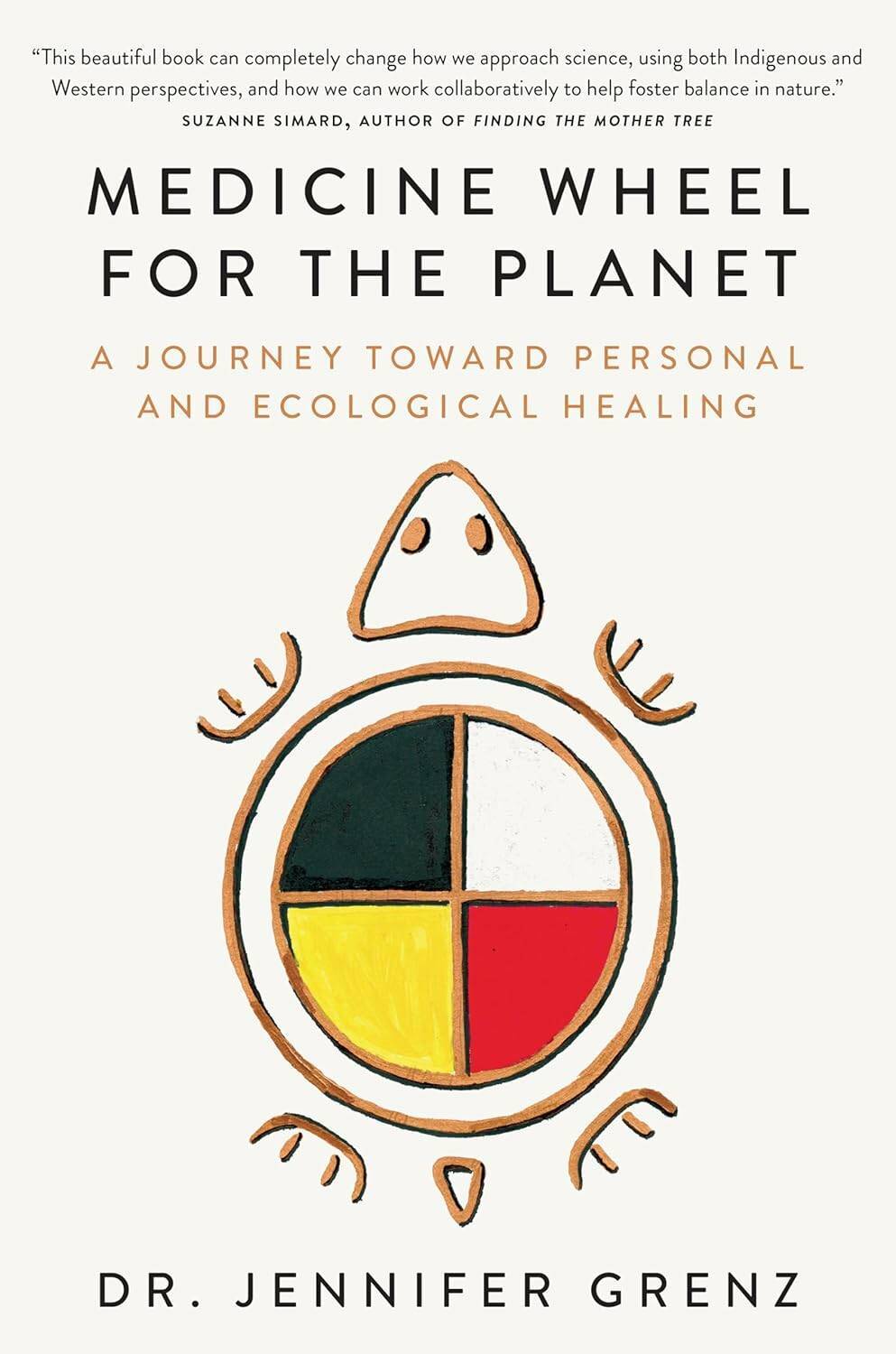
Medicine Wheel for the Planet: A Journey Toward Personal and Ecological Healing is her story of how she got there. But it is also a personal story of the struggle with the ongoing dismissiveness of Indigenous perspectives in Western science and the “do-gooder angst” she experienced after so many laborious efforts to reclaim damaged environments using the Western approach had failed.
As a field practitioner earlier in her career, Grenz followed the standard “Eden” ecology that seeks to return damaged lands to an idealized, pre-contact “natural state.” The Eden model is simple: eradicate bad species and plant good species. For Grenz, that sometimes meant climbing mountainsides, slogging through mud and prickly thickets with her team to eradicate some vast patch of Himalayan blackberries, an invasive species. Or it meant two months of miserable weather spent planting conifers on an old landfill site in miserable weather. But it didn’t work. The blackberries did not die; they flourished. And those conifers, Grenz learned, had all died. All of them.
As Grenz writes, those situations were gutting, but the worst was desk-bound policymakers ignoring her field experience and creating rules that made “zero” ecological sense. It was then that she realized she needed to go back to university and to explore the stories she’d heard from her people’s Elders about the relationality of all elements of the land.
Thus began her journey around the medicine wheel directions beginning at North, as she acknowledged the wisdom of the elders and the duty of humans to sustain the environment’s balance; East as she learned and tried out new ideas and approaches to relationality; South as she put her learning and ideas into practice; and West to reap the harvest of her efforts.
It did seem possible, after all, to utilize the best of the Western and Indigenous world views to address complex ecological issues, to traverse the challenging journey of connecting the head (Western) to the heart (Indigenous). Ecological fixers with technological knowledge could work with the balancers guided by wisdom. And we could all be balancers in helping create a healthy environment.

Each way of knowing, writes Grenz, “can act as a catalyst for the other. Together, they provide a more accessible and complete picture. Sometimes we need more of one than the other. Neither is better. They are simply better together. Both are science.”
However, academic disciplines are notoriously resistant to accommodating new perspectives and sciences such as the quantum physics and cosmology seem even more hidebound than living sciences such as biology and ecology. Nonetheless, Grenz was warned that advancing ecology from an Indigenous perspective could be career limiting. She does hint at some of the eye-rolling and dismissiveness her work faced, but does not dwell on it. Having seen how quickly scientists can shut down and shut out people challenging the prevailing dogma, one suspects she could have said a great deal more.
Medicine Wheel for the Planet
However, Grenz is not alone in her quest. Incorporating Indigenous perspectives into some fields of study in North America and Australia has been part of education, health care and science research for more than a decade. In Canada, the University of Manitoba hosted the 2022 Turtle Island Indigenous Science Conference, with the 2024 conference happening this year at the University of Regina.
Much of Grenz’s story focuses on her own personal journey, but she does at times take a wider lens on historical elements, including describing the complex food systems that were employed more than 2,000 years ago by the substantial Indigenous communities along the Pacific Coast. Those who garden or farm are likely to connect with Grenz’s passion for creating a balanced ecology for our produce and crops, and also for the butterflies, bees, birds and wildlife with which we share this land.
Sheilla Jones is a Winnipeg author with a master’s degree in physics and is now a doctoral student in peace and conflict studies at the University of Manitoba.