Rhetoric a powerful, often perilous tool of persuasion
Advertisement
Read this article for free:
or
Already have an account? Log in here »
To continue reading, please subscribe:

Digital Subscription
One year of digital access for only $205*
- Enjoy unlimited reading on winnipegfreepress.com
- Read the E-Edition, our digital replica newspaper
- Access News Break, our award-winning app
- Play interactive puzzles
*First annual payment billed as $205.00 + GST for one year. This annual subscription will automatically renew at $233.00 + GST every 52 weeks (10% off the regular annual price of $259.35). Offer available to new and qualified returning subscribers only. Cancel any time.
To continue reading, please subscribe:
Add Free Press access to your Brandon Sun subscription for only an additional
$1 for the first 4 weeks*
- Enjoy unlimited reading on winnipegfreepress.com
- Read the E-Edition, our digital replica newspaper
- Access News Break, our award-winning app
- Play interactive puzzles
*Your next Brandon Sun subscription payment will increase by $1.00 and you will be charged $17.95 plus GST for four weeks. After four weeks, your payment will increase to $24.95 plus GST every four weeks.
Read unlimited articles for free today:
or
Already have an account? Log in here »
Hey there, time traveller!
This article was published 10/08/2024 (769 days ago), so information in it may no longer be current.
The term “civil debate” seems oxymoronic these days. In the U.S. and, increasingly, in Canada, political discussion has descended into bitterness and obstructionism, a state of affairs in which defenders of each side are convinced they’re right and have no interest in respectful dialogue with “the other side.” Appealing to reason or pointing to the facts is clearly not going to solve the problem — we’re way beyond that.
So what can we do? In The Ancient Art of Thinking for Yourself: The Power of Rhetoric in Polarized Times, Robin Reames, an associate English professor at the University of Illinois, makes a compelling case that help can be found within the long tradition of rhetorical study and practice. By “rhetoric” Reames does not mean only persuasion, as the word commonly signifies. It is, rather, “a meta-language that describes and explains how language works.” Greater knowledge of rhetoric in this sense can (for better or worse) improve our ability to persuade others, but it can also reduce our susceptibility to weak or dishonest appeals and provoke awareness of our own biases.
History provides abundant evidence of our susceptibility to unethical appeals, especially in polarized times. In the 5th century BCE, Athenians were persuaded by the general Alcibiades to fight a disastrous war. Reames concedes their misjudgment was understandable, since Alcibiades was not just wealthy but clever, handsome, athletic and a war hero to boot.
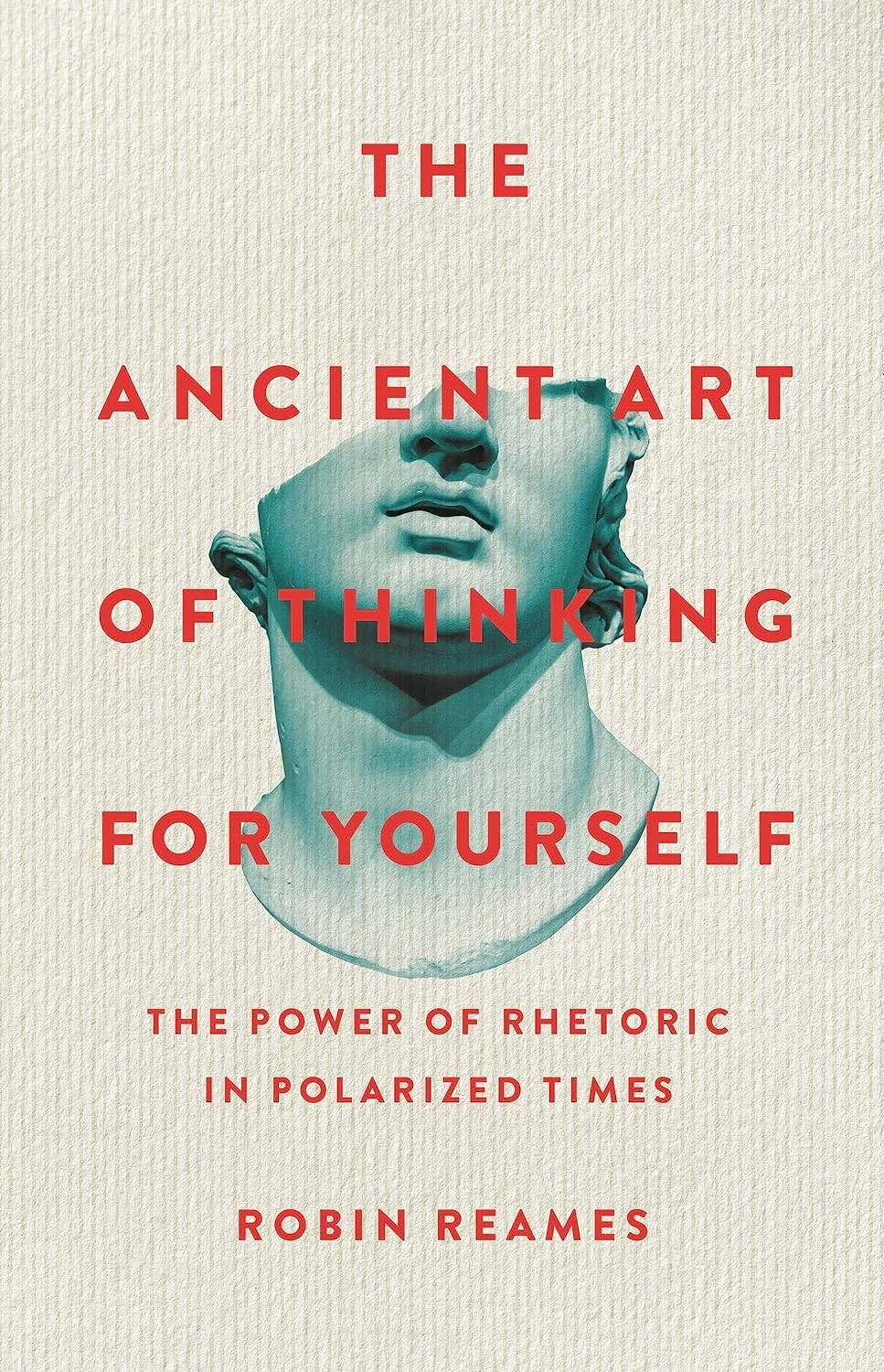
The Ancient Art of Thinking for Yourself
By contrast, the rhetorical success of Donald Trump is puzzling, particularly when he goes off script, inventing facts and rambling incoherently.
Reames, however, offers a plausible explanation: we are still influenced by ancient assumptions that viewed truth as revelation rather than representation. By this definition, speaking off-script reveals “authentic” character. A pre-fabricated speech, however accurate in its representation of the world, is mere imitation, as little like the real thing as a statue is to the living person. Trump has convinced many listeners that he speaks “straight from the heart.”
In the process Trump, like Alcibiades, has also persuaded them that what is best for him is best for everyone. The times and the dissemblers change, Reames tells us, but the power of rhetoric is ever present.
For readers inclined to ask who exactly is most vulnerable and why, the author provides a moving answer in the example of her own life. Reames was a child of America’s Bible Belt, raised by a true believer who taught his daughter “the right way to think about pretty much everything.” When Reames left home and the South to attend university, she began to understand just how much her father had been shaped by Republican slogans about individual rights, free enterprise and government overreach.
Outraged by a congressional phase-out of inefficient incandescent light bulbs, he bought and stockpiled hundreds of them, despite being unemployed and on social security. No government would tell her father what he could and could not buy; he was, laments the author, “made by rhetoric.”
Made, that is, by self-serving persuasion.
Reames believes that all of us can be made by rhetoric in this sense. This is why, in addition to being a cautionary tale of rhetoric’s power to shape others, The Ancient Art is a guide on how to remake ourselves.
Some may laugh at audiences enraptured by Trump, but naiveté about language is commonplace. The best remedy, in Reames’ apt phrase, is to “think rhetorically.” We must view truth not as a fixed entity, above time and space, but as a changing construction, and we must acknowledge our own bias. Interpretation of events is inevitably biased: we select facts; we read these selections through the lenses of our experience, community and “unstated, even ancient assumptions;” and, pleased with our understanding, we reinforce our perspective by following preferred news sources over and over again.
No one can escape this hermeneutic circle completely, but becoming aware of it can make us more flexible and balanced. Widely practiced, such rhetorical thinking will certainly improve the civility in debate.
The Ancient Art is not for everyone. Rhetoric as metalanguage is a subject normally reserved for academic study.
Nonetheless, the author makes it not only accessible but engaging. And for readers who understand that we are all part of the problem — that bias rather than truth is what we all have in common, and that the repair of civil debate begins with the rhetorical conduct of individuals — her timely book may even prove transformative.
Now retired, Brian Turner taught rhetorical criticism at the University of Winnipeg for over 20 years.