Getting to the point… again
Gladwell revisits, updates themes from his breakout bestselling debut
Advertisement
Read this article for free:
or
Already have an account? Log in here »
To continue reading, please subscribe:

Digital Subscription
One year of digital access for only $205*
- Enjoy unlimited reading on winnipegfreepress.com
- Read the E-Edition, our digital replica newspaper
- Access News Break, our award-winning app
- Play interactive puzzles
*First annual payment billed as $205.00 + GST for one year. This annual subscription will automatically renew at $233.00 + GST every 52 weeks (10% off the regular annual price of $259.35). Offer available to new and qualified returning subscribers only. Cancel any time.
To continue reading, please subscribe:
Add Free Press access to your Brandon Sun subscription for only an additional
$1 for the first 4 weeks*
- Enjoy unlimited reading on winnipegfreepress.com
- Read the E-Edition, our digital replica newspaper
- Access News Break, our award-winning app
- Play interactive puzzles
*Your next Brandon Sun subscription payment will increase by $1.00 and you will be charged $17.95 plus GST for four weeks. After four weeks, your payment will increase to $24.95 plus GST every four weeks.
Read unlimited articles for free today:
or
Already have an account? Log in here »
Hey there, time traveller!
This article was published 05/10/2024 (727 days ago), so information in it may no longer be current.
In Malcolm Gladwell’s world, there’s no such thing as too much of a good thing.
Twenty-five years after The Tipping Point made its skinny, frizzy-haired author a star of New York journalism, the southern-Ontario-raised writer returns with more examples of, and explanations for, social epidemics.
Those who appreciated the first outing will likely enjoy the new one, too.

Shannon Greer photo
Malcolm Gladwell’s latest hews closely to the techniques used in his first book The Tipping Point.
Revenge of The Tipping Point hews closely to the techniques Gladwell used the first time out.
In fact, it is a style that has served him well in virtually all his books to date, from Blink and Outliers to Talking to Strangers and The Bomber Mafia.
Again here, Gladwell uses a conversational approach, often rife with digressions (not to mention charts, diagrams and a few too many footnotes), to turn social science research into accessible stories, humanizing their subjects and connecting seemingly unrelated phenomena.
The result, in his words: “a new set of theories, stories and arguments about the strange pathways that ideas and behaviours follow through our world.”
Gladwell did not coin the term “tipping point,” but he certainly “tipped” it into wide usage.
It is, in both his and the dictionary’s usage, “the point at which a series of small changes or incidents becomes significant enough to cause a larger, more important change.”
The examples of social epidemics he cited in his 2000 original ranged from the sudden rise in popularity of the shoe brand Hush Puppies to the dramatic decline of New York City’s crime rate.
In this sequel, his case studies are equally as wide-ranging. He devotes a section to the outsized number of bank robberies in Miami, and another to the high teen suicide rate in an upscale U.S. suburb, here dubbed “Poplar Grove.”
He looks at why the U.S. opioid crisis was so much worse in some states than in others. He examines the points at which the racial makeup of neighbourhoods can change seemingly overnight.
In his original, Gladwell proposed three rules that govern most social epidemics: “The Law of the Few, the Stickness Factor and the Power of Context.”
Here he refines and elaborates on these rules, ideas he encapsulates in his subtitle Overstories, Superspreaders, and the Rise of Social Engineering.
An “overstory” is another form of context. In the case of the opioid epidemic, he relates, a few U.S. states passed laws in the 1940s that made it onerous for doctors to prescribe controlled drugs.
Thus companies like Perdue Pharmaceuticals, the makers of the notorious painkiller OxyContin, concentrated their sales efforts on states with less oversight.
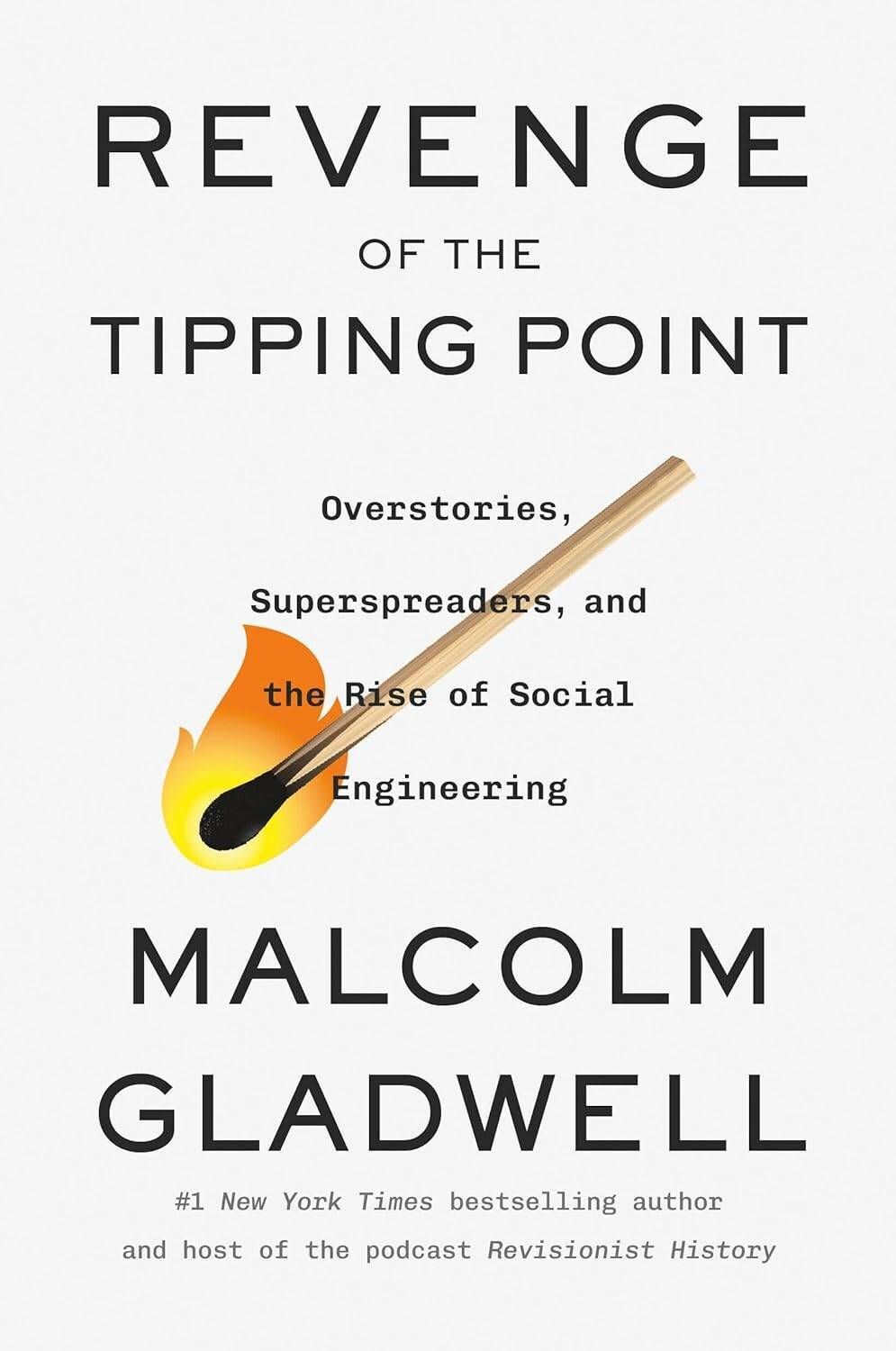
Revenge of the Tipping Point
A superspreader is someone who obeys Gladwell’s Law of the Few, a person whose behaviour has an outsized influence on some trend or event.
This could be a doctor who is promiscuous with his opiate prescription pad, or an individual whose genetic makeup makes her more likely to spread the COVID-19 virus.
One of Gladwell’s key ideas is that social engineering can be consciously wielded to promote change or, in fact, to retard it.
He argues that prestigious U.S. colleges fund second-tier competitive sports such as tennis and rugby to subvert affirmative-action enrolment programs for minority students and benefit the wealthy whites who can afford them.
He credits mass media with being able to effect social change. The Nazi extermination of European Jewry, he shows, was not openly discussed until after the 1978 airing of the ABC miniseries Holocaust.
Gladwell traces the rapid softening of unfavourable North American attitudes toward homosexuality in the early 2000s to the successful run of the sitcom Will & Grace.
In recent years Gladwell, now 61, has pivoted away from print. He appears to have abandoned his perch as a staff writer for the New Yorker magazine.
He has been devoting more time to his podcast Revisionist History and his audio-content company Pushkin Industries.
But it’s good to see he hasn’t given up the form that made him a star in the first place.
Morley Walker is a retired Free Press editor and writer.