Chronicles of a hard-won war
New book highlights Canadian stories in Battle of Britain
Advertisement
Read this article for free:
or
Already have an account? Log in here »
To continue reading, please subscribe:

Digital Subscription
One year of digital access for only $205*
- Enjoy unlimited reading on winnipegfreepress.com
- Read the E-Edition, our digital replica newspaper
- Access News Break, our award-winning app
- Play interactive puzzles
*First annual payment billed as $205.00 + GST for one year. This annual subscription will automatically renew at $233.00 + GST every 52 weeks (10% off the regular annual price of $259.35). Offer available to new and qualified returning subscribers only. Cancel any time.
To continue reading, please subscribe:
Add Free Press access to your Brandon Sun subscription for only an additional
$1 for the first 4 weeks*
- Enjoy unlimited reading on winnipegfreepress.com
- Read the E-Edition, our digital replica newspaper
- Access News Break, our award-winning app
- Play interactive puzzles
*Your next Brandon Sun subscription payment will increase by $1.00 and you will be charged $17.95 plus GST for four weeks. After four weeks, your payment will increase to $24.95 plus GST every four weeks.
Read unlimited articles for free today:
or
Already have an account? Log in here »
Hey there, time traveller!
This article was published 04/11/2024 (672 days ago), so information in it may no longer be current.
Ted Barris says the subject of Canadian airmen in the Battle of Britain “has been in my marrow a long time.”
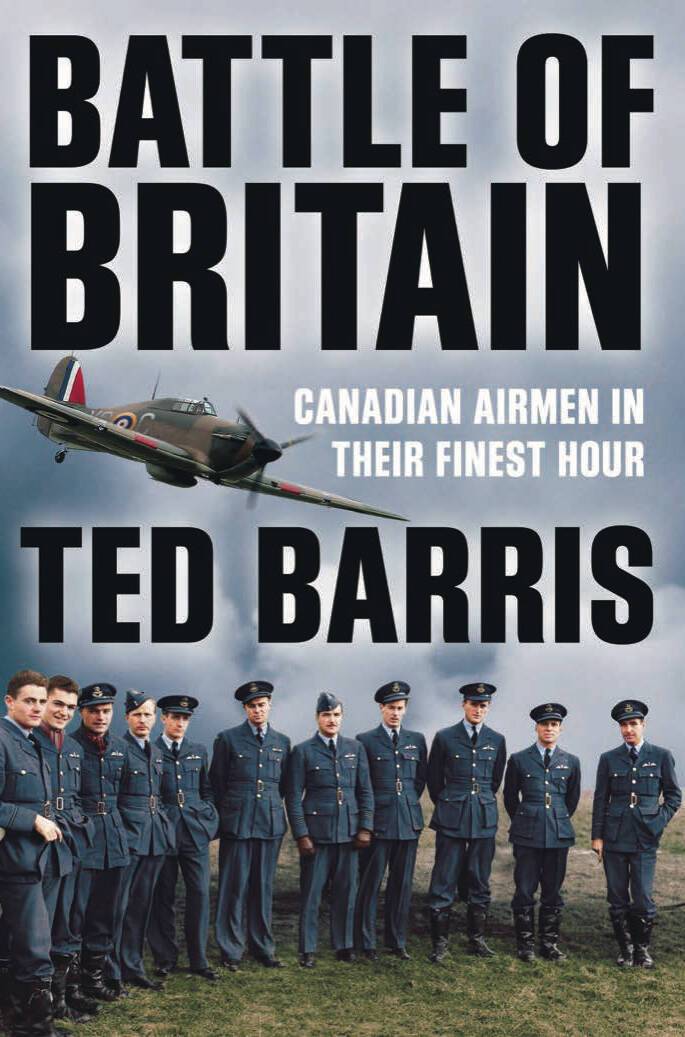
A freelance journalist, broadcaster and former professor of journalism at Centennial College in Toronto, Barris is the author of 22 books, the most recent being Battle of Britain: Canadian Airmen in Their Finest Hour (Sutherland House, 371 pages, $37.95). It’s an exploration of the successful defence of Great Britain against the air raids conducted by the German air force in 1940 after the fall of France during the Second World War.
Barris — who was recently presented with the Order of Canada by Governor General Mary Simon — will be the featured speaker Wednesday at an event sponsored by the Manitoba Chapter of the Canadian Aviation Historical Society at the Royal Aviation Museum of Western Canada.

SUPPLIED
Journalist, broadcaster and former professor Ted Barris has focused on the contributions of Canadian airmen in the Battle of Britain.
“I’ve spent a lot of time digging into air force stories,” Barris says during a telephone interview.
In his research and in conversations with friends, he noticed Canadians were largely absent from other historical books on the Battle of Britain.
“When you do the math, it’s extraordinary. Roughly speaking, there were 3,000-plus pilots and ground crew in the Battle of Britain, with about 2,500 being British. So, that leaves about 500 non-British combatants,” Barris says.
There were 101 New Zealanders, 87 Czechs, 147 Poles, seven Americans and nearly 300 Canadians, both pilots and ground crew.
Among the Canadians were a number of young men from Manitoba, including Winnipeg resident Johnny Kent.
Kent leaned on his parents in the 1920s to take flying lessons, according to Barris.
“His family agreed to pay for his flight instruction at the Winnipeg Royal Flying Club,” Barris writes. “Under the tutelage of former Royal Flying Corps pilot Konrad (Konnie) Johannesson, Kent received lessons in the club’s aging Cirrus Moth.”
His first solo flight was assessed as “godawful.”
“I got my pilot’s licence earlier in my career than Billy Bishop did in his,” Kent writes in his memoir.
Kent got his pilot’s licence and was seduced by the notion of going to England and becoming a commissioned officer in the RAF.
“He gets over to England — 118 Canadians left here with pilot’s licences in their pockets with hopes of making the grade in the RAF. Kent goes over and gets in military wings and short service commission. They send him off to the Royal Aircraft Establishment in Farnborough. There, he becomes a test pilot,” Barris says.
“He’s asked to test the efficacy of British barrage balloons that are tethered along the coast of Britain to prevent low level attacks by bombers. He does 300 collisions with barrage balloons and lives to tell the tale.”
After that, he gets the Air Force Cross and they send him off to do photo reconnaissance at 25,000 to 30,000 feet over Germany just as the war breaks out.
“He’s doing reconnaissance of German troop movements and his Spitfire has been stripped of everything except the camera. There is no armour plating around the cockpit, no radio, no guns. It was painted sky blue so that his aircraft would disappear into the sky at altitude,” Barris says.
“But he doesn’t want any of this. He wants to fight. So, eventually, just as the Battle of Britain is about to begin, he gets posted to RAF 303 Squadron — made up entirely of Polish pilots, none of whom speak any English. He’s got to train these guys. They didn’t know how to operate British aircraft. The Poles were used to operating in the metric system and not the imperial system.”
Kent gets his job done well.
There are many other colourful stories in the book. The late Winnipeg author Floyd Williston, who also did research on Canadian airmen in the Battle of Britain, is referenced numerous times in the notes section.
“Canadians left an impression on the Battle of Britain, which seems to have been lost for 80 years to most writers, but when you examine these guys individually, you realize they brought much different tactics, mentality, attitude to accomplishing the task. The Battle of Britain was the first last stand of the war. If we hadn’t won it, the war would have been a very different thing,” Barris says.
He wants today’s young people to read about young people their age who stepped up and what they accomplished and why they need more recognition.
“By reading about them, we’re paying attention and remembering and paying homage,” Barris says.
fparts@freepress.mb.ca
History
Updated on Monday, November 4, 2024 1:29 PM CST: Corrects date of book launch