The greatest escape

Author’s father survived Holocaust with grace, joy intact

Advertisement

Advertise with us

Former Winnipegger Bernard Pinsky grew up listening to his father Rubin Pinsky’s stories of his childhood in Poland and his time spent living in the forest, where he survived the Holocaust after fleeing a Nazi work camp in 1942.

Read this article for free:


By clicking the button above, an account will be created and you will begin to receive some of our recommended newsletters. You may opt out of any newsletter by visiting your Email and Communication Preferences page or by clicking "unsubscribe" at the bottom of any email.

or

Already have an account? Log in here »

To continue reading, please subscribe:

Digital Subscription

One year of digital access for only $1.44 a week*

  • Enjoy unlimited reading on winnipegfreepress.com
  • Read the E-Edition, our digital replica newspaper
  • Access News Break, our award-winning app
  • Play interactive puzzles

*Billed as $5.77 plus GST every four weeks. After 52 weeks, price increases to the regular rate of $19.95 plus GST every four weeks. Offer available to new and qualified returning subscribers only. Cancel any time.

To continue reading, please subscribe:

Add Free Press access to your Brandon Sun subscription for only an additional

$1 for the first 4 weeks*

  • Enjoy unlimited reading on winnipegfreepress.com
  • Read the E-Edition, our digital replica newspaper
  • Access News Break, our award-winning app
  • Play interactive puzzles
Start now

*Your next Brandon Sun subscription payment will increase by $1.00 and you will be charged $17.95 plus GST for four weeks. After four weeks, your payment will increase to $24.95 plus GST every four weeks.

Hey there, time traveller!
This article was published 08/11/2024 (713 days ago), so information in it may no longer be current.

Former Winnipegger Bernard Pinsky grew up listening to his father Rubin Pinsky’s stories of his childhood in Poland and his time spent living in the forest, where he survived the Holocaust after fleeing a Nazi work camp in 1942.

“My father’s stories didn’t make the Holocaust scary for me as a child,” Pinsky says.

“He told me about scavenging for food in the forest, learning what berries and roots he could eat, making baskets and other things from birch bark and twigs, learning the animal sounds, etc.”

Supplied
                                Bernard Pinsky wrote a book about his father’s escape from Europe after fleeing a Nazi work camp in 1942.

Supplied

Bernard Pinsky wrote a book about his father’s escape from Europe after fleeing a Nazi work camp in 1942.

Pinsky, who lives in Vancouver, will speak at the Winnipeg launch of his book, Ordinary, Extraordinary — My Father’s Life (Behind the Book), on Sunday — the anniversary of Kristallnacht — in honour of International Holocaust Remembrance Day.

The program will feature a conversation between Pinsky and Belle Jarniewski, executive director of the Jewish Heritage Centre. The event is presented by the centre in partnership with Jewish Child and Family Service and the philanthropic Ronald S. Roadburg Foundation, for which Pinsky, a retired lawyer and community leader, is the chairman.

Of his father, a former yeshiva student, Pinsky says, “He was not a particularly successful businessman in Canada, although we didn’t feel poor; we had what we needed. I saw how hard he worked, how positive he was, how he provided for his family despite not knowing any English or French when he came to Canada in his 20s.

“Despite his being an ordinary man, I realized that his life had taken an extraordinarily difficult route, which he overcame to create a normal, ordinary life for himself and his family.”

Pinsky wanted to honour his father, so for his 72nd birthday in 1996, he wrote a manuscript about his life as a gift.

“He was very happy to get it, but by then he had some mini-strokes (TIAs) and I doubt he ever read the whole manuscript,” Pinsky says via email.

He also sent the manuscript to some relatives, including Melvin Fenson, a Winnipegger and former partner of Walsh McKay law firm, who had made Aliyah (immigration of Jews from the diaspora to Israel) in the 1970s.

“Melvin read the manuscript and said that it contained some good information about the Holocaust and Yad Vashem (Israel’s official memorial museum to the victims of the Holocaust) might accept it for their archives,” Pinsky says.

The manuscript was submitted in 1997 and Yad Vashem said it would be included in its catalogue, but nothing happened for a decade.

Then, in 2007, Pinsky received a letter from a history teacher in Djatlovo, Belarus, who was hoping to translate the manuscript into Russian.

It turned out to be the same town as Pinsky’s father grew up in — prewar Gzetl, Poland.

“I went to Djatlovo in 2012 and saw both the incredible work that the teacher, a Russian Orthodox woman, and others like her were doing to create memorials to the Jewish community that perished in the Holocaust, and I saw the small museum in that teacher’s high school that she had created based on my work.

“She said she did it because she is religious and preserving the memory of the Jews, who were now all gone, was the right thing to do.”

At the time, Pinsky was a lawyer with a busy practice and planned to finish the book when he retired. However, at 67, he moved on to a new job at a charitable foundation that also left him little free time.

Finally, his wife pointed out that, since it seemed likely he would work long hours for the rest of his life, the time to finish the book was “now or never.”

He spent evenings and weekends in 2023 finishing the book, had it edited and self-published it.

“Ordinary, Extraordinary is the survival story of Rubin Pinsky and some of Rubin’s immediate family,” he says. “But it is also the story of what Rubin did with his life after the Holocaust, his attitude towards life and his ability to pick himself up and to live life fully after every one of life’s blows, mostly with determination and with joy.

“His life could be an example of what people can endure in life and still be fulfilled and happy.”

Pinsky will offer one copy of the book to each family attending the event at the Berney Theatre. Register at 204-478-8590 or jewishheritage@jhcwc.org.

fparts@freepress.mb.ca
Report Error Submit a Tip

More Stories

Mayoral candidates focus on public safety at Indigenous forum

Morgan Modjeski 4 minute read Preview

Mayoral candidates focus on public safety at Indigenous forum

Morgan Modjeski 4 minute read Tuesday, Oct. 20, 2026

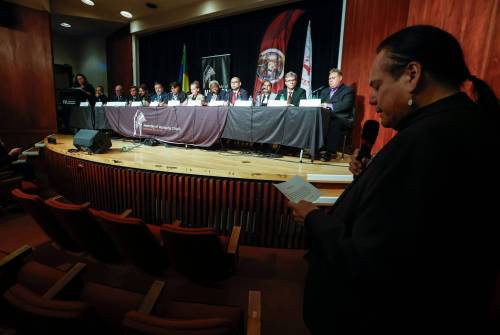
Mayoral hopefuls made their pitch to Winnipeg’s Indigenous community Tuesday at a forum hosted by chiefs organizations.

“Public safety must include trust between police and First Nations,” said candidate Kevin Klein, a former chair of the police board. “Winnipeg needs a policing approach that protects Indigenous residents, supports victims, prevents crime and builds lasting relationships with Indigenous communities.”

The former city councillor and Tory cabinet minister promised harsher penalties for drug dealers and said he’d work to create a community safety task force that would include Indigenous leadership.

He also said the police service must recruit more Indigenous officers to change its culture.

Read
Tuesday, Oct. 20, 2026

Can’t have our cake and eat it, too

Mel Marginet 6 minute read Preview

Can’t have our cake and eat it, too

Mel Marginet 6 minute read 2:00 AM CDT

Last month, the City of Winnipeg said it would soon begin to study ways to improve pedestrian and cyclist safety along Osborne Street, which runs between two of the city’s densest neighbourhoods, where residents walk and bike for many of their daily activities. As someone who lives in South Osborne and who has frequented the shops and restaurants of the Village since my university days over 20 years ago, these changes can’t come soon enough.

Imagine my frustration when I read that this study of the street between Broadway and the St. Vital Bridge will take place “over the next year” to find “quick” solutions. We’ve all been through the COVID-19 pandemic, during which cities around the world found rapid solutions to improve safety and encourage more walking, biking and transit. Entire manuals have been published on easy things our city could try, literally this weekend, to improve the safety of Osborne Street.

Perhaps the reason this project is going to take a year can be found in this quote from David Patman, the city’s manager of transportation: “Osborne Street is currently serving multiple, competing functions … It exists in a dense, pedestrian-oriented development area that is close to rapid transit, which is at odds with the high flow of motor vehicles that travel daily along the corridor.”

Mr. Patman has correctly identified Osborne Street as a “stroad”. A stroad is a dangerous, inefficient combination of a street and a road. Stroads try to be the best of both worlds, and they fail at both. Charles Marohn, author of Strong Towns, offers the best analogy — a stroad is like a futon, which is both a terrible couch and an uncomfortable bed. You try to save money on two functions, but neither is right.

Read
2:00 AM CDT

Living a lie takes a toll on whole family

Maureen Scurfield 5 minute read 2:00 AM CDT

DEAR MISS LONELYHEARTS: My wife is no longer my life partner! To my mind, she’s just the mother of my children. She still lives with us and does the major part of the child care.

This summer she discovered I had a girlfriend, but she didn’t want to “break up our family,” as I earn a lot of money. Now she’s treating me like garbage. She’s pleasant to the kids and our cleaning help, but she doesn’t speak much to me, and is disposed to giving me lists for groceries and medication pickups via email, so I pay for almost everything.

The kids seem fine so far, because we haven’t broken up our family and we haven’t changed how we treat each other in front of them. We’re polite and we never fight.

Then just last weekend, my wife finally let me know she’d recently met someone she’s “seeing privately.” It’s a guy we both know from a sports activity the kids enjoy. That just makes me sick — and is upsetting me far more than breaking up.

Jets out of tune against Blues

Ken Wiebe 7 minute read Preview

Jets out of tune against Blues

Ken Wiebe 7 minute read Updated: Yesterday at 8:29 AM CDT

ST. LOUIS – The issue is no longer limited to secondary scoring for the Winnipeg Jets.

Although they continue to be far too reliant on the top line for production, the Jets have suddenly been limited to not enough goals in a more general sense.

The latest example was a 2-1 loss Tuesday to the St. Louis Blues at Enterprise Center.

The Jets battled hard in this Central Division duel, but they’ve scored 24 goals in nine games (2.67 goals per game) and have one victory during the past five games after a 3-0-1 start. One of those losses did come in overtime (1-3-1).

Read
Updated: Yesterday at 8:29 AM CDT

Manitoba First Nation taking federal government, department to court over damage to sturgeon population

Morgan Modjeski 5 minute read Preview

Manitoba First Nation taking federal government, department to court over damage to sturgeon population

Morgan Modjeski 5 minute read Yesterday at 11:27 AM CDT

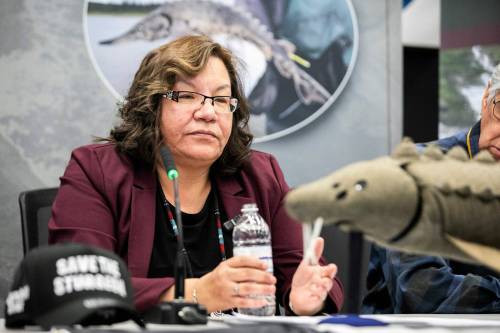
A remote Manitoba First Nation is taking the federal government to court over claims a Manitoba Hydro project is hurting the sturgeon population in the lower Churchill River.

In an Oct. 15 statement of claim filed in Manitoba’s Court of King’s Bench, Tataskweyak Cree Nation said the Churchill River diversion operated by Manitoba Hydro has had widespread ecological effects and damaged sturgeon populations in the area.

The lawsuit alleges Ottawa has breached its treaty obligations to protect the community’s right to harvest the fish.

The lawsuit names both His Majesty the King in Right of Canada, the minister of fisheries and Oceans Canada as defendants.

Read
Yesterday at 11:27 AM CDT

Police HQ report ‘outrageous’: Kinew

Joyanne Pursaga 6 minute read Preview

Police HQ report ‘outrageous’: Kinew

Joyanne Pursaga 6 minute read Tuesday, Oct. 20, 2026

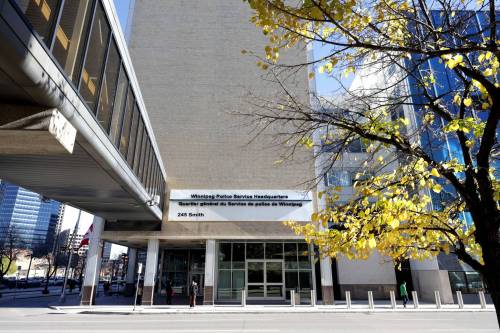
Premier Wab Kinew says public inquiry findings that taxpayers were overcharged more than $40 million for the Winnipeg Police Service headquarters project and two city leaders broke the public trust are “outrageous.”

Inquiry commissioner Garth Smorang’s report, which was released Monday, concluded former mayor Sam Katz “violated the public trust” and council code of conduct, while the city’s former chief administrative officer Phil Sheegl suffered from a “complete lack of a moral compass.”

Smorang also found the city was overcharged $43.3 million for the project, with $42 million of that going to key contractor Caspian Projects.

“It’s outrageous that people who were elected betrayed the public here in the city. It’s outrageous that there were people in business who ripped you off, ripped me off — I was paying property taxes in Winnipeg at the time — and ripped all of us off to the tune of $43.3 million. That’s crazy,” said Kinew.

Read
Tuesday, Oct. 20, 2026