The greatest escape
Author’s father survived Holocaust with grace, joy intact
Advertisement
Read this article for free:
or
Already have an account? Log in here »
To continue reading, please subscribe:
Digital Subscription
One year of digital access for only $1.44 a week*
- Enjoy unlimited reading on winnipegfreepress.com
- Read the E-Edition, our digital replica newspaper
- Access News Break, our award-winning app
- Play interactive puzzles
*Billed as $5.77 plus GST every four weeks. After 52 weeks, price increases to the regular rate of $19.95 plus GST every four weeks. Offer available to new and qualified returning subscribers only. Cancel any time.
To continue reading, please subscribe:
Add Free Press access to your Brandon Sun subscription for only an additional
$1 for the first 4 weeks*
- Enjoy unlimited reading on winnipegfreepress.com
- Read the E-Edition, our digital replica newspaper
- Access News Break, our award-winning app
- Play interactive puzzles
*Your next Brandon Sun subscription payment will increase by $1.00 and you will be charged $17.95 plus GST for four weeks. After four weeks, your payment will increase to $24.95 plus GST every four weeks.
Read unlimited articles for free today:
or
Already have an account? Log in here »
Hey there, time traveller!
This article was published 08/11/2024 (712 days ago), so information in it may no longer be current.
Former Winnipegger Bernard Pinsky grew up listening to his father Rubin Pinsky’s stories of his childhood in Poland and his time spent living in the forest, where he survived the Holocaust after fleeing a Nazi work camp in 1942.
“My father’s stories didn’t make the Holocaust scary for me as a child,” Pinsky says.
“He told me about scavenging for food in the forest, learning what berries and roots he could eat, making baskets and other things from birch bark and twigs, learning the animal sounds, etc.”

Supplied
Bernard Pinsky wrote a book about his father’s escape from Europe after fleeing a Nazi work camp in 1942.
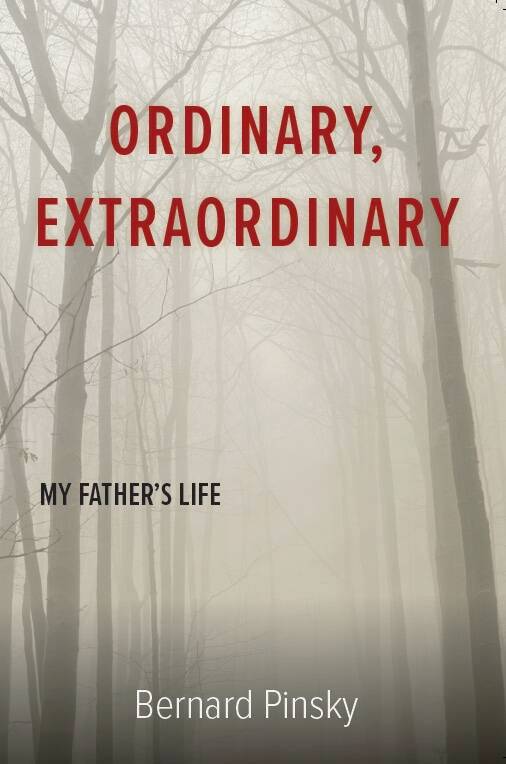
Pinsky, who lives in Vancouver, will speak at the Winnipeg launch of his book, Ordinary, Extraordinary — My Father’s Life (Behind the Book), on Sunday — the anniversary of Kristallnacht — in honour of International Holocaust Remembrance Day.
The program will feature a conversation between Pinsky and Belle Jarniewski, executive director of the Jewish Heritage Centre. The event is presented by the centre in partnership with Jewish Child and Family Service and the philanthropic Ronald S. Roadburg Foundation, for which Pinsky, a retired lawyer and community leader, is the chairman.
Of his father, a former yeshiva student, Pinsky says, “He was not a particularly successful businessman in Canada, although we didn’t feel poor; we had what we needed. I saw how hard he worked, how positive he was, how he provided for his family despite not knowing any English or French when he came to Canada in his 20s.
“Despite his being an ordinary man, I realized that his life had taken an extraordinarily difficult route, which he overcame to create a normal, ordinary life for himself and his family.”
Pinsky wanted to honour his father, so for his 72nd birthday in 1996, he wrote a manuscript about his life as a gift.
“He was very happy to get it, but by then he had some mini-strokes (TIAs) and I doubt he ever read the whole manuscript,” Pinsky says via email.
He also sent the manuscript to some relatives, including Melvin Fenson, a Winnipegger and former partner of Walsh McKay law firm, who had made Aliyah (immigration of Jews from the diaspora to Israel) in the 1970s.
“Melvin read the manuscript and said that it contained some good information about the Holocaust and Yad Vashem (Israel’s official memorial museum to the victims of the Holocaust) might accept it for their archives,” Pinsky says.
The manuscript was submitted in 1997 and Yad Vashem said it would be included in its catalogue, but nothing happened for a decade.
Then, in 2007, Pinsky received a letter from a history teacher in Djatlovo, Belarus, who was hoping to translate the manuscript into Russian.
It turned out to be the same town as Pinsky’s father grew up in — prewar Gzetl, Poland.
“I went to Djatlovo in 2012 and saw both the incredible work that the teacher, a Russian Orthodox woman, and others like her were doing to create memorials to the Jewish community that perished in the Holocaust, and I saw the small museum in that teacher’s high school that she had created based on my work.
“She said she did it because she is religious and preserving the memory of the Jews, who were now all gone, was the right thing to do.”
At the time, Pinsky was a lawyer with a busy practice and planned to finish the book when he retired. However, at 67, he moved on to a new job at a charitable foundation that also left him little free time.
Finally, his wife pointed out that, since it seemed likely he would work long hours for the rest of his life, the time to finish the book was “now or never.”

He spent evenings and weekends in 2023 finishing the book, had it edited and self-published it.
“Ordinary, Extraordinary is the survival story of Rubin Pinsky and some of Rubin’s immediate family,” he says. “But it is also the story of what Rubin did with his life after the Holocaust, his attitude towards life and his ability to pick himself up and to live life fully after every one of life’s blows, mostly with determination and with joy.
“His life could be an example of what people can endure in life and still be fulfilled and happy.”
Pinsky will offer one copy of the book to each family attending the event at the Berney Theatre. Register at 204-478-8590 or jewishheritage@jhcwc.org.
fparts@freepress.mb.ca