Suffrage’s champion
Newspaper columnist played vital role in petition campaign to gain Manitoba women the right to vote
Advertisement
Read this article for free:
or
Already have an account? Log in here »
To continue reading, please subscribe:

Digital Subscription
One year of digital access for only $205*
- Enjoy unlimited reading on winnipegfreepress.com
- Read the E-Edition, our digital replica newspaper
- Access News Break, our award-winning app
- Play interactive puzzles
*First annual payment billed as $205.00 + GST for one year. This annual subscription will automatically renew at $233.00 + GST every 52 weeks (10% off the regular annual price of $259.35). Offer available to new and qualified returning subscribers only. Cancel any time.
To continue reading, please subscribe:
Add Free Press access to your Brandon Sun subscription for only an additional
$1 for the first 4 weeks*
- Enjoy unlimited reading on winnipegfreepress.com
- Read the E-Edition, our digital replica newspaper
- Access News Break, our award-winning app
- Play interactive puzzles
*Your next Brandon Sun subscription payment will increase by $1.00 and you will be charged $17.95 plus GST for four weeks. After four weeks, your payment will increase to $24.95 plus GST every four weeks.
Read unlimited articles for free today:
or
Already have an account? Log in here »
Hey there, time traveller!
This article was published 18/01/2025 (565 days ago), so information in it may no longer be current.
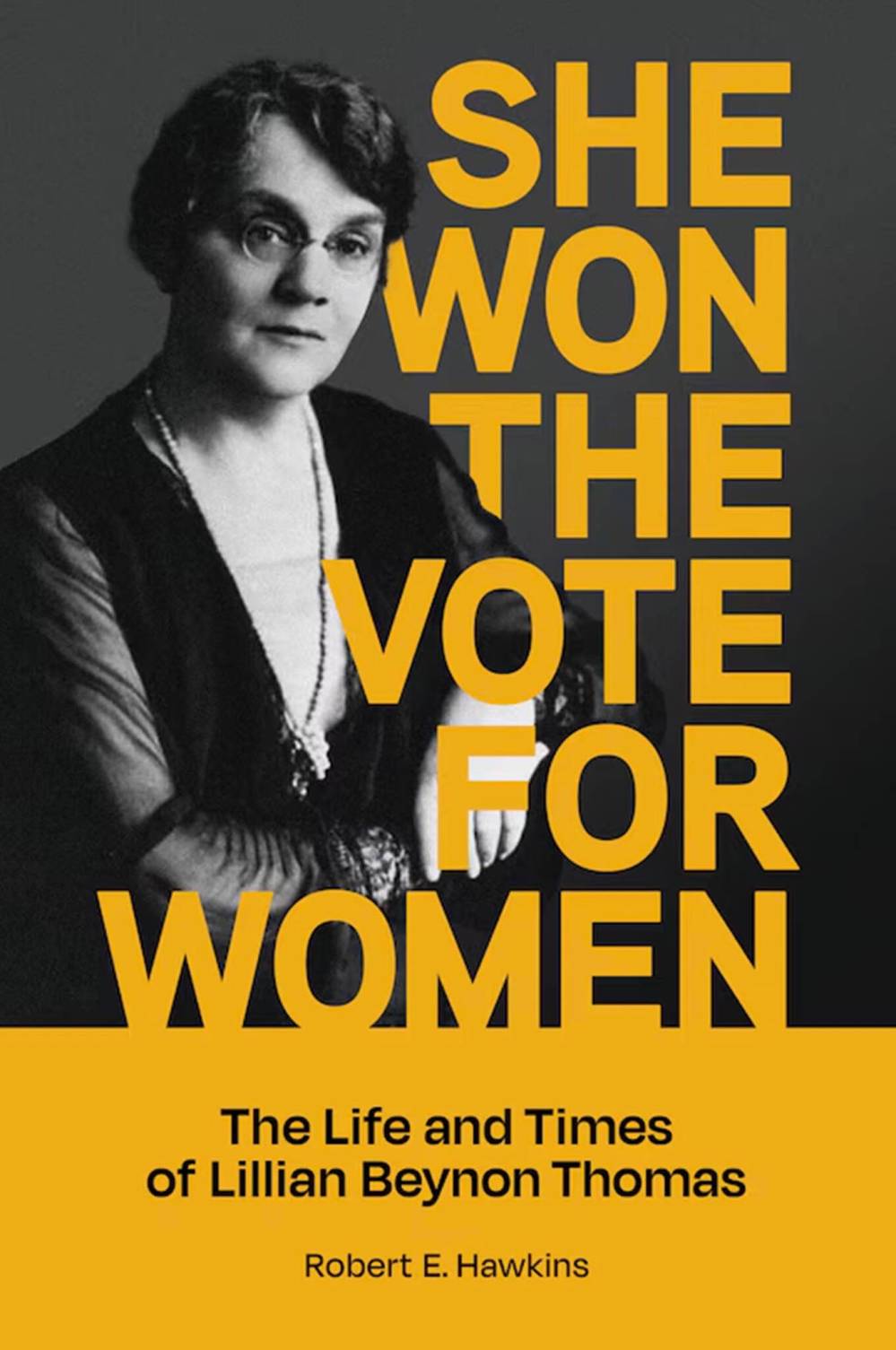
An excerpt from She Won the Vote for Women: The Life and Times of Lillian Beynon Thomas (Great Plains Press). Author Robert E. Hawkins will be in Winnipeg for a book launch at McNally Booksellers on Jan. 23, hosted by the Council of Women of Winnipeg.
Apart from her organizational and speaking skills, Lillian Beynon Thomas’s major contribution to the petition campaign was as chief motivator and cheerleader. For this, she used her newspaper columns. On Sept. 11, she wrote: “All over this province there are women on distant homesteads who have sent for petitions, and they are taking these petitions around getting women to sign. It grips the imagination to think of the women who are walking miles over our Prairie roads these burning hot days just to get one signature.” By Oct. 1, the required 17,520 signatures had been obtained. The goal was raised to 30,000. On Oct. 9, after giving the statistics on the number of leaflets distributed by canvassers, she wrote: “Never in the history of this province of Manitoba has there been such a great educational campaign as the women have carried on during the last few months.” Looking back in 1944, she said simply, “There was something heroic about it.” Years later she recalled: “Women went from farm to farm in country districts getting signatures to the petition. Some walked, some rode on horseback, some drove in a buggy or a buck board or in a lumber wagon, and I heard of one even riding on a stone-boat.”
Nowhere was her leadership more evident than in the defiant exhortation she penned at the midpoint of the campaign in her column under the headline New Dreams:
Archives of Manitoba
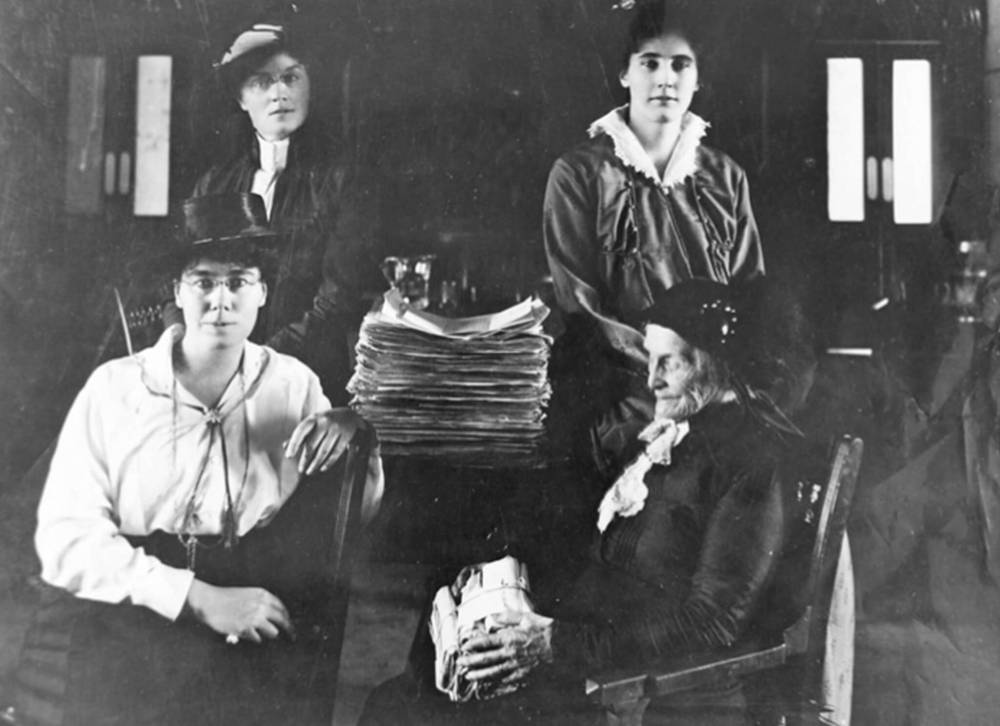
From left: Dr. Mary Crawford, Lillian Beynon Thomas, Winona Flett Dixon and Amelia Burritt with the PEL petition in 1915.
The women of Manitoba who are working to get the petition are dreaming new and greater dreams than ever before. They are dreaming of the great work the women of this province, now they are stirred up, can do to better conditions. They are dreaming of the day when the liquor traffic will be banished, when every child will be compelled to get an education, when our mentally defective will have a home where they will be cared for and society will be protected from them. They are dreaming of the time when our treatment of criminals will be more humane, when our idea of university education will be an education for the many, not the few, when — but who can tell all the dreams that lighten the long walks and drives of our canvassers; dreams that may make of Manitoba, when dreamed by men and women together, a province to which other provinces will look for inspiration to make better conditions of life, not for the few, but for all.
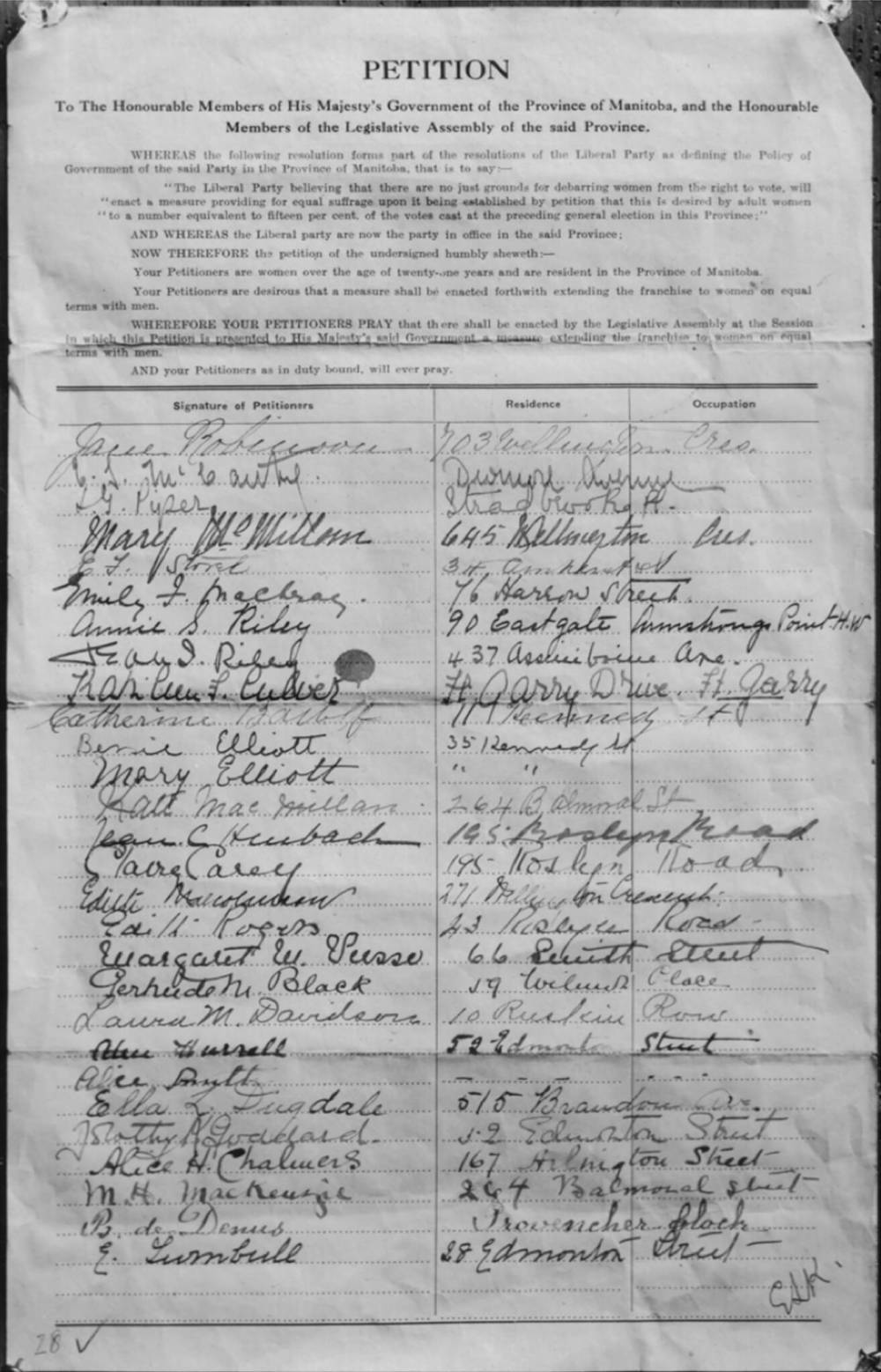
By early October, 55,000 suffrage leaflets had been distributed and over 6,000 petition blanks, with instructions for completing them, had been sent out. Each petition blank contained spaces for women over the age of 21 to sign. The last call for signed petitions went out on Dec. 18, 1915. An iconic photograph was taken on Dec. 23, 1915, of four women with a stack of completed petition forms between them. Moving from left to right were Dr. Mary Crawford, Political Equality League (PEL) chair; Lillian Beynon Thomas, PEL second vice-chair; Winona Flett Dixon, PEL provincial secretary in charge of gathering signatures; and 93-year-old Amelia Burritt. The main petition in the centre of the photograph contained 39,584 signatures or 33.9 per cent of the number of men who had voted in the Aug. 6, 1915 provincial election. The PEL had gathered more than double the number of signatures required. The petition was the largest ever presented to any legislature in Canada up until that time. Amelia Burritt’s separate petition, resting in her lap, contained 4,250 additional signatures that she had collected herself.
A delegation of 60 PEL members, headed by Beynon Thomas, presented the petitions to premier Norris and his cabinet. In her brief remarks, Lillian acknowledged the work of the very early suffrage workers and of the farm women who, despite their onerous daily duties, travelled long distances to get signatures during this final campaign. In a clear response to the delegation, the premier announced that a bill granting woman suffrage was nearly ready for the printers and would be introduced early in the first session of the legislature upcoming in the new year.
Several days before the bill was to be presented to the legislature, a member of the House who was sympathetic to the suffrage cause told Beynon Thomas that he had seen the draft suffrage legislation and that while it gave women the right to vote, it did not give them the right to sit in the legislature. On Jan. 5, 1916, the day before the new legislative session was to begin, Beynon Thomas asked the attorney general to see the draft bill. The attorney general’s lawyer agreed on condition that she not disclose the bill’s contents, which were confidential, until the bill had been tabled in the legislature. She agreed. Upon reviewing the draft, however, she was horrified to learn that the bill in fact did not make provision for women to sit in the legislature. She told the attorney general’s lawyer: “I can’t tell about (the absence of) that clause, but we can and will fight the principle of it.” That day, Lillian telephoned members of the PEL and, without disclosing what was actually in the bill, asked them to contact their member of the legislature and inquire whether women were going to get the right to run for a seat. This resulted in a flurry of phone calls. Lillian also advised her sister, Francis, who was covering the MGGA annual convention in Brandon from Jan. 5-7, 1916, of the situation. The attorney general was then told that if the bill was not changed Francis would arrange for a motion of censure of the Liberal government to be adopted by the women’s meeting of the convention and that this motion, once passed, would be placed before the closing evening session of the main convention. When attorney general Hudson heard of this plan, he quickly agreed that the bill would be changed to allow women to sit in the legislature.
The suffrage bill was introduced on Jan. 10, 1916 by premier Norris, given second reading four days later, and passed third reading with unanimous consent of the legislature on Jan. 27, 1916. In an unprecedented move, members of the executive of the PEL, including Beynon Thomas, were invited to sit on the floor of the legislative chamber during third reading. When the bill passed third reading, over a hundred women and men in the galleries, and the members on the floor of the House, stood to sing O Canada. That completed, the members of the House sat down while the folks in the gallery sang For They Are Jolly Good Fellows, at which point the elected members stood and responded in kind. It was a historic display of enthusiasm. Royal assent was granted on Jan. 28, 1916, two years to the day from the first staging the mock suffrage play, A Women’s Parliament.
Archives of Manitoba
The Political Equality League’s petition was presented to then-premier Tobias Norris on Dec. 23, 1915.