Adapting to new reality a big-picture project
Advertisement
Read this article for free:
or
Already have an account? Log in here »
To continue reading, please subscribe:

Digital Subscription
One year of digital access for only $205*
- Enjoy unlimited reading on winnipegfreepress.com
- Read the E-Edition, our digital replica newspaper
- Access News Break, our award-winning app
- Play interactive puzzles
*First annual payment billed as $205.00 + GST for one year. This annual subscription will automatically renew at $233.00 + GST every 52 weeks (10% off the regular annual price of $259.35). Offer available to new and qualified returning subscribers only. Cancel any time.
To continue reading, please subscribe:
Add Free Press access to your Brandon Sun subscription for only an additional
$1 for the first 4 weeks*
- Enjoy unlimited reading on winnipegfreepress.com
- Read the E-Edition, our digital replica newspaper
- Access News Break, our award-winning app
- Play interactive puzzles
*Your next Brandon Sun subscription payment will increase by $1.00 and you will be charged $17.95 plus GST for four weeks. After four weeks, your payment will increase to $24.95 plus GST every four weeks.
Read unlimited articles for free today:
or
Already have an account? Log in here »
Hey there, time traveller!
This article was published 21/06/2025 (454 days ago), so information in it may no longer be current.
The conclusion of Max Ehrmann’s century-old inspirational poem Desiderata springs to mind when contemplating David Farrier’s beautifully written and astonishingly erudite new book, Nature’s Genius.
To wit: “In the noisy confusion of life, keep peace in your soul. With all its sham, drudgery and broken dreams, it is still a beautiful world.”
The sources of noisy confusion are everywhere, of course, but in the moment they seem most amplified by the grifter-in-chief in Washington, whose anti-intellectual, anti-science, anti-environmental machinations are an increasing source of despair for the future of the planet.
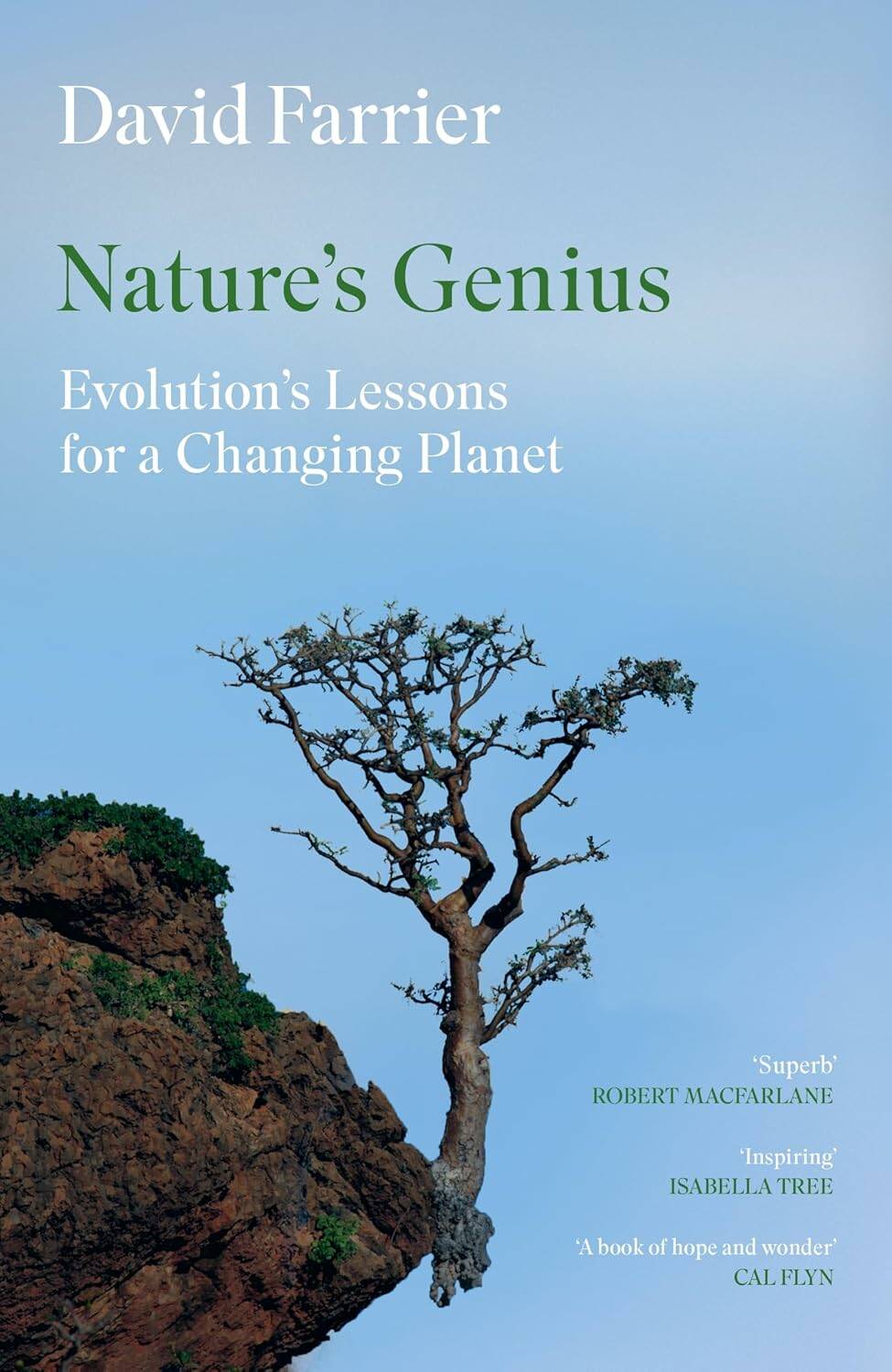
Nature’s Genius
But you wouldn’t know it reading Farrier, a professor of literature and the environment at the University of Edinburgh. He looks at four billion years of evolution on Earth and sees that life has always been infinitely adaptable, given time.
What is different in the present is that human impacts on nature are causing change faster than most living things can adapt. But no need to panic, he seems to be saying, because “human civilization is now the greatest evolutionary force.”
That’s right. We can fix the mess with the same drive, curiosity and inventiveness with which we created it, he argues.
Take, for example, domesticated animals. It took 40,000 years for man to create dogs by domesticating wolves.
Then, in the 19th century, a Russian scientist found that wild foxes could evolve to tame foxes in 50 months using selective breeding, which became the template for domesticating all sorts of animals and breeding them to suit our tastes.
Which led to the current situation in which 40 per cent of the planet’s surface is dedicated to agriculture, much of which is used to feed the billions of animals that humans eat annually.
But what if, instead of eating flesh, we switched to pancakes made with a common soil bacterium that can be ground into “golden flour” that “tastes deliciously buttery” and is 60 per cent protein?
And bonus points: Switching from flesh to bacterium would require a tiny fraction of the land surface now used to raise meat, freeing up millions of acres for re-wilding and carbon sequestration.
As revolutionary as selective breeding was a century ago, it is too slow to keep up with climate change. But gene-editing technologies could make evolution an overnight sensation.
While these ideas as presented here might seem simplistic or far-fetched, in Farrier’s detailed explanations they become calm and reasonable solutions to the seeming intractible challenges of our times.
And this is only a small sample of the myriad ideas Farrier has collected from dozens of interviews with some of the thousands of researchers dedicated to saving the planet and enriching all life.
Their work, and Farrier’s determination to explore and explain it with wit, wisdom and compelling intelligence, won’t silence the “noisy confusion” of climate deniers, profiteers or grifters, but together they point to the only way forward.
This review started with a reference to the poem Desiderata, a word that means “things that are desired.”
It’s a word that could be applied to this inspiring book by a gifted writer and thinker.
Gerald Flood is a former Free Press comment editor.