Heart of the city
Winnipeg’s iconic intersection chronicled in timely, well-researched account
Advertisement
Read this article for free:
or
Already have an account? Log in here »
To continue reading, please subscribe:

Digital Subscription
One year of digital access for only $205*
- Enjoy unlimited reading on winnipegfreepress.com
- Read the E-Edition, our digital replica newspaper
- Access News Break, our award-winning app
- Play interactive puzzles
*First annual payment billed as $205.00 + GST for one year. This annual subscription will automatically renew at $233.00 + GST every 52 weeks (10% off the regular annual price of $259.35). Offer available to new and qualified returning subscribers only. Cancel any time.
To continue reading, please subscribe:
Add Free Press access to your Brandon Sun subscription for only an additional
$1 for the first 4 weeks*
- Enjoy unlimited reading on winnipegfreepress.com
- Read the E-Edition, our digital replica newspaper
- Access News Break, our award-winning app
- Play interactive puzzles
*Your next Brandon Sun subscription payment will increase by $1.00 and you will be charged $17.95 plus GST for four weeks. After four weeks, your payment will increase to $24.95 plus GST every four weeks.
Read unlimited articles for free today:
or
Already have an account? Log in here »
Hey there, time traveller!
This article was published 27/12/2025 (292 days ago), so information in it may no longer be current.
Mayor Scott Gillingham says it is “just an intersection,” but authors Sabrina Janke and Alex Judge show that Portage and Main is anything but ordinary. Barricaded or open, this intersection reflects the often complicated, and sometimes just weird, history of Winnipeg.
Written by the co-hosts of the award-winning local history podcast One Great History, Portage and Main is a lively and entertaining narrative enhanced with intriguing illustrations and archival photos. It covers the evolution of Portage and Main — from a few buildings along muddy tracks, to the rise of the Richardson building and other towers, to the bitter battle over pedestrian use — and exhibits dreams for the future, including interviews with contemporary architects.
By 1870, the intersection of Portage Avenue and Main Street was already taking shape, with two churches, two saloons, shops, a hotel and the first theatre all within close proximity. Only 30 years later, a black-and-white reproduction of a postcard, circa 1906, shows a mind-boggling number of people walking about the intersection along with a jumbled array of trolleys, cars, carts and horses.

Archives of Manitoba
In this photo, taken circa 1905 looking north from Portage Avenue up Main Street, pedestrians, trolleys, horse-drawn carriages and bicycles navigate the intersection.
The corner continued in importance and popularity throughout the next decades. An informal survey in 1934 by a newspaper reporter during a single hour of an afternoon counted “1,880 cars, 144 streetcars, 15 buses, 15 horse-drawn vehicles, 84 bicycles, and 4 motorcycles.” According to the reporter, the number of pedestrians passing through were too many to count as “there were 60 to 80 persons in sight at any one moment.” The scene was described as being “like an ant hill.”
Due to the lack of an official public square in Winnipeg, Portage and Main often became the de facto meeting place. This was especially evident during the Second World War, when the intersection was used for many Victory Loans rallies and even a replicated full-scale blackout. In 1949, this was also the site for Winnipeg’s 75th birthday celebrations. A prominent feature was a 19.5-metre cake sculpture, with more than 5,000 people gathered at the corner for a midnight ceremony to see the cake’s candles blown out.
The latter section of the book deals with the question of what changed in the city’s use of Portage and Main. According to Janke and Judge, a combination of suburban interests, an over-reliance on cars and the consuming need for parking spaces, as well as politicians too ready to fall into line behind corporate gormandizing, led to the contradictory situation of an intersection packed with people in office towers and in cars, but very few humans in actual sight. Even the cover of the book shows only an overhead-view drawing of a cement tower and cars.
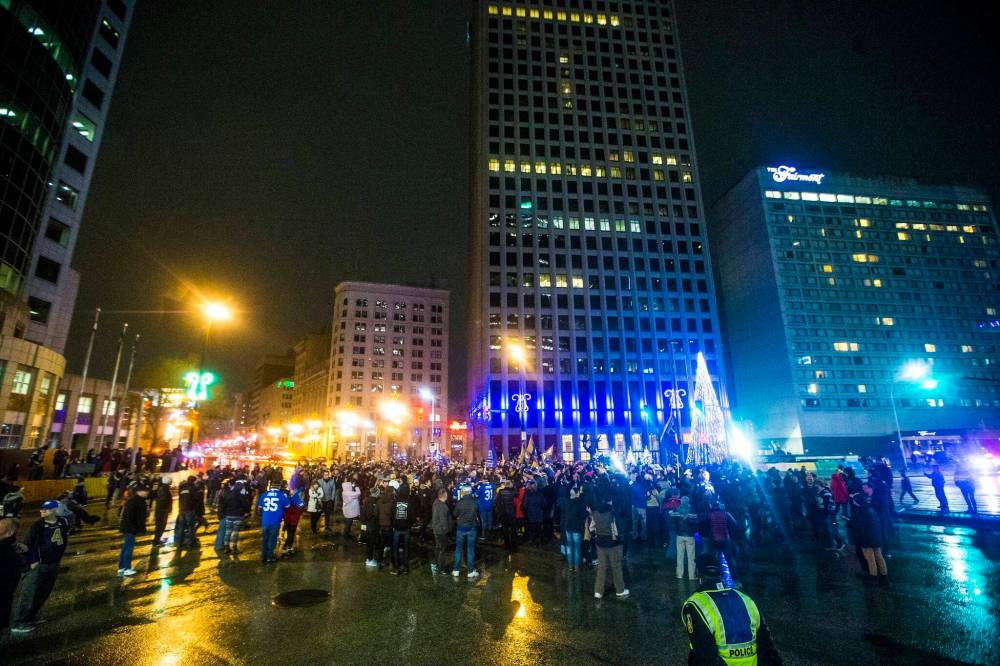
Linking the stories and vignettes is the underlying question: “Who is this city for?” The authors note that even when people were banned by authorities from crossing the corner, crowds assembled at times as though drawn to the city’s beating heart. Whether shoulder-to-shoulder in celebration of hockey, hand-in-hand for a round dance or gathered together in mourning for the loss of Indigenous women and girls, “something about Portage and Main pulls us to it. It’s where we go to shout: in joy, in anger, in despair.”

The authors acknowledge that before Portage and Main, the gathering place for thousands of First Nations people was where the two rivers meet. The arrival of settlers brought disease and displacement, and later the “reign of terror” waged by the Wolseley Expedition in 1870. The tragic story of Elzéar Goulet is offered as one example. A member of Louis Riel’s provisional government, Goulet was chased from Lombard Avenue and Main Street by members of the Wolseley Expedition. He ran to the Red River and tried to swim to safety to St. Boniface, but drowned in his attempt while being barraged by thrown rocks.
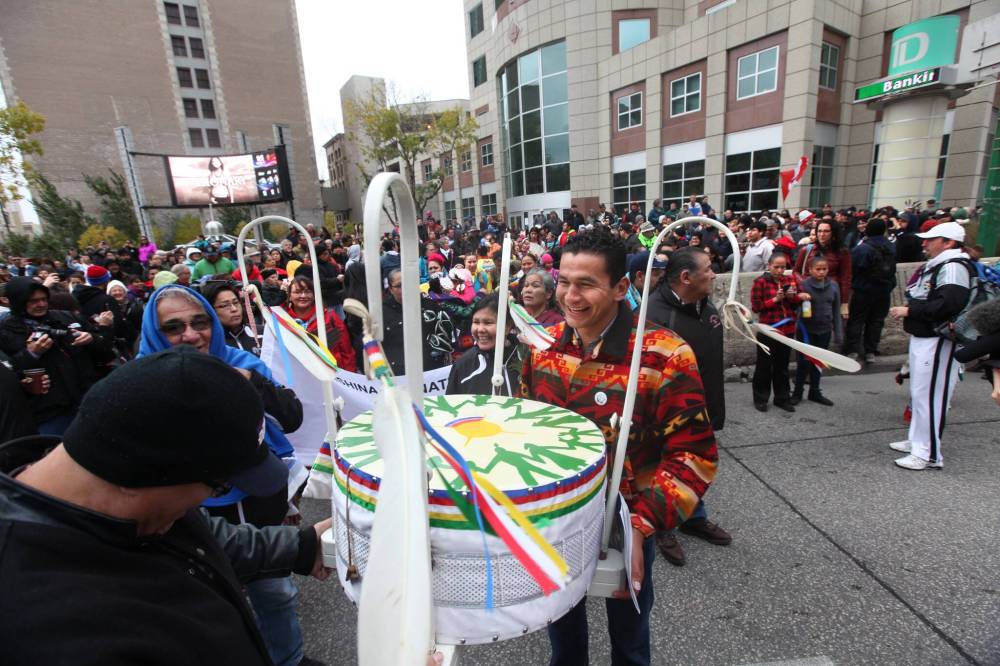
Ruth Bonneville / Free Press files
In this 2013 photo, a group of drummers and jingle dancers (including now-Premier Wab Kinew) gather at Portage and Main to welcome the UN Special Rapporteur on the Rights of Indigenous Peoples.
After this sorry episode, Indigenous people are not mentioned again in the book until 1990, when organizers set up a peace village on the Legislature grounds in solidarity with the Kanesatake resistance in Québec. After the village was dismantled, a march was held that went past Portage and Main. Despite the attention the authors sincerely pay in the opening and closing sections of their book, some further discussion of the intervening years between 1870 and 1990 is warranted, even if to explain more clearly why Indigenous stories are absent from this particular history.
Less significant, but still a quibble worth mentioning, is that keen-eyed readers who enjoy pouncing on typographical errors will get their exercise here. Other readers with poorer eyesight might struggle with the unfortunately small size of some of the image reproductions.
The 46 years of barricades means many Winnipeggers will not have known the intersection any other way. Well-versed in local history, Janke and Judge bring their podcasting and research skills to create succinct and entertaining stories that are sure to change how we view and remember Portage and Main.
Mary Horodyski works as an archivist in Winnipeg. She happily walks across Portage and Main several times a week.

Free Press files
In this 1981 photo, Dale Hawerchuk (left, standing next to John Ferguson) signs his first contract with the Winnipeg Jets at the corner of Portage and Main.
Mike Deal / Free Press files
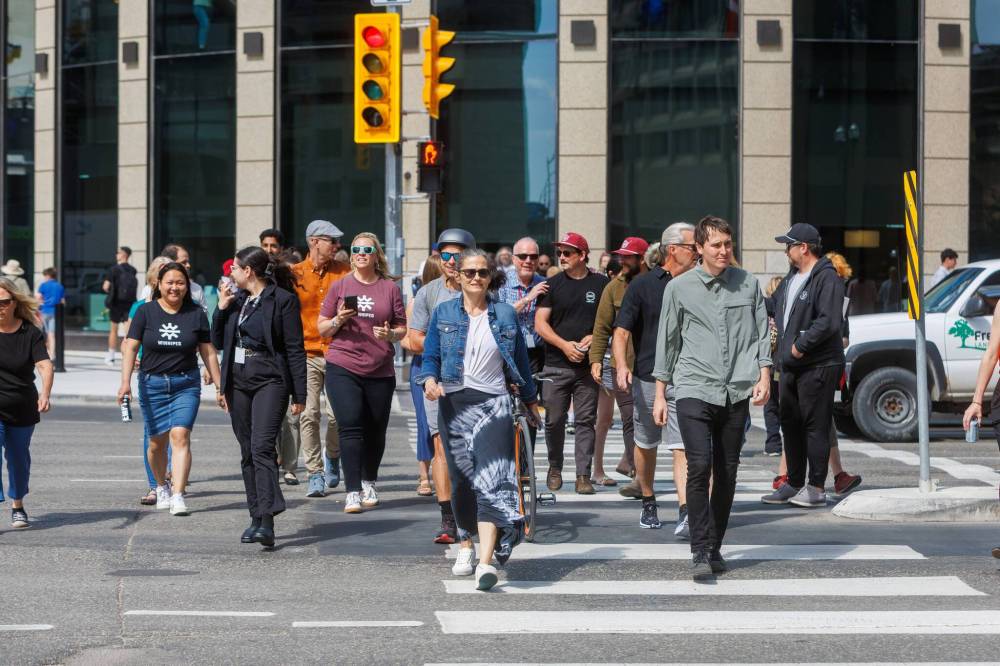
Portage and Main, which had been closed to pedestrians since 1979, finally reopened in June 2025.
Mikaela MacKenzie / Free Press files
In this 2019 photo, Winnipeg Blue Bombers fans converge at Portage and Main to celebrate the team’s Grey Cup victory.

Portage and Main

Supplied photos
Alex Judge (left) and Sabrina Janke
History
Updated on Saturday, December 27, 2025 11:44 AM CST: Corrects cutline