

Voices of resistance to dystopian forces coalesce in collection’s stories, essays

Advertisement
Read this article for free:
or
Already have an account? Log in here »
To continue reading, please subscribe:
Monthly Digital Subscription
$0 for the first 4 weeks*
- Enjoy unlimited reading on winnipegfreepress.com
- Read the E-Edition, our digital replica newspaper
- Access News Break, our award-winning app
- Play interactive puzzles
*No charge for 4 weeks then price increases to the regular rate of $19.95 plus GST every four weeks. Offer available to new and qualified returning subscribers only. Cancel any time.
Monthly Digital Subscription
$4.99/week*
- Enjoy unlimited reading on winnipegfreepress.com
- Read the E-Edition, our digital replica newspaper
- Access News Break, our award-winning app
- Play interactive puzzles
*Billed as $19.95 plus GST every four weeks. Cancel any time.
To continue reading, please subscribe:
Add Free Press access to your Brandon Sun subscription for only an additional
$1 for the first 4 weeks*
*Your next subscription payment will increase by $1.00 and you will be charged $16.99 plus GST for four weeks. After four weeks, your payment will increase to $23.99 plus GST every four weeks.
Read unlimited articles for free today:
or
Already have an account? Log in here »
SPECULATIVE fiction has no shortage of oppressive dystopias, from George Orwell’s 1984 to Suzanne Collins’ The Hunger Games. But how do ordinary people fight back? What does successful resistance to tyranny actually look like?
In a new collection of stories and essays, editors Karen Lord, Annalee Newitz and Malka Older have curated a wide swath of possible answers — but none as simple as, say, blowing up the Death Star. And that’s a good thing.
The editors acknowledge their debt to Octavia’s Brood: Science Fiction Stories from Social Justice Movements by Adrienne Maree Brown and Walidah Imarisha, and include an interview with both.
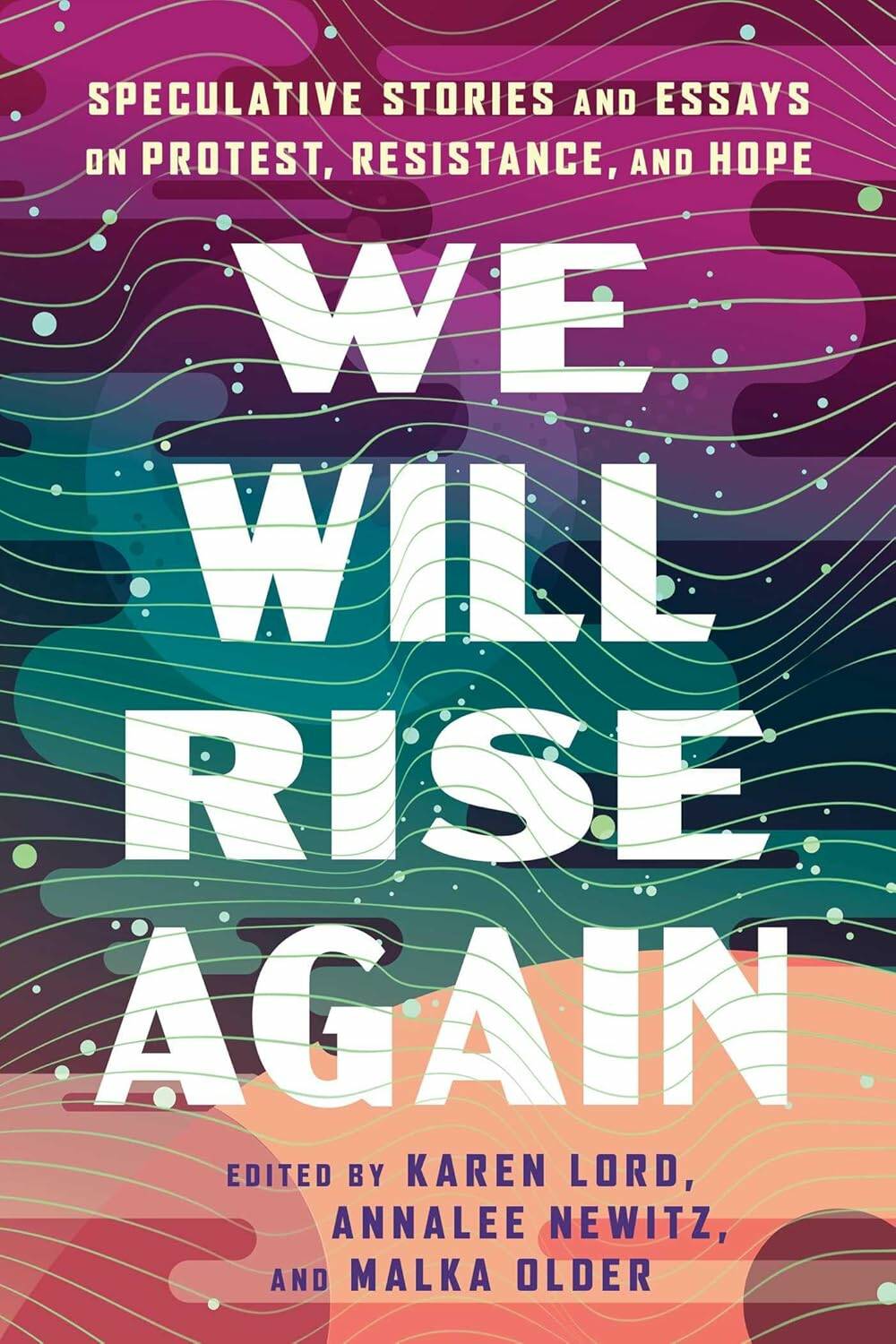
We Will Rise Again
Some stories in We Will Rise Again draw from current events. R.B. Lemberg’s fantasy tale Other Wars Elsewhere, for example, was inspired by Russia’s invasion of Ukraine. Her protagonist meets a magic-endowed survivor whose life experience is paralleled by his sweater’s colour, which he gets help repairing. “It’s still not very blue, but I feel less bitter,” he says. “We can unbitter ourselves, you know, but it works better when we help each other.”
In Rose Eveleth’s Originals Only, a politically incurious, naturally gifted athlete allows himself to become the poster boy for a “purity” action group against all medical augmentation. The neo-fascist group’s goals include banning gender-affirming care — and more.
The shadow of artificial intelligence (AI) looms throughout the anthology. Samit Basu’s Disruption, told in the style of an exit interview, posits an Indian AI that may have started extrapolating into the future to neutralize threats. In Nisi Shawl’s The Gray and the Green, a deepfake of the main character tells him things in his own voice that he would never say — but it turns out other people experienced him saying and doing things he doesn’t remember doing either.
It’s not just bodily autonomy or outmanoeuvring algorithms. Sabrina Vourvoulias’s Perséfoni in the City tackles food sovereignty, showing the connection between local farmers and their land, the value of heirloom seeds and how big-moneyed interests seek to control both.
Tobias S. Buckell’s The Mighty Slinger shows the power of music to effect social change and demonstrates the multi-generational effort needed not only to build megaprojects like a ring orbiting the sun to harness its energy, but also to protect the rights of the people who built it.
Stories more lighthearted in tone have stakes no less serious. Charlie Jane Anders’ Realer Than Real shows trans activists fighting oppressive law enforcement bots by dressing as the U.S. founding fathers — turning transphobic laws against anyone not wearing makeup, powdered wigs and petticoats under the premise of “originalism.”

In Kelly Robson’s Blockbuster, burlesque performers upend notions of privacy to put everyone in the public sphere — not just the marginalized — and in so doing begin to dismantle Canada’s carceral state and move toward restorative justice.
There’s much to enjoy in this collection: a panoply of voices, styles and ideas, with stories tackling different aspects of similar issues, showing there is no one way to view a problem or to solve it.
A sobering but heartening theme throughout We Will Rise Again is that there’s no final battle, no completed revolution — only the work to build a better tomorrow.
Izzy Wassertstein’s The Rise and Fall of Oak Bluff makes that explicit. Lily, a driving force in reviving a small Kansas town subsequently targeted by a fascist militia for being supportive of trans and BIPOC residents, says: “I’d rather we stop looking for heroes. Heroes don’t solve problems. Communities do.”
David Jón Fuller is a Winnipeg writer and editor. His debut novel, Venue 13, is forthcoming in 2026 from Turnstone Press.
Our newsroom depends on a growing audience of readers to power our journalism. If you are not a paid reader, please consider becoming a subscriber.
Our newsroom depends on its audience of readers to power our journalism. Thank you for your support.
We Will Rise Again: Speculative Stories and Essays on Protest, Resistance, and Hope
Edited by Karen Lord, Annalee Newitz and Malka Older
Saga Press, 384 pages, $28
Our newsroom depends on a growing audience of readers to power our journalism. If you are not a paid reader, please consider becoming a subscriber.
Our newsroom depends on its audience of readers to power our journalism. Thank you for your support.
Advertisement Advertise With Us
Advertisement Advertise With Us