Wikipedia founder’s treatise on trust lacks spark
Advertisement
Read this article for free:
or
Already have an account? Log in here »
To continue reading, please subscribe:

Digital Subscription
One year of digital access for only $205*
- Enjoy unlimited reading on winnipegfreepress.com
- Read the E-Edition, our digital replica newspaper
- Access News Break, our award-winning app
- Play interactive puzzles
*First annual payment billed as $205.00 + GST for one year. This annual subscription will automatically renew at $233.00 + GST every 52 weeks (10% off the regular annual price of $259.35). Offer available to new and qualified returning subscribers only. Cancel any time.
To continue reading, please subscribe:
Add Free Press access to your Brandon Sun subscription for only an additional
$1 for the first 4 weeks*
- Enjoy unlimited reading on winnipegfreepress.com
- Read the E-Edition, our digital replica newspaper
- Access News Break, our award-winning app
- Play interactive puzzles
*Your next Brandon Sun subscription payment will increase by $1.00 and you will be charged $17.95 plus GST for four weeks. After four weeks, your payment will increase to $24.95 plus GST every four weeks.
Read unlimited articles for free today:
or
Already have an account? Log in here »
Hey there, time traveller!
This article was published 03/01/2026 (269 days ago), so information in it may no longer be current.
Wikipedia turns 25 in January, making this a fitting time for its founder, Jimmy Wales, to explain how his free internet encyclopedia went from being the butt of jokes to being hailed as a “ray of light” (the Guardian), “the last best place on the internet” (Wired), “the good cop of the internet,” (the Washington Post) and “the last bastion of shared reality” (the Atlantic). Indeed, Wikipedia may be the only institution people trust more than they did a decade ago.
Volunteer-driven, ad-free, independent and not-for-profit (not to mention charmingly nerdy), Wikipedia is cut from a different cloth than its contemporaries — social media platforms such as Instagram, search engines such as Google and sharing economy apps such as Uber — which are now mostly interested in appeasing politicians, pushing unwanted AI (artificial intelligence) features and harvesting users’ data for advertisers. “There are no Facebookians, but all over the world there are Wikipedians,” Wales observes in Seven Rules of Trust — and it’s hard to argue with what that says about community and identity online.
One might assume Wales, 59, is a product of Silicon Valley or the Ivy League. In fact, he was born and educated in Alabama. A self-described “pathological optimist” who loves facts and espouses the virtues of classical liberalism (curiosity, reason, tolerance, good-faith debate), he is quite likely the only tech titan who would be pleasant company on a three-day fishing trip.
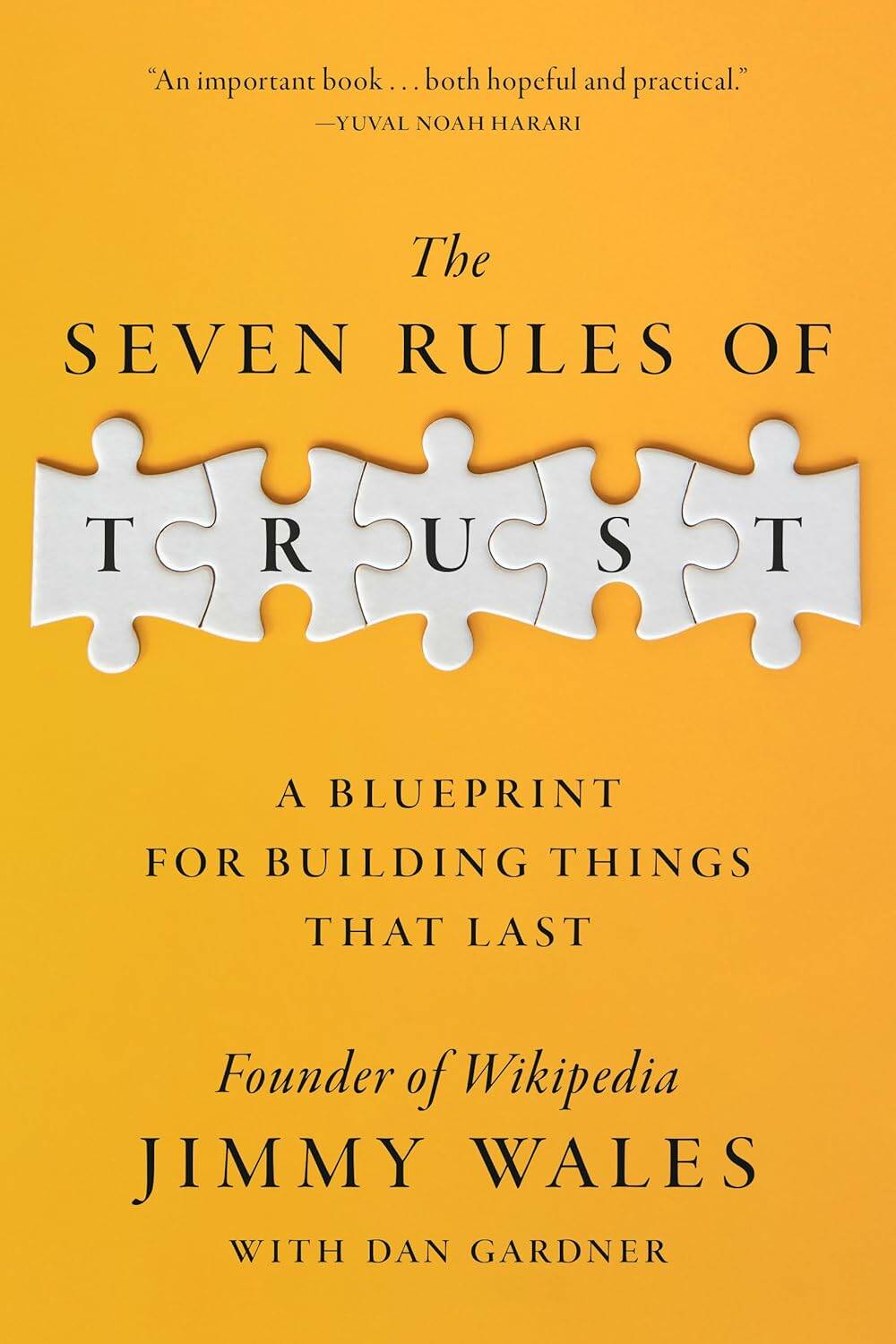
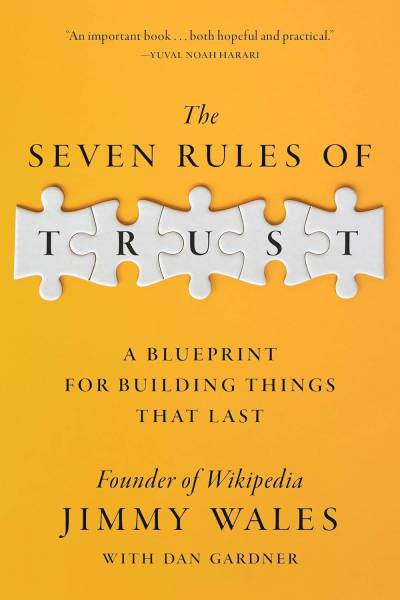
The Seven Rules of Trust
Beginning his career as a financial trader, there was little to suggest Wales would one day establish one of the web’s most popular websites and oversee its gradual evolution from, as he puts it, “a ridiculous idea that could never work to a globally trusted source of information.” He says that happened because Wikipedia was able to hammer out rules that fostered trust among readers and editors.
The Seven Rules of Trust is an attempt to speak calmly into today’s polarized society while distilling lessons from Wikipedia’s success. Wales defines trust as honesty, empathy and the ability to deliver on promises. It boils down to reliability and is fundamentally practical and reciprocal.
The book’s strongest chapter unpacks what he calls “the virtue of independence.” Wales analyzes Jeff Bezos’ decision to prevent the Washington Post from endorsing a presidential candidate in the 2024 U.S. election, showing how and why it broke trust with readers.
Asides on various Wikipedians are another highlight, including one on James Heilman, an emergency-room doctor in B.C. who has made some 300,000 edits to medical entries over 16 years, placing him among Wikipedia’s top 200 most prolific editors of all time.

Unfortunately, much of the rest of the book is bland, utilizing the tired formula of case studies, rhetorical questions and brief sound bites from academics. Perhaps in an attempt to make the book accessible, Wales and his collaborator, Canadian author and academic Dan Gardner, employ a simplistic writing style that saps the book of colour and wit. Certain sections read like a bad TED Talk.
Where is the fire-in-the-belly frankness Wales displayed in his October 2025 interview with the New York Times, where he deftly navigated a minefield of questions on the culture wars? Other than a few brief anecdotes to illustrate a point, readers learn little about Wales’ life.
Throughout the book, Wales brings up Airbnb, the short-term housing rental app, because its business model hinges on trust. But this choice seems tone deaf in an age when many cities around the world are regulating Airbnb heavily, recognizing its detrimental effect on local neighbourhoods.
Wales would have been better off writing a more straightforward memoir. The book he did write may still be of interest to the professional class: managers, HR professionals, board members and anyone trying to grow a non-profit or small business.
Jordan Ross is a Winnipeg writer and photographer who cannot lay claim to any of the numerous Wikipedia entries bearing his name.