Wartime rescue mission movingly recalled
Advertisement
Read this article for free:
or
Already have an account? Log in here »
To continue reading, please subscribe:

Digital Subscription
One year of digital access for only $205*
- Enjoy unlimited reading on winnipegfreepress.com
- Read the E-Edition, our digital replica newspaper
- Access News Break, our award-winning app
- Play interactive puzzles
*First annual payment billed as $205.00 + GST for one year. This annual subscription will automatically renew at $233.00 + GST every 52 weeks (10% off the regular annual price of $259.35). Offer available to new and qualified returning subscribers only. Cancel any time.
To continue reading, please subscribe:
Add Free Press access to your Brandon Sun subscription for only an additional
$1 for the first 4 weeks*
- Enjoy unlimited reading on winnipegfreepress.com
- Read the E-Edition, our digital replica newspaper
- Access News Break, our award-winning app
- Play interactive puzzles
*Your next Brandon Sun subscription payment will increase by $1.00 and you will be charged $17.95 plus GST for four weeks. After four weeks, your payment will increase to $24.95 plus GST every four weeks.
Read unlimited articles for free today:
or
Already have an account? Log in here »
Hey there, time traveller!
This article was published 17/01/2026 (256 days ago), so information in it may no longer be current.
In the midst of the Second World War, the British army and the Jewish leadership in Palestine forged a tenuous partnership based on a shared need to infiltrate Nazi-occupied Europe.
Each party had different strategic motives, and these differences would be a source of tension. But each party needed the other to realize its objectives.
In Crash of the Heavens, Douglas Century, a veteran investigative journalist who grew up in Canada, elaborates the politics of this uneasy alliance in an admirable, substantive account.
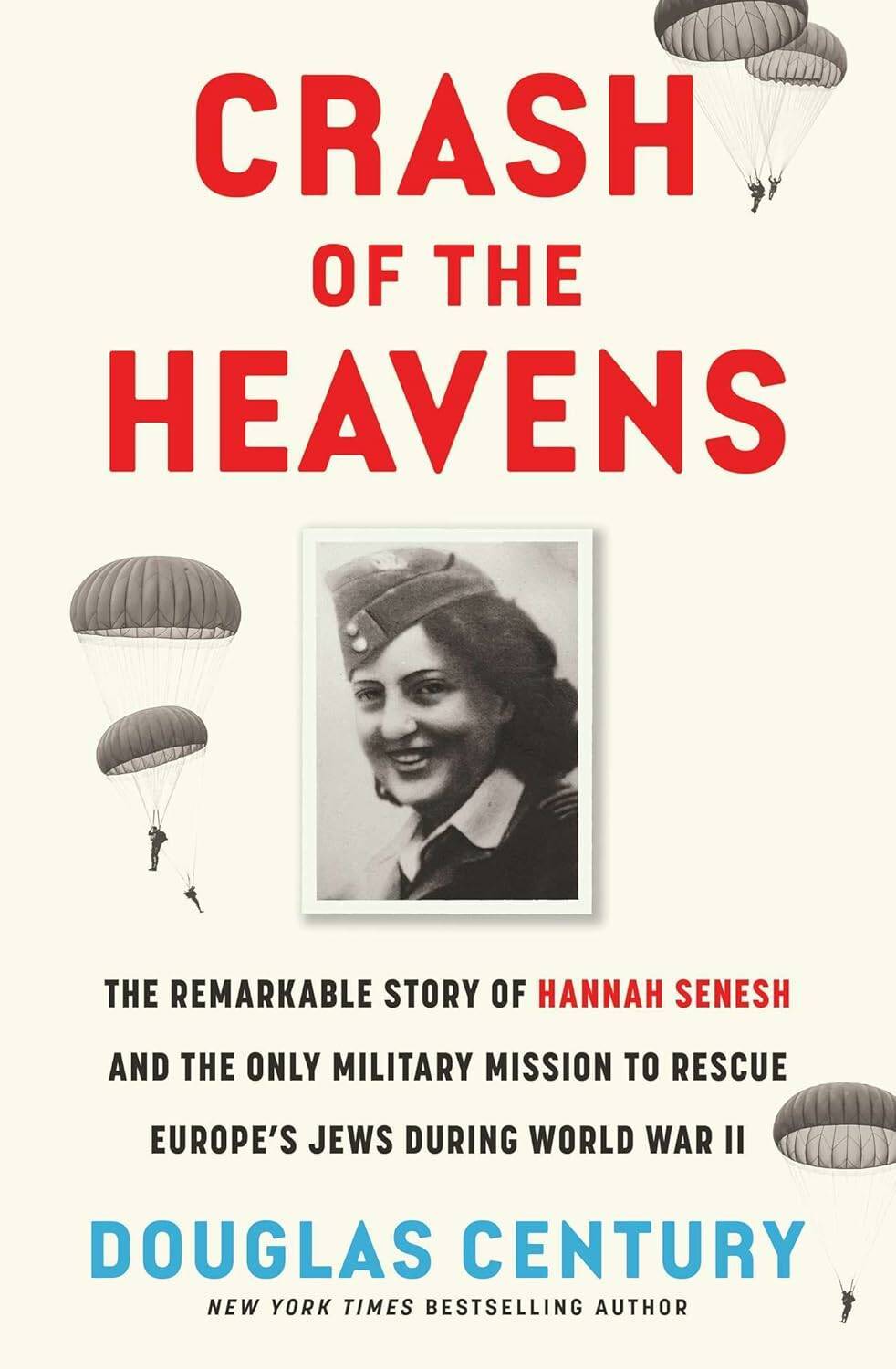
Crash of the Heavens
By 1943, Britain faced a shortage of pilots. Thousands of Allied airmen had been forced to bail out over Romania, Hungary, Yugoslavia and Bulgaria, where they tried to evade capture but could not speak the local language.
Britain had tried to send British-born agents to extricate the pilots, but these efforts were unsuccessful. As Lieutenant Colonel Anthony Simonds, the officer in charge of recovering downed Allied airmen in central Europe and the Balkans, observed, “it is hard to find an Englishman who can successfully pose as a Bulgarian, Greek, Romanian, or Hungarian.”
Simonds had the inspired idea that Jews in the British mandate of Palestine would make ideal agents for covert missions in search of British pilots behind enemy lines.
He explained his rationale: “There’s practically not a country in the world that does not have a Jewish minority familiar with the local way of life and language.”
And Palestinian Jews were eager to work with the British, provided the mission could be expanded to include succoring Jewish refugees from Nazi Germany, where Jews were being persecuted and systematically murdered.
But neither Simonds nor the Jewish leadership in Palestine were able to persuade the British brass of the merits of this plan. For various reasons, British officials in the Middle East and at the Foreign Office in London were indifferent or hostile to Simonds’s proposal.
But Simonds did find an influential supporter: Colonel Dudley Clarke, a friend of British prime minister Winston Churchill.
Clarke recognized the value of young, motivated, multilingual Jews for dangerous covert tasks in Europe. He cabled Churchill, and Simonds’s mission was promptly approved.
One of the Palestinian Jews who volunteered for the mission was Hannah Senesh, a brilliant young woman, a gifted poet and intellectual, originally from Hungary.

Century focuses on her experiences — her recruitment, training and eventual deployment by parachute to the Balkans.
Tragically, she was taken prisoner in Hungary, tortured by the Gestapo and ultimately executed. She came to be seen as a Jewish Joan of Arc.
With its emphasis on the doomed Hannah, the story Century tells is necessarily sad.
But his account of the politics of the mission shows how the British and the Jews in Palestine could co-operate to realize their respective aims.
Graeme Voyer is a Winnipeg writer.