A fine final chapter
Barnes melds memoir, novel, essay and farewell letter, leaving the reader to sort fiction from fact

Advertisement
Read this article for free:
or
Already have an account? Log in here »
To continue reading, please subscribe:

Digital Subscription
One year of digital access for only $205*
- Enjoy unlimited reading on winnipegfreepress.com
- Read the E-Edition, our digital replica newspaper
- Access News Break, our award-winning app
- Play interactive puzzles
*First annual payment billed as $205.00 + GST for one year. This annual subscription will automatically renew at $233.00 + GST every 52 weeks (10% off the regular annual price of $259.35). Offer available to new and qualified returning subscribers only. Cancel any time.
To continue reading, please subscribe:
Add Free Press access to your Brandon Sun subscription for only an additional
$1 for the first 4 weeks*
- Enjoy unlimited reading on winnipegfreepress.com
- Read the E-Edition, our digital replica newspaper
- Access News Break, our award-winning app
- Play interactive puzzles
*Your next Brandon Sun subscription payment will increase by $1.00 and you will be charged $17.95 plus GST for four weeks. After four weeks, your payment will increase to $24.95 plus GST every four weeks.
Read unlimited articles for free today:
or
Already have an account? Log in here »
Hey there, time traveller!
This article was published 24/01/2026 (236 days ago), so information in it may no longer be current.
“This hybrid stuff you do — I think it’s a mistake. You should do one thing or the other.”
So says Jean to the author-narrator of this new work from Julian Barnes, the Man Booker Prize-winning English writer who broke onto the literary scene with 1984’s Flaubert’s Parrot.
Jean is either a purely made-up character or a real person who’s been given a different name. Or maybe she’s some complicated combination of both these things. It’s difficult to say, because Jean, in fact, is inside one of Barnes’s literary hybrids. This slender book is a supple mix of memoir, novel, essay and farewell letter, where the reader is left to sort out fact and fiction — along with the larger truths that stretch across both categories.

Ian Lindsay / Canadian Press files
In his 26th (and perhaps final) book, Julian Barnes revisits his perpetual themes with emotional ruefulness.
A few pages into Departure(s), the 26th book in his long career, the 80-year-old Barnes makes an abrupt announcement: “1) There will be a story — or a story within the story — but not just yet; and 2) This will be my last book.”
Around the edges of that promised story, Barnes ranges widely, talking about mind and consciousness, memory and identity, how our past shapes our present. He discourses on many of his perpetual themes — love and grief, age and mortality — with a characteristic tone of elegant intellect and emotional ruefulness.
He can be erudite — longtime fans will be expecting the nods to Ivan Turgenev and T.S. Eliot and the Goncourt brothers — but he’s also casually chatty, making light of a medical crisis that gets him out of attending an ABBA-themed wedding, for example.
He has written before about death, in Nothing to be Frightened Of and Levels of Life, but he is staring at it directly now. Just as the COVID lockdown loomed, Barnes was diagnosed with a rare blood cancer, which he initially feared might be terminal. It turns out to be “incurable but manageable,” he tells us, “rather like life.”
As we reach the story within a story, the narrator, who happens to be a well-known English novelist named Julian, tells us about Jean and Stephen. Julian introduced them to each other when they were all Oxford undergraduates in the 1960s, and Jean and Stephen had a brief romantic relationship. Julian, a friend to both, acted as their sounding-board and go-between, thus setting up one of those emotional triangles Barnes has often explored.
After a gap of four decades, during which they all lose sight of each other, Stephen resurfaces, hoping that Julian will help engineer another meeting with Jean.
Jean and Stephen try for love once more, each telling Julian that this represents a last chance for happiness. He watches, helpless, as the couple seems doomed to repeat youthful mistakes, along with some new ones involved with what Julian calls their “reattachment dilemma.”
Meanwhile, the Jean and Stephen story becomes a sly way to talk about the creative process and the tricky back-and-forth between art and life.
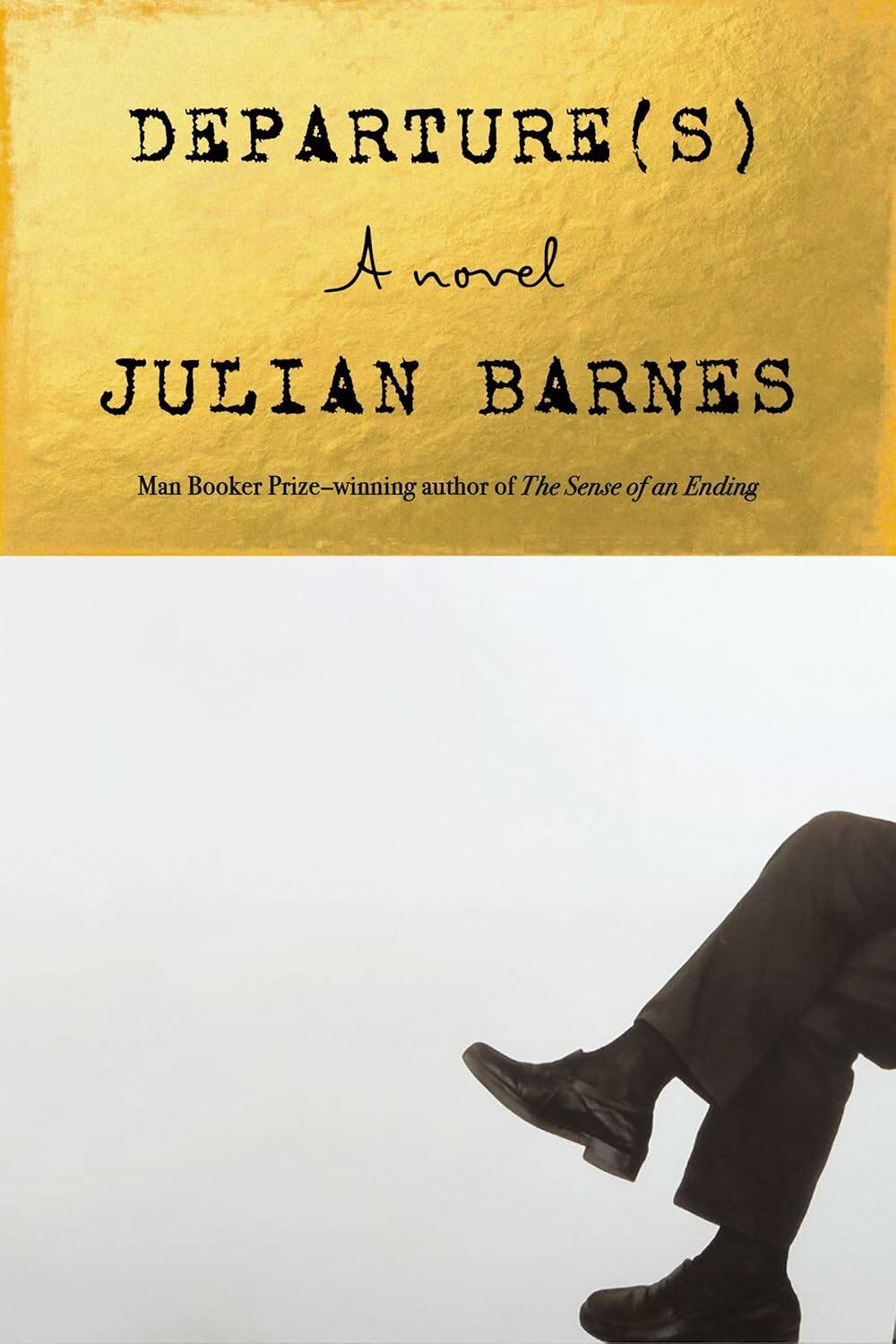
Departure(s)

“I hope you won’t ever think of writing about Jean and me,” Stephen says warily to Julian. “Of course not — in any case, that’s now how it works,” Julian assures him.
Jean is irked that Julian is trying to impose narrative form on what seems like an increasingly messy situation. “This isn’t some scenario you’ve invented,” she tells him.
Ultimately, the Jean and Stephen story comes off as distanced and muted, perhaps because we sense Barnes is already saying farewell to his own art. The story-within-a-story structure functions more as a jumping off point for Barnes’s reflective, discursive passages.
In the final pages — of what will (perhaps) be his final book — Barnes imagines sitting at a café table with his reader, having one last drink before the day ends. Barnes finds no consolation in the notion that art outlasts life, but he is determined to make an understated, elegiac exit.
Alison Gillmor writes on movies for the Free Press.
Studying at the University of Winnipeg and later Toronto’s York University, Alison Gillmor planned to become an art historian. She ended up catching the journalism bug when she started as visual arts reviewer at the Winnipeg Free Press in 1992.
Our newsroom depends on a growing audience of readers to power our journalism. If you are not a paid reader, please consider becoming a subscriber.
Our newsroom depends on its audience of readers to power our journalism. Thank you for your support.
Departure(s): A Novel
By Julian Barnes
Random House Canada, 176 pages, $36
Studying at the University of Winnipeg and later Toronto’s York University, Alison Gillmor planned to become an art historian. She ended up catching the journalism bug when she started as visual arts reviewer at the Winnipeg Free Press in 1992.
Our newsroom depends on a growing audience of readers to power our journalism. If you are not a paid reader, please consider becoming a subscriber.
Our newsroom depends on its audience of readers to power our journalism. Thank you for your support.
Advertisement Advertise With Us
Advertisement Advertise With Us