Common threads between sibling’s fate, black bears explored in moving memoir

Advertisement

Advertise with us

People and animals are more alike than we might like to think — at least according to Trina Moyles.

Read this article for free:


or

Already have an account? Log in here »

To continue reading, please subscribe:

Subscribe and receive a limited-edition Free Press branded hat or tote.

Digital Subscription

One year of digital access for only $205*

  • Enjoy unlimited reading on winnipegfreepress.com
  • Read the E-Edition, our digital replica newspaper
  • Access News Break, our award-winning app
  • Play interactive puzzles

*First annual payment billed as $205.00 + GST for one year. This annual subscription will automatically renew at $233.00 + GST every 52 weeks (10% off the regular annual price of $259.35). Offer available to new and qualified returning subscribers only. Cancel any time.

To continue reading, please subscribe:

Add Free Press access to your Brandon Sun subscription for only an additional

$1 for the first 4 weeks*

  • Enjoy unlimited reading on winnipegfreepress.com
  • Read the E-Edition, our digital replica newspaper
  • Access News Break, our award-winning app
  • Play interactive puzzles
Start now

*Your next Brandon Sun subscription payment will increase by $1.00 and you will be charged $17.95 plus GST for four weeks. After four weeks, your payment will increase to $24.95 plus GST every four weeks.

Hey there, time traveller!
This article was published 24/01/2026 (223 days ago), so information in it may no longer be current.

People and animals are more alike than we might like to think — at least according to Trina Moyles.

In Black Bear: A Story of Siblinghood and Survival, Moyles uses accounts of her observations of bears in the Peace River area of Alberta as a backdrop for the story of her often-troubled relationship with her brother, combining the two narratives in a book that many readers will enjoy.

Moyles is an environmental journalist, creative producer and writer with a focus on land, wildlife, food security and climate change. She is the author of Women Who Dig: Farming, Feminism, and the Fight to Feed the World and Lookout: Love, Solitude, and Searching for Wildfire in the Boreal Forest. her writing has also appeared in Canadian Geographic, the Narwhal and the Globe and Mail. She currently lives in Whitehorse.
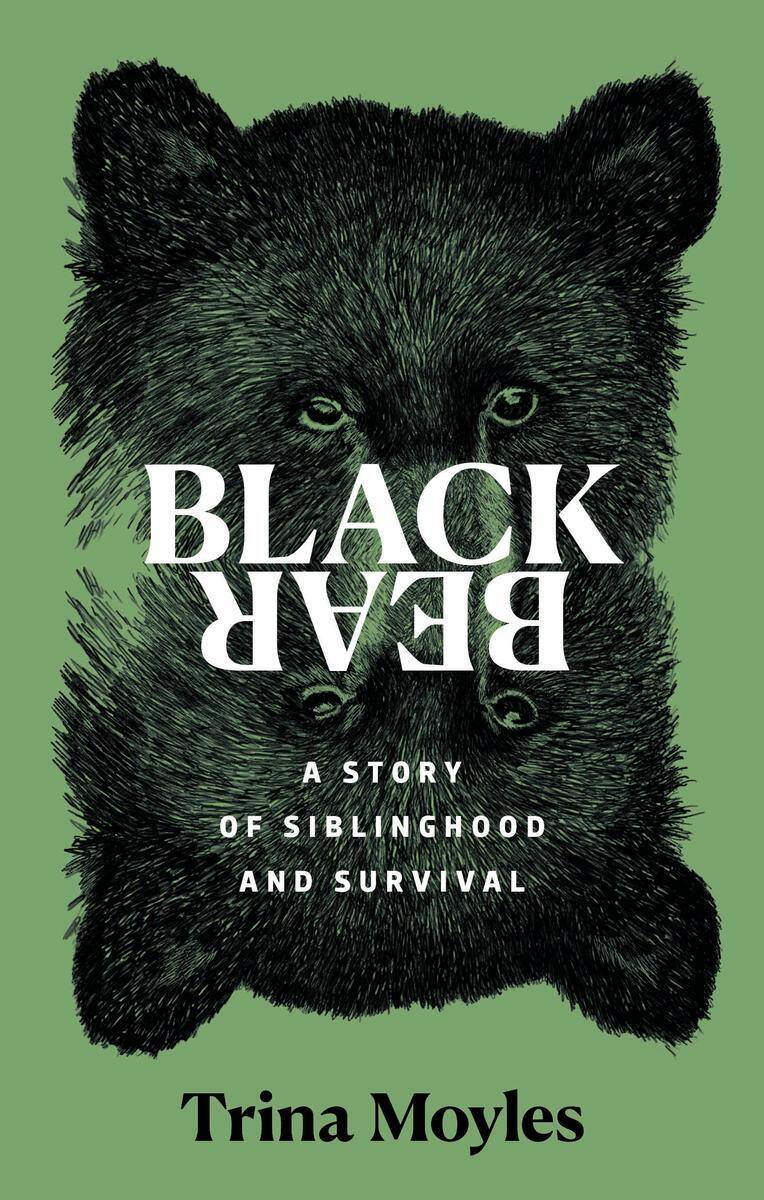
Black Bear

Black Bear

Trina Moyles and her brother Brendan grew up in northern Alberta with their parents, experiencing both the joys of learning about the animals and plants from their naturalist father and the struggles of growing up in a region where drugs and alcohol are common. Trina was already experimenting with these substances by the time she was 14, while Brendan also began to struggle with addictions at an early age.

Although they grew up in the same household, the siblings soon made radically different career choices. Trina found work as a fire ranger, spending hours every day high up in a tower and looking for signs of fire in the area to help alert authorities to the danger. She became familiar with the black bears in the area, watching them raise their cubs, form alliances and contend with rivals.

Interspersed with her observations of the bears, Moyles relates the story of her brother. Unlike his sister, Brendan worked for the oil and gas industry, a decision that caused many squabbles between the siblings. One of the issues was the lifestyle of oil workers, who often depend on drugs and alcohol to get them through long weeks working away from their family and friends. Despite a brief reprieve when he became a father, Brendan continued to struggle with addictions and eventually died by suicide.

Even in her grief over her brother’s death, Moyles sees parallels in how animals and people deal with loss. Like humans, bears appear to grieve the deaths of family members. Meanwhile, Moyles reflects on issues such as how people’s use of language can diminish the natural world, the “hyper-masculinity” of the oil and gas industry and the effects of the COVID-19 pandemic on people’s mental health.

Black Bear is generally an easy read, told in a casual style with few scientific terms or difficult sections. Readers might find the connections between the lives of bears and the author’s family a bit of a stretch at times, but these sections help explain some of Moyles’ responses to her brother’s actions.

Moyles writes very little about her parents’ involvement in family matters; while this might initally puzzle some readers, it allows the author to focus on her relationship with her brother and on the bears that she comes to know. It’s an engaging story with insights into both human and animal behaviour.

Susan Huebert is a Winnipeg writer and pet sitter.

Report Error Submit a Tip

More Stories

Winnipeg teacher disciplined for ‘liking’ student’s post

Maggie Macintosh 5 minute read Preview

Winnipeg teacher disciplined for ‘liking’ student’s post

Maggie Macintosh 5 minute read Monday, Aug. 31, 2026

A Winnipeg teacher has been reprimanded for accidentally clicking ‘like’ on a student’s year-old social media post during a late-night scroll.

A recent investigation by Manitoba’s independent teacher commissioner found Jordan Nelson, a hockey coach in the Pembina Trails School Division, engaged in professional misconduct by viewing online profiles of students who were following a team account he was managing on behalf of his school.

“Using information associated with the school’s hockey team account to access and review a student’s social media account, without any legitimate educational or workplace purpose, was inappropriate and inconsistent with the professional boundaries expected of a teacher,” commissioner Noni Classen wrote.

A five-page report, better known as a consent resolution agreement, details agreed-upon facts about an October 2025 incident and subsequent disciplinary action.

Read
Monday, Aug. 31, 2026

‘Where are they going to go?’: encampment policy blamed for homeless people sleeping outside thrift store

Scott Billeck 5 minute read Preview

‘Where are they going to go?’: encampment policy blamed for homeless people sleeping outside thrift store

Scott Billeck 5 minute read Yesterday at 4:55 PM CDT

The owner of a Portage Avenue thrift shop says the city’s encampment ban has pushed dozens of homeless people from tent communities to spaces near her store.

Susan Lockhart, who runs Just Like New to You at 635 Portage Ave., says anywhere from 25 to 50 people can be found at any given time behind the store and along the back lane stretching between Sherbrook and Furby streets.

“Where are they going to go?” she said Wednesday from her shop. “I was just here on the weekend and I couldn’t get to our back door. There were people everywhere. Mattresses.”

Earlier this week, the city reported 275 people were known to be living in 72 encampments across Winnipeg — down from 100 encampments housing about 700 people last September. The report also noted that 141 sites have been remediated since the city’s encampment policy came into effect in November.

Read
Yesterday at 4:55 PM CDT

Provencher Park eyed for new aquatic centre

Malak Abas 4 minute read Preview

Provencher Park eyed for new aquatic centre

Malak Abas 4 minute read Tuesday, Sep. 1, 2026

Provencher Park may be the next site for a new aquatic centre.

Read
Tuesday, Sep. 1, 2026

Class delayed a day after mould found in Tyndall Park school

Maggie Macintosh 6 minute read Preview

Class delayed a day after mould found in Tyndall Park school

Maggie Macintosh 6 minute read 7:31 PM CDT

The first day of school has been postponed at École Stanley Knowles School after teachers discovered mould on chairs, rugs and other items when they were setting up their classrooms.

Families were alerted Thursday afternoon that an “HVAC malfunction” required extensive cleanup and, as a result, a one-day delay to the new year.

“I called it a couple weeks ago — it smelled really strong of mould,” said Amanda Bell, a mother who’s gone to the building regularly all summer to drop off and pick up her children from the on-site daycare.

Bell recalled she and her partner got a whiff of “wet mould” in a first-floor hallway near the library in mid-August and flagged it to an employee who told them they’d contact a custodian.

Read
7:31 PM CDT

Jockey wisecrack a hurtful low blow

Maureen Scurfield 4 minute read Yesterday at 2:00 AM CDT

DEAR MISS LONELYHEARTS: I ran into my boyfriend from Grade 9 at the horse races recently. He’s still really short. I said, “You’re so small you could be a great jockey!” He said, ”And you still talk before you think!”

Ouch! I was just stating what was true. If he doesn’t like being compared to a jockey, he should stay away from the racetrack, where people will mistake him for one, don’t you think?

— Hurt Feelings, St. James

Dear Hurt Feelings: It’s important not to make cracks about personal traits people are sensitive about.

Chefs gather in St. Boniface to see whose version of jollof is best

Eva Wasney 4 minute read Preview

Chefs gather in St. Boniface to see whose version of jollof is best

Eva Wasney 4 minute read Tuesday, Sep. 1, 2026

Chef Alex Bockarie is bringing an age-old African culinary battle to Winnipeg.

On Saturday, five local chefs hailing from Senegal, Liberia, Sierra Leone, Ghana and Nigeria will go head-to-head to determine who makes the best jollof — a rice dish simmered in a savoury tomato-based stew.

“Jollof rice originated from Senegal but it has spread throughout West Africa and every country has its own method of cooking it,” Bockarie says. “It’s a long-standing fight; even among the communities here in Winnipeg, everybody’s always saying that Sierra Leone’s (jollof) is the best, Ghana’s is the best, Nigeria’s is the best.

“It’s a friendly competition; friendly, but very serious too.”

Read
Tuesday, Sep. 1, 2026