Memory, dreams and well-being connected
Advertisement
Read this article for free:
or
Already have an account? Log in here »
To continue reading, please subscribe:

Digital Subscription
One year of digital access for only $205*
- Enjoy unlimited reading on winnipegfreepress.com
- Read the E-Edition, our digital replica newspaper
- Access News Break, our award-winning app
- Play interactive puzzles
*First annual payment billed as $205.00 + GST for one year. This annual subscription will automatically renew at $233.00 + GST every 52 weeks (10% off the regular annual price of $259.35). Offer available to new and qualified returning subscribers only. Cancel any time.
To continue reading, please subscribe:
Add Free Press access to your Brandon Sun subscription for only an additional
$1 for the first 4 weeks*
- Enjoy unlimited reading on winnipegfreepress.com
- Read the E-Edition, our digital replica newspaper
- Access News Break, our award-winning app
- Play interactive puzzles
*Your next Brandon Sun subscription payment will increase by $1.00 and you will be charged $17.95 plus GST for four weeks. After four weeks, your payment will increase to $24.95 plus GST every four weeks.
Read unlimited articles for free today:
or
Already have an account? Log in here »
Sleep can be a time of peaceful rest and happy dreams or a terrifying ordeal of nightmares to endure, depending on the kinds of images that fill people’s heads at night.
In The Brain Never Sleeps: Why We Dream and What It Means for Our Health, Karen van Kampen explores the importance of dreams for our memories and our mental health, showing that even the strangest dreams have a purpose.
Van Kampen is a journalist with a specialty in health and science with an interest in sleep that began when she was assisting her father in his sleep laboratory in her childhood (which continued into her adulthood). She has a master of health science degree from the University of Toronto, wrote The Golden Cell: The Quest for the Next Great Medical Breakthrough and has contributed articles to a range of publications. She currently teaches creative nonfiction at the University of Toronto.
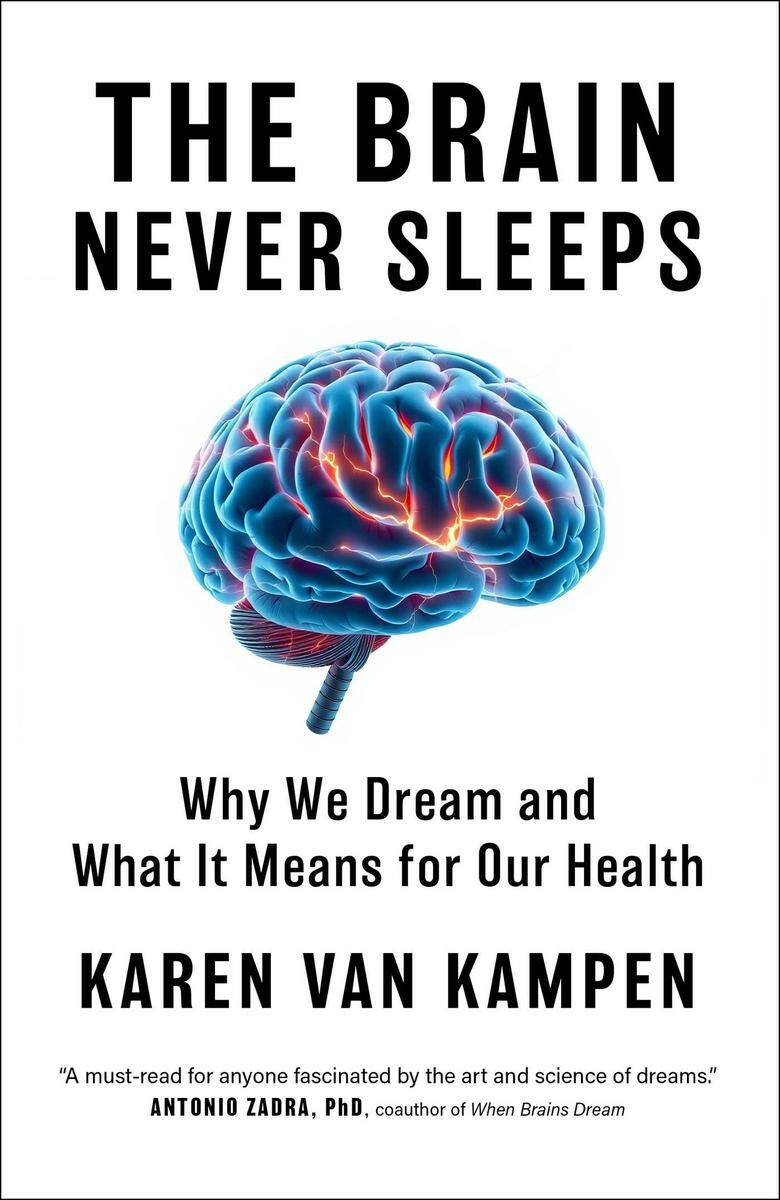
The Brain Never Sleeps
The Brain Never Sleeps begins with a chapter on the art and science of dreaming, using the example of Salvador Dali’s famous painting The Persistence of Memory. Van Kampen notes that its dreamlike character fits well with her own research on the connections between dreaming and waking life. As the author also comments, her early work with her father gave her a good start on her own research into the significance and contributions of dreams.
Sigmund Freud is one of the names most often associated with dream analysis, and the author discusses his work and the contributions of other researchers. Van Kampen then describes the workings of the brain, including rapid eye movement (REM) sleep and how people’s waking life can affect the types of dreams they experience.
The main purpose of dreams, according to van Kampen, is to process experiences and feelings from people’s waking hours. If dreams do their work, people can integrate the lessons from these nighttime stories into their waking lives. Personality, life experiences and even the temperature of the room can affect the content and quality of dreams.
Memory is closely tied to dreaming, according to van Kampen. People’s ability to remember their dreams can increase their ability to process the information and experiences of the day more effectively than if they have only a vague idea of what they have dreamt.
The Brain Never Sleeps is a comprehensive exploration of the contribution and purpose of dreams. Although some sections might be too technical and detailed for general interest, the book contains many practical insights that non-experts could find valuable. “A Dreamer’s Toolkit” at the end of the book, for example, gives tips on techniques such as the power nap, dream incubation and lucid dreaming, while extensive endnotes give readers opportunities for further research.
Despite its somewhat academic style, The Brain Never Sleeps is an accessible book many readers should enjoy. A few more examples and lengthier case studies throughout the book would be helpful, but otherwise this volume gives valuable insights into the our brain and our dreams.
Susan Huebert is a Winnipeg writer and pet sitter.