

Devotion and dismay
When commodification stays out of the way, sports still offers emotional release
Advertisement
Read this article for free:
or
Already have an account? Log in here »
To continue reading, please subscribe:
Digital Subscription
One year of digital access for only $1.44 a week*
- Enjoy unlimited reading on winnipegfreepress.com
- Read the E-Edition, our digital replica newspaper
- Access News Break, our award-winning app
- Play interactive puzzles
*Billed as $5.77 plus GST every four weeks. After 52 weeks, price increases to the regular rate of $19.95 plus GST every four weeks. Offer available to new and qualified returning subscribers only. Cancel any time.
To continue reading, please subscribe:
Add Free Press access to your Brandon Sun subscription for only an additional
$1 for the first 4 weeks*
- Enjoy unlimited reading on winnipegfreepress.com
- Read the E-Edition, our digital replica newspaper
- Access News Break, our award-winning app
- Play interactive puzzles
*Your next Brandon Sun subscription payment will increase by $1.00 and you will be charged $17.95 plus GST for four weeks. After four weeks, your payment will increase to $24.95 plus GST every four weeks.
Read unlimited articles for free today:
or
Already have an account? Log in here »
It’s absurd, perhaps even an abomination. When the Winnipeg Jets desperately flung a puck into the St. Louis Blues’ net, we all lost our minds — 15,000 hockey fans. I grabbed my son and picked him up. The guy next to me kissed my cheek. My best friend behind me hugged me with a grip that caught me off guard. How could we all be caught up in sports? How could we not?
This is part of the power and allure of sports. All of us in that arena, and watching on TV, know sports has become spoiled by the grotesqueness of prolific and condoned online gambling, the ridiculous and preposterous salaries of 20-year-olds and the general bread-and-circuses state of affairs that is professional sport.
But at the same moment, we all admired that singular second when sports became athletics and when athletics became art. And when that art drives community, relationships and the ability to marvel at human capability, something special is happening

John Woods / Canadian Press files
In the sporting world, we admire that singular second when an act or a play becomes athletics, and when athletics then becomes art.
Such is the struggle of Canadian sports writer David MacFarlane, in Biblioasis’ latest offering in its diminutive Field Notes series of non-fiction books. The Giller-shortlisted author (Summer’s Gone) digs deep into his southern Ontario roots — peppered with Toronto Maple Leafs, Hamilton Tiger-Cats and Toronto Blue Jays nostalgia — in On Sports, a dissection of our adoration and dismay that is sports.
MacFarlane, who beautifully shines a spotlight on the athleticism, movement, community building and mythology of sports, is equal in his condemnation of the “Get Loud” jumbotrons, the $12 American beer, the constant bombardment of advertisements — can you please let us think and have a conversation? — the horrific and apocalyptic monster that is online gambling and the desire to commodify everything. (Including the kiss cam.)
Through meandering, decidedly Canadian prose, MacFarlane cleverly and romantically suggests that what the athletes do, and what we have done throughout our childhoods, is simply bewildering.
When we see athletes perform what can only be described as miraculous, god-like feats, sports becomes art. At their cores, both are expressions of the human condition — and MacFarlane expertly braids what it means to play shinny with your comrades every Saturday afternoon and then watch your heroes do the unexplainable on Hockey Night in Canada.
Corporate greed is perpetually at odds with our desire to pursue and admire what our bodies and minds can do. As MacFarlane argues, “All it takes to be a sports fan is the capacity to be amazed at how good a human can be at something, and at how much work… it takes to be good.”
Trying to replicate a Matt Dunigan touchdown pass, a Teemu Selanne celebration or a Martina Navratilova forehand allowed us in youth to push our bodies in a time when screens didn’t rob us of our childhoods. Through sport, we became artists and admirers of art.
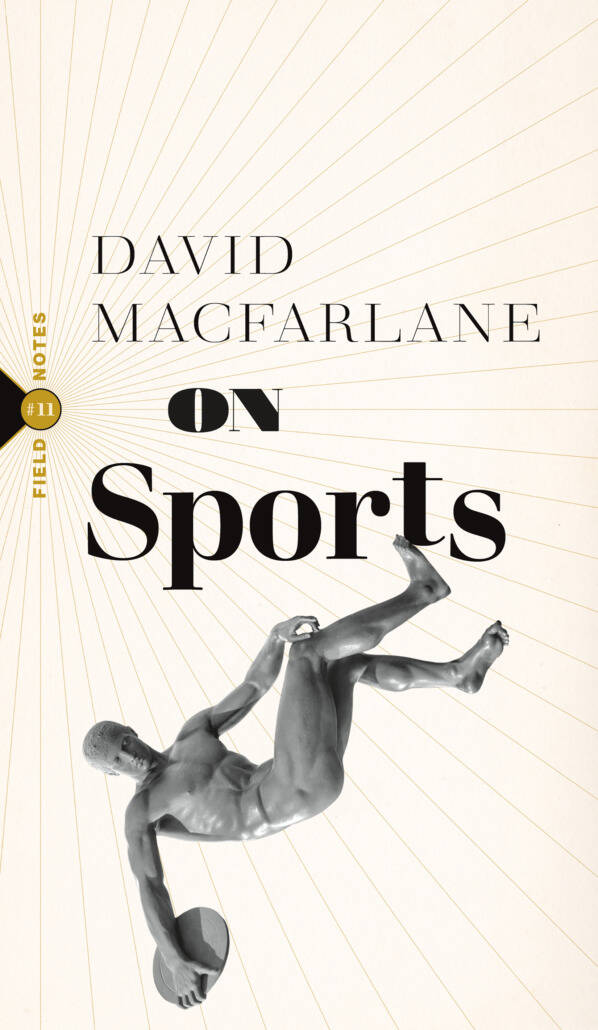
On Sports
Via connections with Greek mythology, war, art and relationships, MacFarlane paints a picture about why throwing the ball with Dad in the front yard translates into something just as uplifting and purposeful as throwing my teenage son up in the air when a 20-year-old slapped a rubber disc into a net. There are quiet connections made in the work of a rigorous elite athlete, the taken-for-grantedness of tossing a ball back and forth (and even having your dad introduce you to the “trough” at the old Winnipeg Stadium).
Canadian football is a particular fixture for MacFarlane. His obsession with his beloved Tiger-Cats is indicative of the essence of sport. Largely community owned and with only nine teams — and a trophy handled by more Canadians than any other professional chalice — the CFL is emblematic of the resistance to American greed. (Well, maybe — we had the beer snake and the rouge, for a while, as our lines in the sand.)
MacFarlane loves the crisp passes of PWHL (Professional Women’s Hockey League) athletes, but is furious they make a fraction of their male counterparts’ pay. He exalts and praises exquisite backhands and lauds the what-ifs and I-can’t-believe-its of sports. “Art is often understood to be created with the same mysterious, otherworldly process,” he writes. “The same mysteries prevail in sport and in art.”
MacFarlane captures why it is hard to pin down what it is that humans do. “And here, dear reader, we encounter the essential problem of writing about sport: it’s impossible,” he laments. “It’s like explaining sculpture with a paintbrush, music with a bowling ball.” Writing about the unknown is the best we can do.
On Sports is as much a ripple of an analysis on capitalism and greed as it is a masterclass on writing. MacFarlane’s prose will entice even the hardiest sports cynic, while inviting the non-reading teen into a world of words and ideas — in only a few short yet romantic pages.

Supplied photo
David MacFarlane
It’s essential reading for those who ponder, and rightly so, why so much energy is bestowed upon movement, grace, billionaire owners, the oligarchic media class and the tragic addiction of so many to online sports gambling.
Matt Henderson is superintendent of the Winnipeg School Division.