Literary musings
Enright reflects on life, love, writerly icons and more in new essay collection
Advertisement
Read this article for free:
or
Already have an account? Log in here »
To continue reading, please subscribe:

Digital Subscription
One year of digital access for only $205*
- Enjoy unlimited reading on winnipegfreepress.com
- Read the E-Edition, our digital replica newspaper
- Access News Break, our award-winning app
- Play interactive puzzles
*First annual payment billed as $205.00 + GST for one year. This annual subscription will automatically renew at $233.00 + GST every 52 weeks (10% off the regular annual price of $259.35). Offer available to new and qualified returning subscribers only. Cancel any time.
To continue reading, please subscribe:
Add Free Press access to your Brandon Sun subscription for only an additional
$1 for the first 4 weeks*
- Enjoy unlimited reading on winnipegfreepress.com
- Read the E-Edition, our digital replica newspaper
- Access News Break, our award-winning app
- Play interactive puzzles
*Your next Brandon Sun subscription payment will increase by $1.00 and you will be charged $17.95 plus GST for four weeks. After four weeks, your payment will increase to $24.95 plus GST every four weeks.
Read unlimited articles for free today:
or
Already have an account? Log in here »
Irish writer Anne Enright, now 63, has written eight novels, including the 2007 Booker Prize-winning The Gathering. Her latest book, Attention, pulls together 24 of her essays, most of them written over the last few years. Topics vary from the fiction and lives of other writers, such as James Joyce and Alice Munro, to how women are faring in today’s world.
Enright leads off with a brief two-pager on how the gender of an author affects a reader’s view of that author’s writing. “If a man writes, ‘The cat sat on the mat,’ we admire the economy of his prose; if a woman does, we find it banal,” she suggests.
In her observations of women’s interactions with men, she points out a great number of differences in views of sex. In her provocative essay, On Consent, she quotes sex researcher Shere Hite as saying that “‘penetrative sex is unpleasurable and demeaning. Women should abandon sex with men.’” Enright cites writer Katherine Angel’s concern that “consent ‘is being asked… to address problems it is not equipped to resolve’… Consent ‘represents sex as something a man wants, and something a woman agrees or refuses to yield.’”

Hugh Chaloner photo
Anne Enright’s new essay collection closes with the recollection of trips taken with her husband; particularly memorable are the pair’s cycling jaunts throughout Europe.
In Ulysses: An Introduction, Enright explains that she always found Joyce’s famous novel difficult to read, though she certainly respected his writing. “These days,” she says, “I read everything slowly; my brain is like an old computer file with too much information in it. I slow down, stop. I go back over it again. This a good way to read Ulysses, with a guidebook, notes, the internet at your fingertips.” She concludes, “If you ask me what Ulysses has to offer — despite the maleness of the text, despite the author’s perversion… — the answer is still, ‘Everything, everything, everything.’”
Enright has great respect for late American author Toni Morrison, who won the Nobel Prize for Literature in 1993. Enright sums up Morrison’s effect on late-20th-century life with a quotation from critic Laura Miller: “Reading Toni Morrison in the over-worshipped territory of (Philip) Roth, (Saul) Bellow, (John) Updike and (Norman) Mailer was like being released from literary jail.”
Perhaps the best-known female Irish writer before Enright was Edna O’Brien, who wrote her first novel, The Country Girls, in 1960, which was admired in London and New York and soon banned in Ireland. O’Brien was a Joyce fan too, and she triumphed over the forces that silenced many a potential female writer, becoming known world-wide.
One of Enright’s best essays is devoted to Alice Munro, one of Canada’s most famous authors, who was regarded as possibly the finest short story writer in the world. Her first collection, Dance of the Happy Shades, was published in 1968 and won the Governor General’s Literary Award for fiction. Her brilliant final collection, Dear Life, appeared in 2012.

Munro died in 2024 and, two months later, Andrea, one of the three daughters Alice had with husband James Munro, released information about Gerald Fremlin, the man Alice took up with after leaving James in 1975. Andrea said Fremlin had been sexually abusing her since she was nine years old.
Enright intends no disrespect for Alice Munro, whose work she admires; she states in her essay that Andrea’s revelation “throws a sharp light on Munro’s later fiction, throughout which elements of Andrea’s experience, and all that came after it, can be found. Some people may choose not to read the late stories: they may find it egregious that Munro both dismissed the damage done to her daughter and used it to fuel her work. Yet the tug of this long-kept secret is there on the page and, as with many unpleasant discoveries, once you see it, you find it everywhere.”
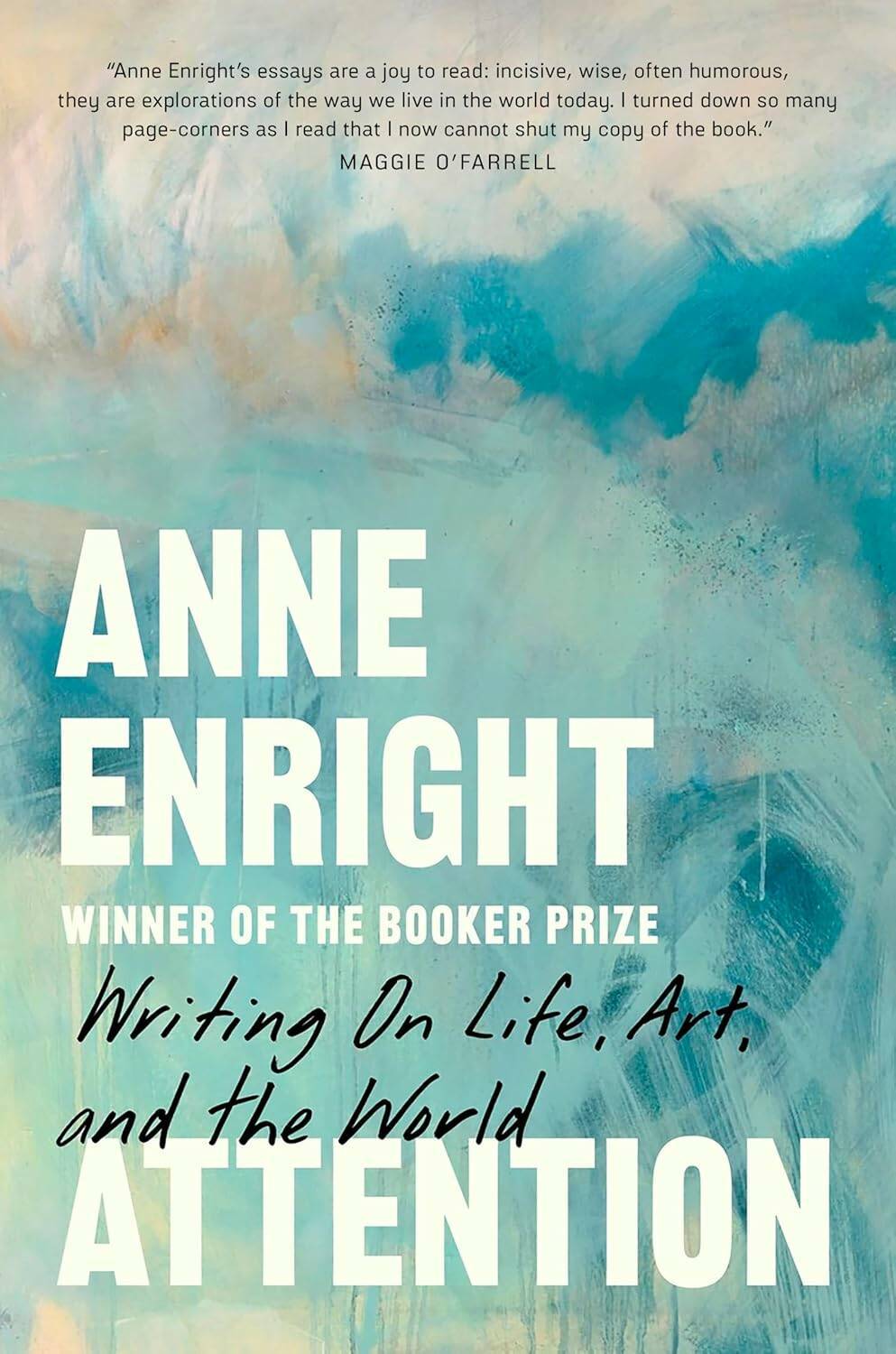
Attention
Though almost all of these essays are lively and have been published before — many in the London Review of Books — some do not flow as smoothly as one might expect, given Enright’s stature and experience.
The book’s final essay, The Husband, is one of the most satisfying in the collection, in which Enright reflects on trips taken with her husband, Martin Murphy. Particularly memorable are their cycling jaunts in Europe. A bike trip in the mountains of France when they were young ended with him thinking, “‘I have to get away from that woman,’” and Enright knowing “I must marry that man.” She won.
Dave Williamson is the Winnipeg author of six novels, a collection of short stories, a memoir and two works of non-fiction.