
WEATHER ALERT

Early editions

Manitoba’s early newspapers painted province as rife with untapped potential — to the detriment of theIndigenous community

Advertisement

Advertise with us

Historian Howard Zinn once compared the historian’s perspective to that of the mapmaker. We have the human tendency to see the world from our point of view, regardless of our best intentions and feigned attempts at objectivity.

Read this article for free:

or

Already have an account? Log in here »

To continue reading, please subscribe:

Subscribe and receive a limited-edition Free Press branded hat or tote.

Digital Subscription

One year of digital access for only $205*

  • Enjoy unlimited reading on winnipegfreepress.com
  • Read the E-Edition, our digital replica newspaper
  • Access News Break, our award-winning app
  • Play interactive puzzles

*First annual payment billed as $205.00 + GST for one year. This annual subscription will automatically renew at $233.00 + GST every 52 weeks (10% off the regular annual price of $259.35). Offer available to new and qualified returning subscribers only. Cancel any time.

To continue reading, please subscribe:

Add Free Press access to your Brandon Sun subscription for only an additional

$1 for the first 4 weeks*

  • Enjoy unlimited reading on winnipegfreepress.com
  • Read the E-Edition, our digital replica newspaper
  • Access News Break, our award-winning app
  • Play interactive puzzles
Start now

*Your next Brandon Sun subscription payment will increase by $1.00 and you will be charged $17.95 plus GST for four weeks. After four weeks, your payment will increase to $24.95 plus GST every four weeks.

Historian Howard Zinn once compared the historian’s perspective to that of the mapmaker. We have the human tendency to see the world from our point of view, regardless of our best intentions and feigned attempts at objectivity.

Such is the same for newspapers, both historically and in their present form. Newspapers carry with them a certain perspective — a leaning of sorts that is inherent and molded in the perspective of owners, editorial boards and journalists themselves.

You can’t be neutral on a moving train, as Zinn would argue.
Mike Deal / Free Press files

Mike Deal / Free Press files

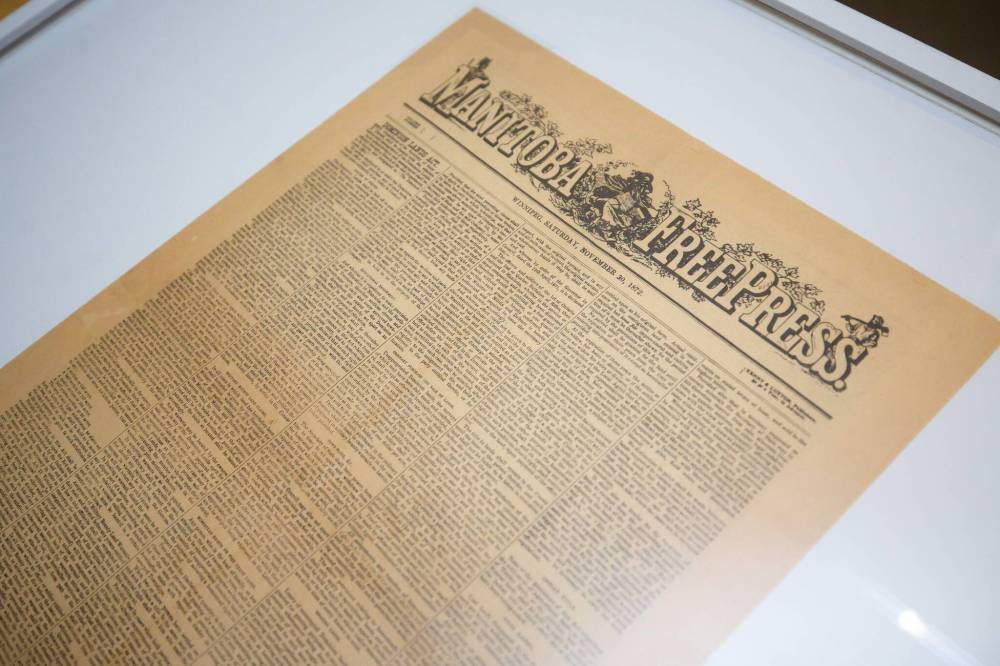
In the 19th century, however, newspapers notoriously and explicitly saw the world and tried to shape it from the perspective and agenda of its owners. George Brown’s Globe in Upper Canada, for example, was a classic example of a partisan media that used its platform to undermine rivals, the French and various governments.

Winnipeg, or Red River, was not immune to the partisan press, and in fact, according to University of Regina historian Shelisa Klassen, was shaped and colonized thanks in part to the messages and myths espoused by various editors and owners. In Imprinting Empire: Land and Settler Colonialism in Manitoba Newspapers, Klassen argues that newspapers and immigration pamphlets in the 1870s and 1880s helped create the conditions for land grabs, dispossession, erasure and the advent of a colonial experiment that has yet to fully reveal itself.

Drawn from her PhD dissertation, Klassen’s work also tells the story of Indigenous, and notably Métis, resistance to settler narratives — ones that suggested the prairie held nothing but vastness and untamed potential. In reality, the complexity, diversity and indigeneity of Red River and Manitoba (think postage stamp-sized Manitoba) in many ways defied the pace of the settler colonial project — and perhaps does to this day. Indigenous (First Nations and Métis) resistance and reclamation are at the heart of Winnipeg and Manitoba in 2026. As Klassen argues, Winnipeg, and Manitoba more broadly, had remained an Indigenous space, even as settlers arrived in ever-increasing numbers.

For Klassen, the power vacuum created by the Hudson’s Bay Company’s departure in 1869, coupled with Métis resistance, helped germinate a ubiquitous press — the amount of newspapers given the population at the time is mind-boggling — that “played an important role in the mythmaking project of creating settler colonialism.” Red River was isolated due to climate and a lack of rail, so life was incredibly difficult. Settler newspapers, controlled by the likes of William Luxton, Acton Burrows, William Coldwell, and John Christian Schultz, were set on creating a narrative for would-be immigrants that land was waiting and wealth impending.

But there were also newspapers focused on resisting the spread of the British empire. The Louis Riel’s government’s New Nation, which would later become Le Métis, would be highly critical of the motives of Canada’s colonial project. The voices of First Nations, not surprisingly, are systematically erased from newspapers — perhaps barely making an appearance in columns devoted to treaties. As Haitian historian Michel-Rolph Trouillot has noted, history can be silenced at many points, most notably at the source and in the creation of narratives. The conflation of the Métis experience with that of First Nations throughout history can misrepresent the experience of those on the prairies — both then and now.

Imprinting Empire

Imprinting Empire

Klassen scours newspapers and pamphlets from Red River at the end of the 19th century to paint a picture of how we have come to our current nexus point in this city and province. Treaties were weaponized to remove First Nations from their land, and the Manitoba Act was systematically ignored to deny the Métis reserve land that was promised. As she posits, “intense levels of government control, surveillance, and forced assimilation were required in order to create a ‘liberal order’ for white settler Canadians.” And newspapers delivered the message, both locally and abroad.

In Imprinting Empire, Klassen carefully peels back the nuance of a media and capitalist oligarchy desperate for labour and investment, while new immigrants from Ontario and the United States soon realized the Eden-esque myths that were created were couched in colonial arrogance. “The white settlers of the 1870s had not arrived at the ‘blank slate’ many of them had optimistically imagined, and instead found themselves in a largely Indigenous province that was still dealing with the aftermath of their resistance to Canadian expansion,” she argues.

In 2026, Indigenous (First Nations) resistance is alive and well, and it would be wise for settlers to understand their place within this complexity. Honouring treaties and their spirit is most certainly the first step.

The second would be to listen — and allow space for Indigenous voices to continue to shape the narrative of this place. Providing space counters the colonial desire for the erasure of indigeneity and creates the conditions for everyone to thrive.

Matt Henderson is superintendent of the Winnipeg School Division.

Andrea Norberg
                                Shelisa Klassen
Andrea Norberg

Shelisa Klassen

Report Error Submit a Tip

More Stories

What’s up

5 minute read Preview

What’s up

5 minute read 12:02 AM CDT

Summer Movie Night: JawsBarn Hammer Brewing Co., 595 Wall St.Today, 7 p.m.FreeIt was the first film to be marketed in North America on LaserDisc (in MCA DiscoVision, no less). The main character doesn’t have a name, but was dubbed Bruce by its co-stars. And a prosthetic arm made for the film didn’t look realistic enough, so a cast member was buried in the sand with only her arm sticking out.

Steven Spielberg’s 1975 film Jaws was a sensation upon release, overtaking The Godfather as the highest grossing film at the North American box office (a title it held until Star Wars was released two years later). The film follows the plight of a New England town terrorized by a massive great white shark, and the ragtag trio that set out to take down the beast after a series of attacks.

Tonight at Barn Hammer, you can revisit the film that had so many afraid to go in the water (and spawned Roy Scheider’s infamous line “you’re going to need a bigger boat” which, according to IMDb, he improvised).

The film gets going at 7:30 p.m., but pop by the brewery tap room beforehand for some pre-show trivia (such as the above nuggets). There will be happy hour-priced pints, a themed cocktail and even a candy bar for viewers of all ages to enjoy. Admission is free.

Read
12:02 AM CDT

Preserving past, pondering future of 142-year-old downtown church

Chris Kitching 6 minute read Preview

Preserving past, pondering future of 142-year-old downtown church

Chris Kitching 6 minute read Yesterday at 6:55 PM CDT

A 142-year-old church in downtown Winnipeg needs about $7.7 million for upgrades and related costs, while an ongoing heritage renewal project aims to create a blueprint for its future.

Potential options include selling Holy Trinity Anglican Church and leasing it back for a decades-long term, or building an apartment or office tower on an existing surface parking lot to generate revenue, officials said Wednesday.

“I think that is part of the negotiation and ensuring we have the right partners, but it is hard to put down on paper precisely every aspect of the future of a place of worship,” project manager Stephen Borys said of the potential duration of a sale and leaseback agreement to ensure the church still exists generations from now.

Similar agreements with 50- or 100-year leases exist elsewhere in Canada, he said, noting the option has been on the table for Holy Trinity for a year.

Read
Yesterday at 6:55 PM CDT

Gaps in homecare leave Winnipeg man in perilous situation

Nicole Buffie 4 minute read Preview

Gaps in homecare leave Winnipeg man in perilous situation

Nicole Buffie 4 minute read Yesterday at 6:00 AM CDT

Tom Landy fears he won’t live long enough to receive adequate homecare.

The 49-year-old Winnipegger has spinal muscular atrophy, a degenerative disease, and requires 24-7 homecare, but gaps in his care leave him sitting in one spot for hours and lately he’s developed bed sores.

Landy was approved for around-the-clock care in June 2025, but staffing issues and an investigation into a homecare worker’s workplace injury have left him without help for periods of time throughout the day and forced his 76-year-old father to fill in.

“This is what they’re here for, to take care of me, and now it feels like I’m a burden,” he said from his home in the Maples.

Read
Yesterday at 6:00 AM CDT

Autopsy confirms dog attack killed animal-rescue volunteer on First Nation

Free Press staff 3 minute read Preview

Autopsy confirms dog attack killed animal-rescue volunteer on First Nation

Free Press staff 3 minute read Tuesday, Jul. 28, 2026

An autopsy has confirmed an animal rescue volunteer died of a dog attack on Sandy Bay Ojibway Nation earlier this month, the Manitoba First Nations Police Service says.

Amanda Nobiss, a 37-year-old woman from Winnipeg, was found dead in Sandy Bay on July 17 after police were contacted by a friend trying to locate her.

She often visited the community 180 kilometres northwest of Winnipeg to save animals.

The police service said Tuesday that an autopsy confirmed her “injuries were consistent with a dog attack.”

Read
Tuesday, Jul. 28, 2026

South Osborne residents fail in bid to prevent construction of 131-unit apartment tower

Malak Abas 4 minute read Preview

South Osborne residents fail in bid to prevent construction of 131-unit apartment tower

Malak Abas 4 minute read Yesterday at 3:01 PM CDT

A proposed 10-storey highrise on an empty south Osborne lot will move forward despite concerns from residents about the impact the building will have on nearby parking and traffic.

The city-owned lot at 425 Osborne St., which previously served as a gas station but has long sat vacant, will be developed into a mixed-use residential building with 131 units, 39 of which would be affordable, along with additional office space for the adjacent Winnipeg Transit garage and the Transit customer service centre across the street, along with a two-level parkade for tenants and Transit employees.

The property is being developed by the University of Winnipeg Community Renewal Corp. 2.0, and designed by Prairie Architects Inc.

At a meeting held by city council’s appeal committee Wednesday, several residents said while they supported the idea of more housing in the Lord Roberts neighbourhood, they had lingering concerns about the impact the development will have on the already-busy area.

Read
Yesterday at 3:01 PM CDT

Bracket creep: A stealthy tax increase

Gage Haubrich 4 minute read Yesterday at 2:00 AM CDT

About $2,100. That’s how much Premier Wab Kinew’s bracket creep tax hike could cost your family by 2030, depending on how much you make.

Bracket creep is an income tax hike that happens when the government stops indexing tax brackets to inflation. That means that after getting a cost-of-living raise, taxpayers can be bumped into a new tax bracket and have their tax bill increased even though they can’t afford to buy more.

Think about it this way: A raise that only covers higher grocery prices isn’t a real raise. You’re not richer. Your cart costs the same. But the bigger number on your paycheque bumps you into a higher bracket. That means higher taxes on a paycheque that buys the exact same number of groceries as last year.

That’s why most provincial governments and the federal government adjust income tax brackets with inflation.