Story about stories rewards committed readers
Advertisement
Read this article for free:
or
Already have an account? Log in here »
To continue reading, please subscribe:

Digital Subscription
One year of digital access for only $205*
- Enjoy unlimited reading on winnipegfreepress.com
- Read the E-Edition, our digital replica newspaper
- Access News Break, our award-winning app
- Play interactive puzzles
*First annual payment billed as $205.00 + GST for one year. This annual subscription will automatically renew at $233.00 + GST every 52 weeks (10% off the regular annual price of $259.35). Offer available to new and qualified returning subscribers only. Cancel any time.
To continue reading, please subscribe:
Add Free Press access to your Brandon Sun subscription for only an additional
$1 for the first 4 weeks*
- Enjoy unlimited reading on winnipegfreepress.com
- Read the E-Edition, our digital replica newspaper
- Access News Break, our award-winning app
- Play interactive puzzles
*Your next Brandon Sun subscription payment will increase by $1.00 and you will be charged $17.95 plus GST for four weeks. After four weeks, your payment will increase to $24.95 plus GST every four weeks.
Read unlimited articles for free today:
or
Already have an account? Log in here »
At the start of Saudade, the sixth novel by award-winning author Thomas Trofimuk, the reader is greeted with a scene that expresses the novel’s uncanny bridging of the ordinary and absurd.
Bruce Flynn lies in a bathtub full of his wife’s lavender-scented bubbles wearing a Groucho Marx nose and glasses, listening to polka music, which “is never sad,” smoking a cigar and drinking whisky flavoured with “cimonnin,” “a word he’s never been able to pronounce correctly.” When Pilar, his wife, joins him in the bath, “the bubbles barely rise, as if she isn’t there.”
Bruce fears Death, a woman who visits him in dreams. Pilar, a doctor, has discovered a strange solution: like a Scheherazade plucked from the literary tradition and put in suburban Canada, she will tell her husband complicated, winding stories that fend off Death. She will do this whenever he is very afraid. Her stories will be so full of crossroads and quick turns, “so tangled and convoluted, so quick” that Death, if she is pursuing Bruce, will lose her way.
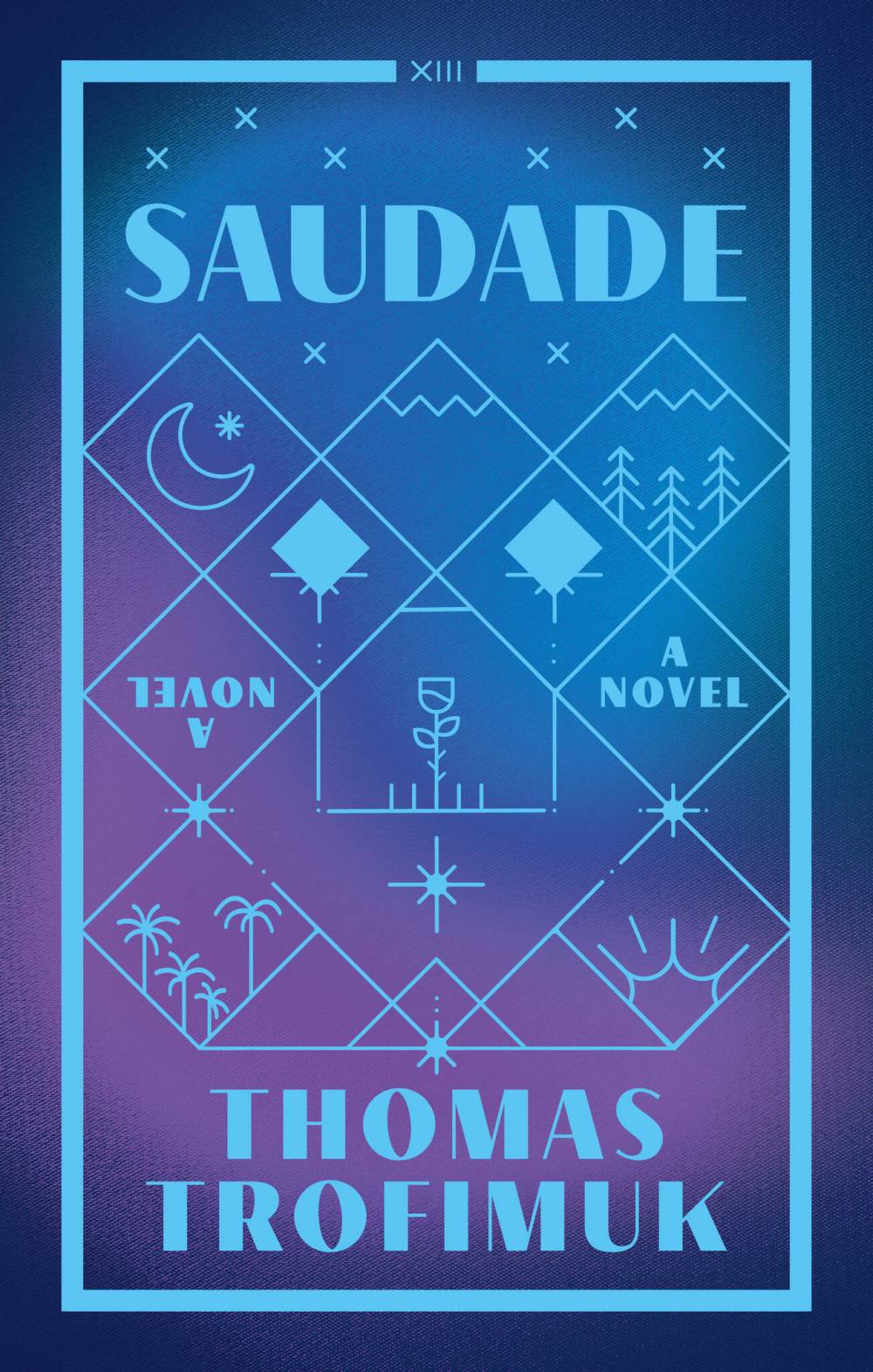
Saudade
Bruce is skeptical. He loves stories and believes in their power to inspire, “to make human connections, and to grow empathy,” but does not believe there is a story so powerful that time itself, and Death, could get lost in it.
One day Pilar suddenly disappears right in the middle of lunch at a café in Mâcon, France. Rather than panic or alert authorities, Bruce finishes his wine and then orders another bottle. He is sure Pilar is playing with him, concocting a bizarre quest to help him with his anxiety.
Bruce spends the rest of the novel in pursuit of Pilar, just as Death is in pursuit of him. It’s a conceit that asks a lot of its reader, but Trofimuk is so buoyant in his undertaking — and, in the end, so utterly in control — that the strain on the reader’s incredulity results in rewards.
Travelling between Mâcon, Lyon, Palm Springs, Seattle, Lake Louise and Sanremo, the main river of the novel — and all the tributaries that branch out in the stories within stories nestled inside — do their best to cover their tracks. Eventually the reader comes to feel what Bruce does: that the distinction between reality and dream, consciousness and the subconscious, sobriety and drunkenness, has lost its edge. Everything is entangled. It becomes harder and harder to know what is story, what is flesh. Names and places in one story populate another, impossibly.
Saudade is heaped with allusion to other works that take story as their main subject, including The Arabian Nights and Italo Calvino’s If on a winter’s night a traveler. Bruce, the hero, is not trustworthy. Sometimes he feels like a stock character in a picaresque or film noir — most of the novel takes place in hotels, tantalizing women appear in strange places to drop further breadcrumbs, there is always a drink in his hand. The sensation is like being trapped in someone’s frame of reference.
Discovering, as a reader, that you are trapped, and then having to find a way back to reality, is its own kind of pleasure. That is the pleasure offered by this slippery, mysterious and ultimately moving novel.
Seyward Goodhand is a Winnipeg writer and instructor.