Rousing reflections
Sedaris’s essays meld charm, humour and vitriol in musings on aging, mortality and deception

Advertisement
Read this article for free:
or
Already have an account? Log in here »
To continue reading, please subscribe:

Digital Subscription
One year of digital access for only $205*
- Enjoy unlimited reading on winnipegfreepress.com
- Read the E-Edition, our digital replica newspaper
- Access News Break, our award-winning app
- Play interactive puzzles
*First annual payment billed as $205.00 + GST for one year. This annual subscription will automatically renew at $233.00 + GST every 52 weeks (10% off the regular annual price of $259.35). Offer available to new and qualified returning subscribers only. Cancel any time.
To continue reading, please subscribe:
Add Free Press access to your Brandon Sun subscription for only an additional
$1 for the first 4 weeks*
- Enjoy unlimited reading on winnipegfreepress.com
- Read the E-Edition, our digital replica newspaper
- Access News Break, our award-winning app
- Play interactive puzzles
*Your next Brandon Sun subscription payment will increase by $1.00 and you will be charged $17.95 plus GST for four weeks. After four weeks, your payment will increase to $24.95 plus GST every four weeks.
Read unlimited articles for free today:
or
Already have an account? Log in here »
With every new David Sedaris collection, one is tempted to think the American essayist couldn’t possibly have pulled together enough personal material for another book, certainly not one that meets the standard of his established classics, such as 2000’s Me Talk Pretty One Day or 2004’s When You Are Engulfed in Flames.
And it must be said, in The Land and Its People, there are a couple of entries that find the prolific humorist… not phoning it in exactly, but sounding like a bit of a grumpy old man. Lamenting the wokeness of the youth tills familiar comedic soil and probably resonates with older readers, but it feels both beneath someone of Sedaris’s talent and wilfully unmindful of his privilege.
One imagines Sedaris would roll his eyes at the phrase “punching down,” but there is definitely some low-hanging fruit plucked in this collection.
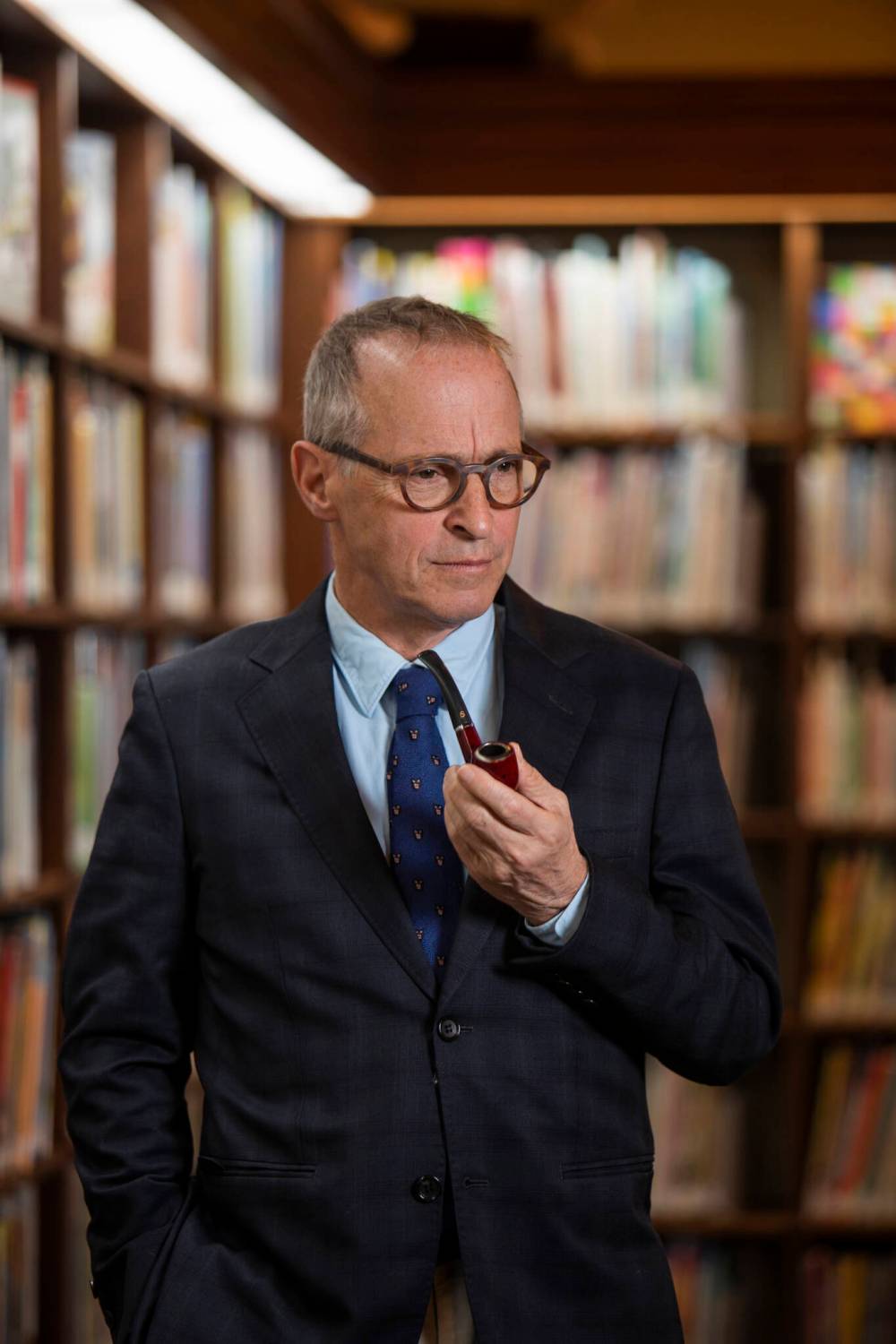
Anne Fishbein photo
David Sedaris’s latest essay collection finds the author reflecting on the death of his father, among other topics.
However, The Land and Its People also wrestles gracefully with aging and mortality — there’s a lovely piece about the death of a childhood friend, and the essay Good Grief centres around all the people in his address book who have died. It also contains some of the writer’s most touching work, though the sentiment is, as always, perfectly mitigated by a flinty tone and the author’s insistence on his own selfish nature.
Particularly affecting is a short piece called Goodyear about his long and abiding friendship with his college girlfriend Dawn, who accompanies him on many of his book tours.
But to call it a friendship sells it short, really. “Back at Kent State, loving Dawn meant hating myself — for being gay, for being too cowardly to admit it, and ultimately for hurting her the way I did,” he writes. “I will forever be grateful that she forgave me and that we can be in love again.”
Sedaris loves his partner Hugh, of course, but it’s Dawn with whom he will walk endless distances — so far that their toenails fall off.
Speaking of Hugh, Sedaris reveals in I Did that his longtime companion, to use the euphemism of the ’80s, is now his husband and has been since 2016 (for financial reasons, he stresses). They wed at a county courthouse: “Hugh and I would never kiss in public so at the end we shook hands.”
He’s kept it secret and admits it’s hypocritical, since he made his sisters sign a contract when they were children that they would never marry; Amy and Gretchen have both kept up their end of the bargain.
“I learned that historically the word (spinster) applies only to unmarried women up to the age of 25. After that they’re called thornbacks,” he writes. “(M)eanwhile, an unmarried man of the same age is simply called a bachelor or, in gaming circles, a wizard.”

His fraught relationship with his father, now dead, has been the subject of many of Sedaris’s essays over the years, but there’s a sense of simmering anger here that is surprising; you might imagine death would have mellowed him, but the eye-rolling indulgence of his father’s often cruel behaviour — usually played for laughs in previous works — has been replaced with a real vitriol.

That’s not to say Sedaris can’t mine humour out of the situation. He reveals that his father lied to him for decades about depositing money in his bank account, never coming clean despite the annual thank you cards his son sent him.
When the charade is eventually revealed, his father dismisses Sedaris’s dismay, saying, “You don’t need any more money.”
As always, Sedaris is the master of the sneak attack, eliciting guffaws and then pivoting unexpectedly but gracefully to deliver an emotional blow, and then a tossed-off, insouciant comment, as if he hasn’t just knocked the wind out of you.
Jill Wilson is the Arts & Life editor of the Free Press.
Jill Wilson is the editor of the Arts & Life section. A born and bred Winnipegger, she graduated from the University of Winnipeg and worked at Stylus magazine, the Winnipeg Sun and Uptown before joining the Free Press in 2003. Read more about Jill.
Jill oversees the team that publishes news and analysis about art, entertainment and culture in Manitoba. It’s part of the Free Press‘s tradition, since 1872, of producing reliable independent journalism. Read more about Free Press’s history and mandate, and learn how our newsroom operates.
Our newsroom depends on a growing audience of readers to power our journalism. If you are not a paid reader, please consider becoming a subscriber.
Our newsroom depends on its audience of readers to power our journalism. Thank you for your support.
The Land and Its People: Essays
By David Sedaris
Little, Brown and Company,
272 pages, $40
Jill Wilson is the editor of the Arts & Life section. A born and bred Winnipegger, she graduated from the University of Winnipeg and worked at Stylus magazine, the Winnipeg Sun and Uptown before joining the Free Press in 2003. Read more about Jill.
Jill oversees the team that publishes news and analysis about art, entertainment and culture in Manitoba. It’s part of the Free Press‘s tradition, since 1872, of producing reliable independent journalism. Read more about Free Press’s history and mandate, and learn how our newsroom operates.
Our newsroom depends on a growing audience of readers to power our journalism. If you are not a paid reader, please consider becoming a subscriber.
Our newsroom depends on its audience of readers to power our journalism. Thank you for your support.
Advertisement Advertise With Us
Advertisement Advertise With Us