Rise of the right
Prominent extremist organizations in Canada come and go, but the danger of violence remains
Advertisement
Read this article for free:
or
Already have an account? Log in here »
To continue reading, please subscribe:
Digital Subscription
One year of digital access for only $1.44 a week*
- Enjoy unlimited reading on winnipegfreepress.com
- Read the E-Edition, our digital replica newspaper
- Access News Break, our award-winning app
- Play interactive puzzles
*Billed as $5.77 plus GST every four weeks. After 52 weeks, price increases to the regular rate of $19.95 plus GST every four weeks. Offer available to new and qualified returning subscribers only. Cancel any time.
To continue reading, please subscribe:
Add Free Press access to your Brandon Sun subscription for only an additional
$1 for the first 4 weeks*
- Enjoy unlimited reading on winnipegfreepress.com
- Read the E-Edition, our digital replica newspaper
- Access News Break, our award-winning app
- Play interactive puzzles
*Your next Brandon Sun subscription payment will increase by $1.00 and you will be charged $17.95 plus GST for four weeks. After four weeks, your payment will increase to $24.95 plus GST every four weeks.
Read unlimited articles for free today:
or
Already have an account? Log in here »
For Blood and Soil: Far-Right Extremism in Canada is a brief and broad survey of far-right movements in Canada.
Written by Amarnath Amarasingam, associate professor in the School of Religion and the department of political studies at Queen’s University, and Stephanie Carvin, associate professor of international relations at Carleton University, the book is an academic text and so the writing is clear and straightforward, but somewhat dry, offering information without commentary or colour.
The authors state they have made conscious choices as to what to include. However, these choices come with limitations. Their decision to begin the survey of violent hate groups in the 1920s means the book lacks a grounding in the ways in which white supremacy was instrumental to the founding of Canada and has permeated so many of our institutions.
Ed Jones / AFP
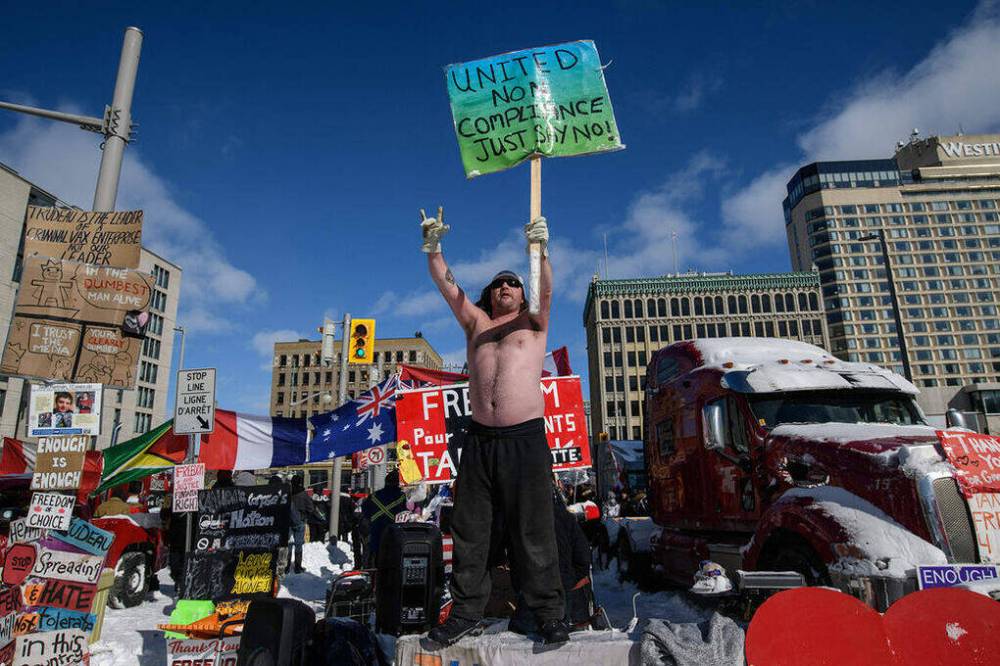
The 2022 Freedom Convoy in Ottawa is framed in a new book, For Blood and Soil, as being a movement unique in its ability to mobilize extreme right-wing groups in Canada.
The pair does remind us that violent right-wing extreme groups have killed more people in Canada than have extreme Islamic movements. This fact cannot be repeated enough, as it often fails to make it into the discourse on extremist violence in this country.
The authors also effectively show how hate groups are constantly evolving through a combination of pressure from authorities, successful lawsuits against them and infighting. For example the Proud Boys, whose name was frequently in the news in the early 2020s, are already described as being in decline, largely due to their failure to pay damages for vandalizing a Black church.
Amarasingam and Carvin then turn their attention to the reasons people join these groups, and what has been successful in getting them to leave. For this section of the book, the authors rely not only on historical analysis and media research, but on in-depth structured interviews with former members of hate groups and with individuals who work to get members to leave. (Because it’s understandably hard to find suitable interview subjects, many of the interviews are with people in differently structured societies in the United States or Europe, which is another weakness of For Blood and Soil.)
One former white supremacist was upset that a Black nurse attended to his wife in labour, but when the delivery was difficult and the nurse provided excellent care and showed him grace, he renounced his former beliefs.
Another man described joining a hate movement because he was mugged by Black youth. The authors offer these anecdotes without comment, but it’s a mark of white supremacy that individual actions by Black people and other minorities are taken to represent the group as a whole, while individual actions of white people are never framed that way. There is an unfair burden placed on people of colour that the book does not interrogate.
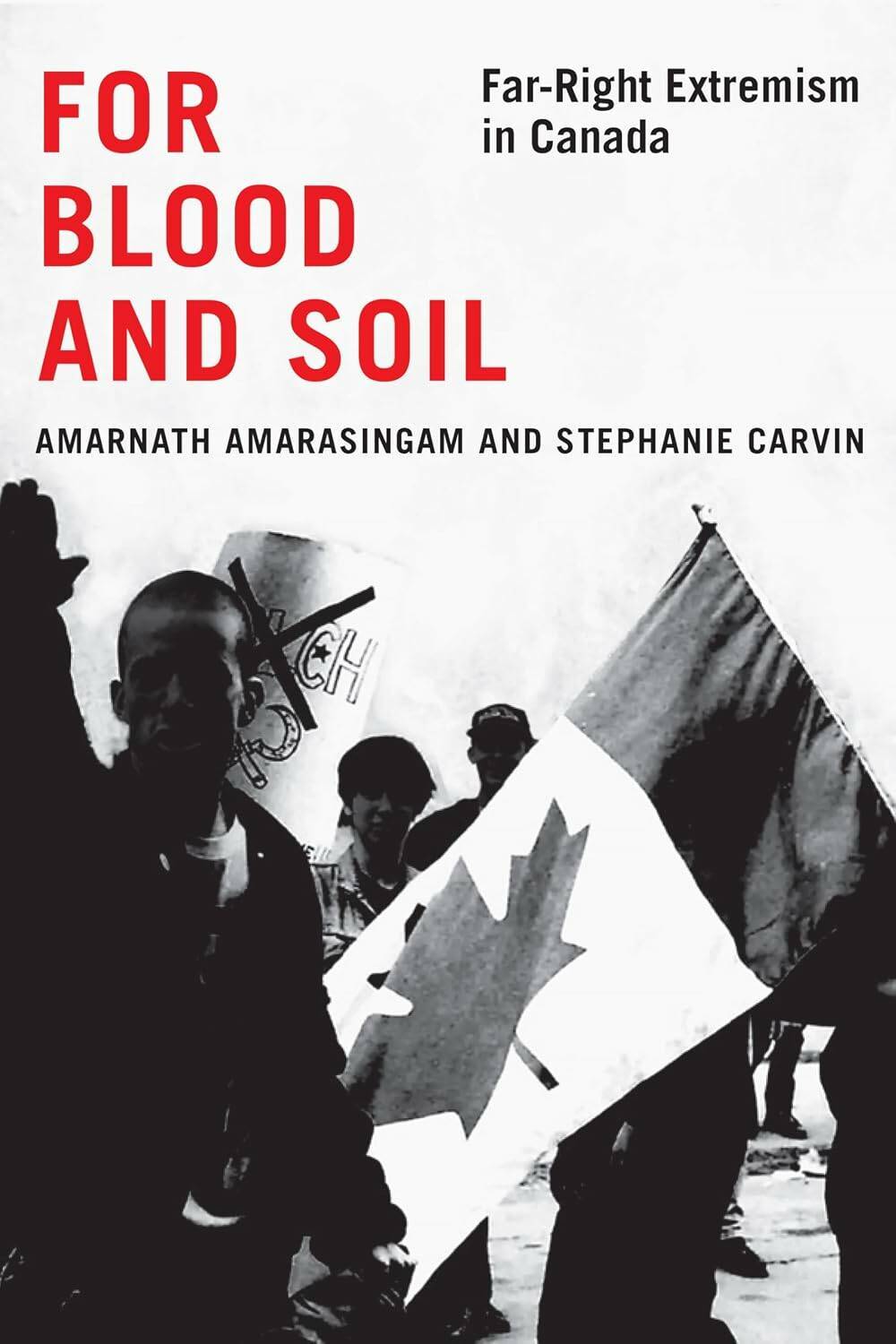
For Blood and Soil
For Blood and Soil
The actions required to successfully disengage members from extremist groups are resource- and time-intensive. While some members of hate groups do engage in acts of violence, the authors also note that there are many other members who are essentially “keyboard warriors” — they engage in hateful rhetoric anonymously on the internet, but will not do so openly in real life. It would be helpful be able to identify those who pose the greatest risk, but this is beyond the scope of the book.
Amarasingam and Carvin describe the Freedom Convoy in Ottawa in 2022 as an event attended and promoted by many violent extremists, though others who participated did not necessarily have hateful motives. Nonetheless, many extremists were attracted to the anti-vaccination rallies, including those who brought guns to the Alberta border town of Coutts.
The convoy is framed as being unique in its ability to mobilize extreme right-wing groups, and hate movements in the aftermath of the convoy are described as fragmented and disorganized. However, there have recently been other organized far-right events such as this summer’s Bigotfest in North Bay, Ont. and September’s white nationalist gathering at the reserve near Kamloops, B.C., which occurred after this book went to press, confirming the authors’ point that the far-right landscape is constantly shifting.
For Blood and Soil exposes very effectively the reluctance of Canadian police and courts to take far-right violent extremism seriously. For example, despite the presence of weapons at the Freedom Convoy protests, the Federal Court of Appeal has ruled the Canadian government’s invocation of emergency powers was unconstitutional (the government has a pending appeal to the Supreme Court of Canada.)
As another example, the individual who killed six and injured 18 in a shooting at a Quebec mosque in 2017 was charged with murder but, inexplicably, not with terrorism. Incredibly, the first time terrorism charges were upheld in a Canadian court was in 2024, with the conviction and sentencing of the individual who murdered a Muslim family in London, Ont. Violent, hateful extremists frequently receive sentences far less than those routinely given for offences with much less negative societal impact.
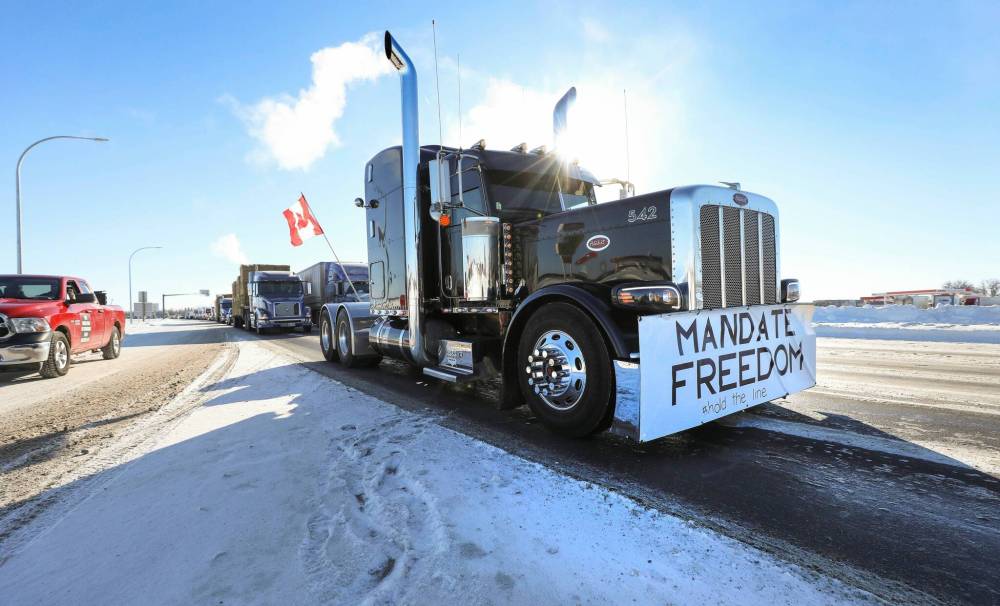
Ruth Bonneville / Free Press files
Many extremists were attracted to anti-vaccination rallies during the COVID-19 pandemic.
While For Blood and Soil doesn’t break new ground or shed fresh light onto the broader historic and legal frameworks for Canadian hate, it’s a well-written, easily digestible summary of the subject. It would be a useful book for high school or university students researching far-right extremism in Canada, or anyone teaching on this topic.
Zilla Jones is a Winnipeg-based writer. Her debut novel The World So Wide was published in 2025.