African postwar stories stellar

Advertisement

Advertise with us

Written in the aftermath of the civil war in Mozambique, Rain and Other Stories is author Mia Couto’s magnificent response to how the barbarity of war is overcome by, as he puts it, “the rain of hope,” tenuous as that may be, and the dream of renewal.

Read this article for free:


or

Already have an account? Log in here »

To continue reading, please subscribe:

Subscribe and receive a limited-edition Free Press branded hat or tote.

Digital Subscription

One year of digital access for only $205*

  • Enjoy unlimited reading on winnipegfreepress.com
  • Read the E-Edition, our digital replica newspaper
  • Access News Break, our award-winning app
  • Play interactive puzzles

*First annual payment billed as $205.00 + GST for one year. This annual subscription will automatically renew at $233.00 + GST every 52 weeks (10% off the regular annual price of $259.35). Offer available to new and qualified returning subscribers only. Cancel any time.

To continue reading, please subscribe:

Add Free Press access to your Brandon Sun subscription for only an additional

$1 for the first 4 weeks*

  • Enjoy unlimited reading on winnipegfreepress.com
  • Read the E-Edition, our digital replica newspaper
  • Access News Break, our award-winning app
  • Play interactive puzzles
Start now

*Your next Brandon Sun subscription payment will increase by $1.00 and you will be charged $17.95 plus GST for four weeks. After four weeks, your payment will increase to $24.95 plus GST every four weeks.

Hey there, time traveller!
This article was published 02/03/2019 (2739 days ago), so information in it may no longer be current.

Written in the aftermath of the civil war in Mozambique, Rain and Other Stories is author Mia Couto’s magnificent response to how the barbarity of war is overcome by, as he puts it, “the rain of hope,” tenuous as that may be, and the dream of renewal.

A Booker Prize-shortlisted author of Portuguese-Mozambiquean descent, Couto has fashioned 26 very short stories in the form of prose poems encompassing fable, allegory, legend and a cross between magic realism and Kafkaesque mystery.

The wonder of the collection, indeed its grip on the reader, is that such seemingly disparate tales come together to ultimately present how the land is remade with the “water of ‘benedreamtion,’” a lovely word and indicative of the way Couto renews language as well throughout the stories.

Many are tales of transformation. In Beyond the River Bend, a hippopotamus crashes through a town and is eventually shot. It is revealed that, in fact, the creature was an old man who had died in the neighbourhood, and had returned to proclaim key prophesies concerning drought and plague. The creature is so large it really should be called “a hyper-potamus.” No matter.

The official sent to kill it comes to realize he has killed a man, not a beast; retribution awaits. But a baby hippo offers a kind of salvation. The aching beauty of the story, entwined with its dark humour, gives the reader the same kind of peace that the tormented official finds.

In Serpent’s Embrace, another transformation has a snake killing a jealous husband from the inside for his suspicion over his wife’s affair with a UN peacekeeper (an outsider much resented by the local population). In lesser hands, the snake would be near cliché in its symbolism. Couto, a true master, makes the symbol universal: the biting snake is within us, and the answer is the realization that our life can only be cured with death.

The best of the transformation tales, Lamentations of a Coconut Tree, has a coconut producing not sweet water but blood; the fruit also cries out in a human voice. Skepticism greets the story when it is widely told, until the narrator understands that green coconut was sacred and left until ripe until the war and the outsiders who invaded the area had their way.

The further topsy-turvyness of this world leads the reader to believe that chicks given the coconut to eat were transformed into plants. Yet, from the fruit a voice is still heard, a cry needing to be acknowledged. Couto’s prose in this fable is measured throughout as if his realization — the sacred must be observed, the human need to communicate must be answered — requires a slow reckoning from the reader.

Many of the stories offer a link, nearly broken, making it clear that the country’s history from colonial past to recovering modern present is a saga of a people creating a myth to live by — as all people must.

Couto spares no one, nor is anyone condemned — with the exception, in the Kafkaesque story Two Clowns, of the menace of unyielding hate itself. While this hate seems to present a battle of two wills, it leads not to the destruction of the clowns who jocularly fight, but rather of the towns they visit.

Nearly each sentence is astonishing in this riveting, challenging collection.

Rory Runnells is a Winnipeg writer.


By buying through links provided on this page, you are supporting local writers, reviewers and book sellers.

History

Updated on Saturday, March 2, 2019 9:12 AM CST: Format fixed.
Report Error Submit a Tip

More Stories

African postwar stories stellar

Reviewed by Rory Runnells  3 minute read Preview

African postwar stories stellar

Reviewed by Rory Runnells  3 minute read Saturday, Mar. 2, 2019

Written in the aftermath of the civil war in Mozambique, Rain and Other Stories is author Mia Couto’s magnificent response to how the barbarity of war is overcome by, as he puts it, “the rain of hope,” tenuous as that may be, and the dream of renewal.

A Booker Prize-shortlisted author of Portuguese-Mozambiquean descent, Couto has fashioned 26 very short stories in the form of prose poems encompassing fable, allegory, legend and a cross between magic realism and Kafkaesque mystery.

The wonder of the collection, indeed its grip on the reader, is that such seemingly disparate tales come together to ultimately present how the land is remade with the “water of ‘benedreamtion,’” a lovely word and indicative of the way Couto renews language as well throughout the stories.

Many are tales of transformation. In Beyond the River Bend, a hippopotamus crashes through a town and is eventually shot. It is revealed that, in fact, the creature was an old man who had died in the neighbourhood, and had returned to proclaim key prophesies concerning drought and plague. The creature is so large it really should be called “a hyper-potamus.” No matter.

Read
Saturday, Mar. 2, 2019

Trump: Ozymandias revisited?

John R. Wiens 5 minute read 2:01 AM CDT

In 1818, Percy Bysshe Shelley, inspired by the shattered statue of the most powerful Egyptian Pharaoh, Ramses II, wrote the sonnet Ozymandias as a comment on human hubris and impermanence. It provides a fitting epithet for the imperialistic forays of the current United States’ president and would-be autocrat, Donald J. Trump.

What Ramses and Trump have in common is unrestrained hubris and unlimited delusion.

Ramses says: “My name is O, King of Kings. Look at my works you Mighty and despair.”

Trump’s hubris and bluster on limits to his power: “There is one thing. My own morality. My own mind. It’s the only thing that can stop me.” On Truth Social, Trump declared himself the “most powerful person that has EVER walked this planet.”

Doctor pays $500K to revamp courtyard at care home where he works

By Zoe Pierce 4 minute read Preview

Doctor pays $500K to revamp courtyard at care home where he works

By Zoe Pierce 4 minute read Thursday, Aug. 27, 2026

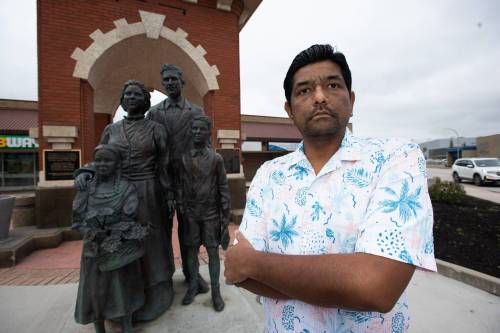
Fifty years after Dr. Pravinsagar Mehta began caring for residents at Actionmarguerite, a courtyard he had long watched deteriorate is getting a new life after he and his wife committed $500,000 to its redevelopment and long-term maintenance.

Read
Thursday, Aug. 27, 2026

Nightclub owner, divorced dad sentenced for involvement in cocaine-trafficking case

Erik Pindera 5 minute read Preview

Nightclub owner, divorced dad sentenced for involvement in cocaine-trafficking case

Erik Pindera 5 minute read Saturday, Aug. 29, 2026

Three people, including a Winnipeg nightclub owner and a divorced dad desperate for cash, have been sentenced in a cocaine-trafficking case city police were once concerned had been compromised by a corrupt cop.

The trio was charged in early 2024 as part of Project Roasted, a lengthy investigation into a drug trafficking network by the Winnipeg Police Service organized crime unit.

Investigators arrested two of the men, Mohamed Ali and Abdullah Khan, as they left the Stella’s on Pembina Highway in early February 2024. Two kilograms of cocaine was found in Khan’s car.

On the same day, Ahmed Dini was arrested at his River Avenue suite, where investigators found more than 200 rocks of crack cocaine.

Read
Saturday, Aug. 29, 2026

Winnipeg police ID deceased man, notify family

Free Press staff 3 minute read Preview

Winnipeg police ID deceased man, notify family

Free Press staff 3 minute read Yesterday at 11:26 AM CDT

Winnipeg police have been able to notify next-of-kin about the death of a man found unresponsive on a city street in July.

The man was identified after police asked for the public’s help and issued a composite sketch and description of the unknown man on Friday.

On Sunday, police said his family has been notified and thanked the public. Additional details about the man were not released in order to respect the family’s privacy, police said.

The man died in hospital after being found unresponsive July 28 at the corner of Main Street and James Avenue in Winnipeg, and investigators’ previous efforts to identify him were unsuccessful.

Read
Yesterday at 11:26 AM CDT

At the city’s busiest fire and paramedic hall, first responders face a relentless workload

Scott Billeck 24 minute read Preview

At the city’s busiest fire and paramedic hall, first responders face a relentless workload

Scott Billeck 24 minute read Friday, Aug. 28, 2026

As a soft rain begins to fall between the concrete walls of “Hope Alley,” little feels further away than the place’s namesake.

Winnipeg Fire Paramedic Service crews have been called to the narrow downtown passage, named by Al Wiebe, a formerly homeless man turned advocate. People regularly pass through here, moving between the shelters, drop-ins and resource centres clustered around Main Street between Logan and Higgins avenues.

Against a wall, as the sky switches into night mode, a man sits bleeding from his nose, seemingly unaware of how he ended up with blood running down his T-shirt.

His situation has already set Winnipeg’s emergency response network in motion.

Read
Friday, Aug. 28, 2026