America’s Mideast involvementshows top brass are slow learners

Advertisement

Advertise with us

The United States is engaged in its fourth Gulf War, the enemy a product of the third Gulf War.

Read this article for free:


or

Already have an account? Log in here »

To continue reading, please subscribe:

Subscribe and receive a limited-edition Free Press branded hat or tote.

Digital Subscription

One year of digital access for only $205*

  • Enjoy unlimited reading on winnipegfreepress.com
  • Read the E-Edition, our digital replica newspaper
  • Access News Break, our award-winning app
  • Play interactive puzzles

*First annual payment billed as $205.00 + GST for one year. This annual subscription will automatically renew at $233.00 + GST every 52 weeks (10% off the regular annual price of $259.35). Offer available to new and qualified returning subscribers only. Cancel any time.

To continue reading, please subscribe:

Add Free Press access to your Brandon Sun subscription for only an additional

$1 for the first 4 weeks*

  • Enjoy unlimited reading on winnipegfreepress.com
  • Read the E-Edition, our digital replica newspaper
  • Access News Break, our award-winning app
  • Play interactive puzzles
Start now

*Your next Brandon Sun subscription payment will increase by $1.00 and you will be charged $17.95 plus GST for four weeks. After four weeks, your payment will increase to $24.95 plus GST every four weeks.

Hey there, time traveller!
This article was published 21/05/2016 (3731 days ago), so information in it may no longer be current.

The United States is engaged in its fourth Gulf War, the enemy a product of the third Gulf War.

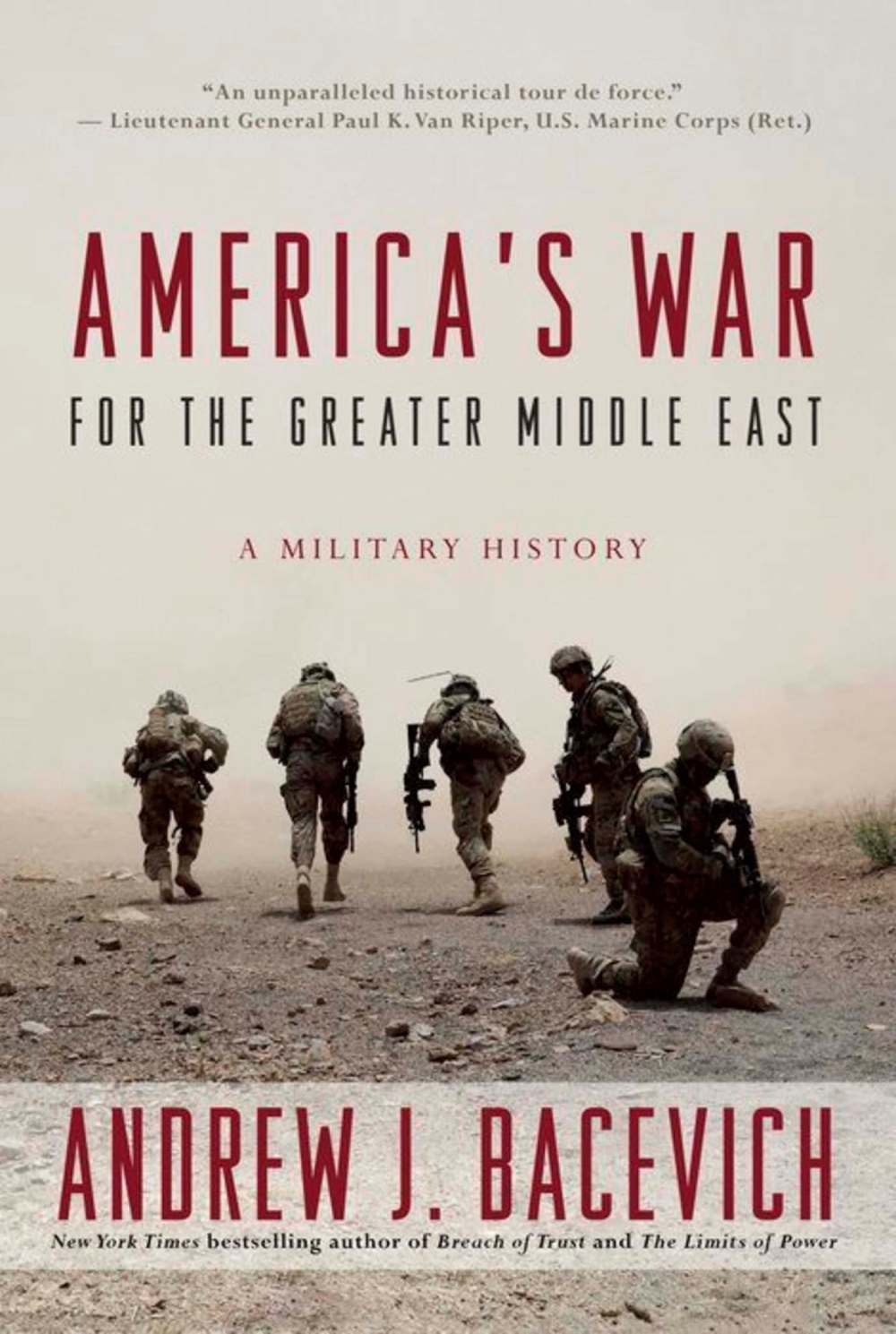
That, in a nutshell, is how Andrew J. Bacevich characterizes the war against Islamic State (IS) in his insightful and thoroughly researched history of U.S. military endeavours in the Middle East since 1980.

A retired army colonel, Bacevich has taught military history at Boston University and West Point. America’s War for the Greater Middle East is a followup to his 2013 bestseller, Breach of Trust: How Americans Failed Their Soldiers and Their Country.
No XMP or IPTC Header Found

The first Gulf War, by Bacevich’s reckoning, was the 1980-88 conflict between Iran and Iraq. In that clash Washington backed the Iraqi military of Saddam Hussein, “thereby emboldening him.”

The second Gulf War was Washington’s attempt at swatting down the emboldened Hussein, who invaded neighbouring Kuwait in 1990.

U.S. forces invaded Iraq and ousted the dictator in the third Gulf War, creating a power vacuum that was filled by disorder and sectarian conflict out of which eventually emerged IS.

Islamic State was, Bacevich writes, “the second harvest of poisonous fruit resulting from Operation Iraqi Freedom,” the first having been the Sunni Islamist group known as al-Qaida in Iraq.

Among the dozens of other military campaigns and operations covered in this ambitious and provocative historical survey are (first) a botched effort to rescue hostages in Iran in 1980, the disastrous attempt at imposing order on Lebanon circa 1983, the bombing of Moammar Gadhafi’s Libya in 1986, and the more recent invasion and occupation of Afghanistan.

Each action was committed with supposedly high-minded goals such as spreading democracy and promoting human rights. Each produced significant blowback for Washington, as not everyone was pleased to see their country invaded and/or bombed.

Reading America’s War, one gets the impression Pentagon brass (and politicians in both major U.S. parties) are decidedly slow learners regarding the Islamic world. Their efforts repeatedly fail and stoke anti-American sentiment in the process, yet they continue with essentially the same approach.

The pattern brings to mind two old observations: “Everything looks like a nail when all you have is a hammer” and “one definition of insanity is trying the same thing repeatedly but always expecting a different result.”

Curiously, the robust expansion of U.S. military activity in the Middle East was sparked by a 1980 pronouncement from the least hawkish president of recent decades.

In what became known as the Carter Doctrine, kindly peanut millionaire Jimmy Carter declared any encroachment on U.S. oil interests in the Persian Gulf “will be repelled by any means necessary, including military force.”

Carter’s successor, Ronald Reagan, followed up on that proclamation by supporting Iraq in its war with Iran, a country where a U.S.-installed tyrant was overthrown in 1979 and which Washington feared might embrace partnership with the Soviet Union. (That Reagan also came to secretly supply arms to Iran is another ironic turn.)

Bacevich concludes that “the War for the Greater Middle East (is) a diversion that Americans can ill afford.” The U.S. is kidding itself about being able to steer the course of events in the region, he says.

Furthermore, he says it has had a negative impact on domestic freedom and security in the U.S. “One day the American people may awaken to this reality. Then and only then will the war end.”

The subject matter is heavy, but America’s War is written in clear, reader-friendly prose. If you seek military history with a critical eye, it’s probably worth the $40.

Winnipeg writer Mike Stimpson has never been to the Persian Gulf, but he understands the weather’s warm there this time of year.


Report Error Submit a Tip

More Stories

Local medical scrubs retailer feeling abandoned by U of M, RRC Polytech nursing programs

Maggie Macintosh 4 minute read Preview

Local medical scrubs retailer feeling abandoned by U of M, RRC Polytech nursing programs

Maggie Macintosh 4 minute read Thursday, Aug. 6, 2026

A Winnipeg uniform store is appealing to medical students to shop locally for scrubs this back-to-school season as it grapples with growing competition online and an apparent shutout by local campuses.

Unimor Healthwear has long ordered uniforms in bulk in navy blue, burgundy and pewter, as nurses-in-training are required to wear those colours based on where they’re enrolled in the province.

“It’s not like it used to be,” Evan Schwartz said about customer traffic to his store at 98 Sherbrook St.

The company’s director estimated he spent about $15,000 to stock up on scrubs in pewter in preparation for the launch of Red River College Polytechnic’s upcoming nursing intake.

Read
Thursday, Aug. 6, 2026

Venezuela: unfinished business for the U.S.

Gwynne Dyer 5 minute read 2:01 AM CDT

Experienced imperialists understand that you can’t just take over a country and expect it to run itself. It takes time and work to turn it into an obedient and profitable colony and two months is not enough. Donald Trump moved on to his next target too soon and given how Iran’s been working out for him, he probably hasn’t thought of Venezuela in months.

U.S. Secretary of State Marco Rubio, who acts as Trump’s viceroy for Venezuela, hasn’t been there since the U.S. kidnapped President Nicolás Maduro and his wife in January. (In fact, he may never have been there at all — I can find no evidence of it.) But he does think about Venezuela. In fact, he controls the country very tightly from his Washington office.

He and Trump’s choice for interim president, Delcy Rodríguez, talk online every day, we are told. (She was the vice-president under Maduro, so she was the obvious choice if Trump wanted a local collaborator with supporters in the army and the secret police.) Rubio collects the government’s income and he tells her what she can spend her share on.

It’s an awkward arrangement, because the cabinet is still the core Chavista leaders, minus only Maduro himself. Trump thinks Rodríguez is a “terrific person” and doesn’t worry about elections: Venezuelans “wouldn’t even know how to have an election right now.” But Rubio understands that they really do expect an election to be part of the “transition.”

Gilbert Plains Country Club closes for remainder of season due to flood damage

Ken Wiebe 6 minute read Preview

Gilbert Plains Country Club closes for remainder of season due to flood damage

Ken Wiebe 6 minute read Thursday, Aug. 6, 2026

Scott McCallum has made the trek to the Gilbert Plains Country Club clubhouse countless times.

But this was the first time the golf professional and general manager of the course required hip waders to get to his office.

Walking hand in hand with his wife Lindsay, McCallum didn’t need much time to see the devastation caused by the flash flooding in the Parkland region in late June.

“We’re on a river and it’s a beautiful golf course, but anytime you’re on a body of water you know that you’re taking a chance of events like this happening,” McCallum said in a telephone interview. “To this magnitude, we’ve never seen anything like it before. So, this is new to us.

Read
Thursday, Aug. 6, 2026

The view from here: Phyllis Green. Boob Tree, 1975

2 minute read Preview

The view from here: Phyllis Green. Boob Tree, 1975

2 minute read 2:01 AM CDT

Staycation: The Art of Being Here feautres more than 100 Manitoba-related artworks from the Winnipeg Art Gallery-Qaumajuq collection, spanning the past 50 years. These pieces reveal how the places around us are layered with memory, story and lived experience. Over the coming weeks, the Free Press will spotlight works from this eclectic exhibition, each one offering a new way of seeing home. Experience it in person and enjoy some staycation time at the gallery, on view until December.

Phyllis Green. Boob Tree, 1975

(Yarn, wood. Collection of the Winnipeg Art Gallery; Acquired with funds from the Estate of Mr. and Mrs. Bernard Naylor, funds administered by The Winnipeg Foundation, 2014-128. Photo: Ernest Mayer.)

The year 1975 was designated International Women’s Year by the United Nations, and in celebration, the WAG staged the show Images of Women, which explored how women had historically been depicted, an impressive selection but by mostly male artists. Amid pushback from the community, Sharron Zenith Corne and Marian Yeo organized a second exhibition, Woman as Viewer, which challenged those portrayals by only featuring works by women. It was called the first Canadian exhibition of feminist art. American artist Phyllis Green’s Boob Tree, a four-foot-tall crochet sculpture of a cluster of breasts, adorned the exhibit posters, which were so popular they were snatched by passersby! The sculpture is playful and unsettling, re-appropriating the objectification of women’s bodies.

Read
2:01 AM CDT

Livestreamed mental-health meltdown underscores medium’s disturbing decline

Melissa Martin 7 minute read Preview

Livestreamed mental-health meltdown underscores medium’s disturbing decline

Melissa Martin 7 minute read Updated: Yesterday at 4:42 PM CDT

On Tuesday evening, a well-known celebrity blogger, best known by the nom de plume Perez Hilton, opened up his TikTok account and began a livestream from his Miami home. What unfolded over the next 30 minutes horrified all who witnessed it — and should force the rest of us to take a very sober look at the ways social media can harm.

Read
Updated: Yesterday at 4:42 PM CDT

Watching while we work

Tory McNally 7 minute read Preview

Watching while we work

Tory McNally 7 minute read 2:01 AM CDT

For many employees, the idea that their employer might be tracking how long they spend at their keyboard, how often they move their mouse, or whether they are actively working throughout the day feels unsettling. For many employers, however, workplace surveillance is increasingly viewed as another management tool, particularly as hybrid and remote work become more common. The recent news that TD plans to monitor certain employees’ activity during the workday has reignited a conversation that has been quietly growing for several years: where is the line between legitimate oversight and excessive monitoring?

The reality is that workplace surveillance is nothing new. Employers have long monitored attendance, reviewed security camera footage, tracked company vehicles using GPS, audited expense reports, and reviewed internet usage on company-owned devices. What has changed is the sophistication of the technology. Today’s software can record login times, monitor application usage, track keystrokes, capture screenshots, analyze email activity, and even generate reports ranking employees based on their perceived productivity.

This naturally raises an important question. Does increased surveillance actually make people work harder?

The answer is not nearly as straightforward as many organizations hope.

Read
2:01 AM CDT